La Vierge de la Victoire
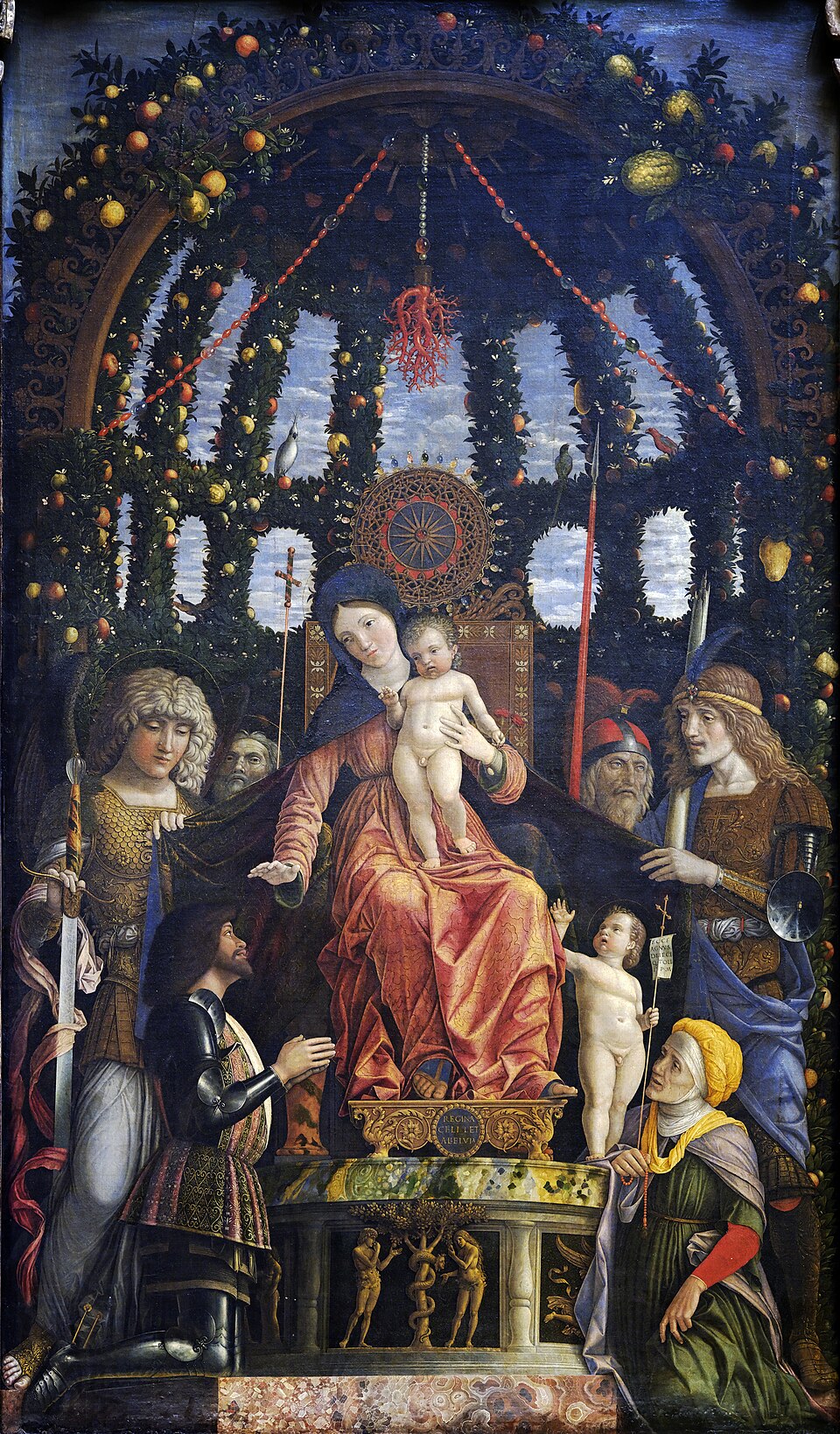
A marquess kneels in armour, smiling, as the Virgin's mantle falls over his head like a shield. Behind this glowing altarpiece lies a disputed battle, a destroyed house and a story of injustice Mantegna was paid to cover with flowers.
The story behind the painting
On 6 July 1495 the Italic League, led by Francesco II Gonzaga, Marquess of Mantua, fought the retreating French army of Charles VIII at Fornovo. The League failed to capture the king but took his treasure, and both sides claimed victory. While Francesco was away, the Jewish banker Daniele da Norsa had bought a house in Mantua and replaced the image of the Virgin on its façade with his own coat of arms. Ordered to restore it, he agreed, but a crowd driven by antisemitic feeling destroyed his house. On his return, Francesco forced Daniele to pay for a chapel and a painting, which Mantegna, the court painter, delivered in 1496 on the battle's anniversary.
What to look for
Mary sits on a high throne of marble inlay and reliefs, its lion-pawed base inscribed with Queen of Heaven, rejoice, Alleluia, above scenes from Genesis including Original Sin. A great solar disc rises behind her. She and the Child, who holds two red flowers, look down at the kneeling Francesco, whose face is grateful and smiling. Opposite kneel John the Baptist with his cross and his mother Elizabeth in a yellow turban. Standing at the sides are Michael and Longinus in richly decorated armour, with Andrew and George behind. Overhead, a pergola of leaves, fruit and birds frames a shell hung with coral, rock crystal and a parrot; a sulphur-crested cockatoo also appears among the birds.
Meaning and intent
Mary's mantle, partly covering Francesco's head, shows the protection he believed he received in battle. Elizabeth, protector of Francesco's wife Isabella d'Este, takes the place a patron saint might occupy, perhaps as a message of judgement to the Norsa family, who were made to pay for the work as a penalty. Unlike them, Elizabeth was said to be the first to recognise Mary's holiness. The red flowers and the coral both point to the Passion of Jesus, the shell marks the Virgin as a new Venus, and the parrot comments on the birth of Christ. The painting was a victory monument built on a family's punishment.
Legacy
The altarpiece was placed in the church of Santa Maria della Vittoria, built over the ruins of Daniele da Norsa's house. After Mantua surrendered during the French campaign in Italy, it was taken to France and by 1798 was on show in the Louvre. It was never returned; the stated excuse was that its size, about 285 by 168 cm, made transport difficult. The cockatoo has been cited as evidence of Arab trade reaching the Australasian region, a trade traced back to a bird given by Sultan al-Kamil to Frederick II in the 1240s. Wikidata leaves the year blank; Wikipedia gives 1496.
Le saviez-vous ?
- Commissioned by Francesco II Gonzaga after the Battle of Fornovo, 1495.
- Paid for, under compulsion, by the banker Daniele da Norsa.
- Unveiled in 1496 on the battle's anniversary.
- In the Louvre since at least 1798.
À propos de l'artiste
Andrea Mantegna (1431-1506)
art religieux · femme · homme · Marie · Enfant Jésus · département des peintures du musée du Louvre · garçon · ange · mère · Georges de Lydda
Autres œuvres de Andrea Mantegna
 Lamentation sur le Christ mort - Andrea Mantegna (1483)
 retable de San Zeno - Andrea Mantegna (1457)
 Adoration of the Shepherds - Andrea Mantegna (1450)
 La Madone de la carrière - Andrea Mantegna (1489)
 Le Parnasse - Andrea Mantegna
 L'Introduction du culte de Cybèle à Rome - Andrea Mantegna (1500s)
 Saint Jérôme dans le désert - Andrea Mantegna
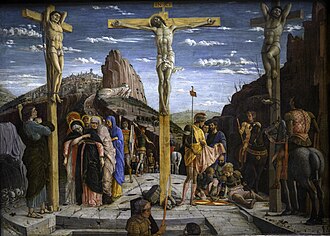 La Crucifixion - Andrea Mantegna (1450s)
Œuvres d'artistes liés
 La Naissance de Vénus - Sandro Botticelli (c. 1485)
 Le Printemps - Sandro Botticelli (1480s)
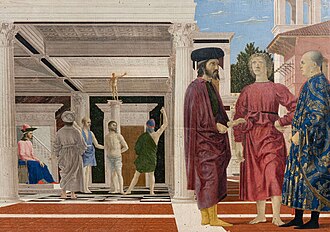 La Flagellation du Christ - Piero della Francesca (1450s)
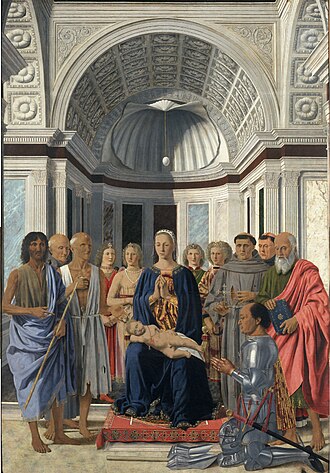 La Conversation sacrée - Piero della Francesca (1472)
 La Joconde - Leonardo da Vinci (1503-1519)
 La Dame à l'hermine - Leonardo da Vinci (1490)
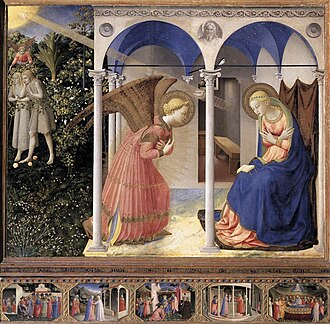 L'Annonciation - Fra Angelico (1425)
 Tondo Cook - Fra Angelico (1430)