retable de San Zeno
Andrea Mantegna · 1457
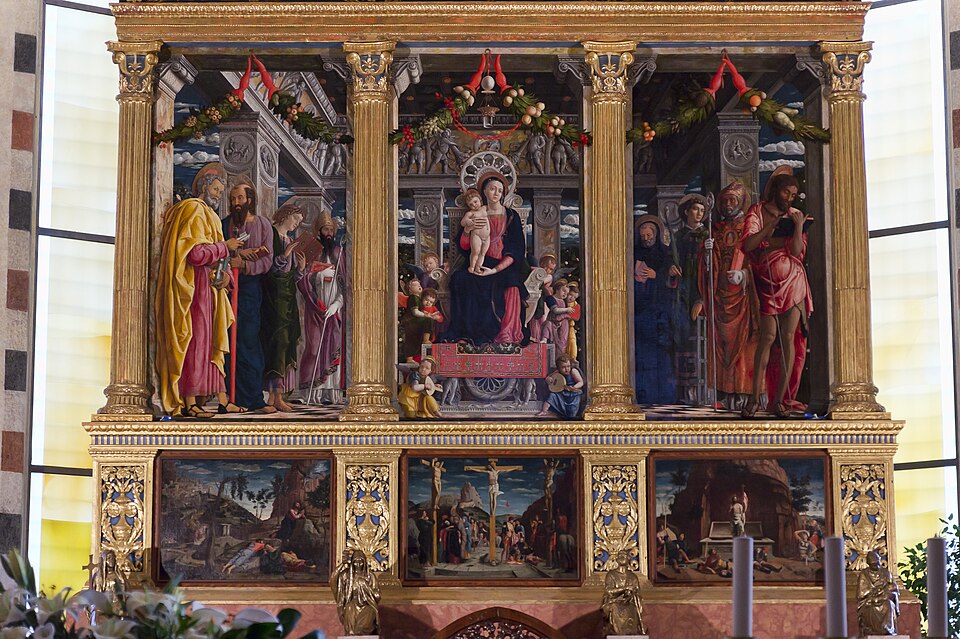
Mantegna built a heaven that looks like a Roman temple: the Virgin on a marble throne, eight saints in bright cloaks, angels with lutes, and fruit garlands tied with red ribbons. The altarpiece still stands in the Verona church it was made for, though part of it is now copies.
The story behind the painting
The altarpiece was commissioned around 1456 to 1459 by Gregorio Correr, a Venetian nobleman, humanist scholar and abbot of San Zeno in Verona. It was meant to show a heavenly realm, so that worshippers would aspire to a place in the court of heaven. Saint Zeno, the patron saint of Verona, is believed to have brought Christianity to the city. Mantegna painted it while his move to Mantua was delayed: Ludovico III Gonzaga had hired him in 1457, but disputes over pay and status kept him away until 1460.
What to look for
The Madonna and Child sit on a marble throne that recalls a Roman sarcophagus, surrounded by angels playing lutes or singing from songbooks. On the left are Saints Peter with his keys, Paul, John the Evangelist and Zeno as a bishop; on the right Benedict, Lawrence, Gregory and John the Baptist, who stands in contrapposto. Above the Virgin hangs a burning oil lamp topped by an ostrich egg, a symbol of the Virgin birth, with red rosary beads below. Notice how the carved columns of the real gilded frame stand directly in front of the painted pilasters, so frame and picture merge.
Meaning and intent
The scheme is a sacra conversazione, saints from different eras gathered around the Madonna, set in a classical temple full of pagan details: putti with cornucopias, an egg-and-dart border, mythological roundels. Steven Zucker and Beth Harris note that the ancient past is mostly painted in greys, while the Christian present glows in saturated colour. The vivid reds, blues, yellows and greens may answer critics who had found his colours opaque in the Ovetari Chapel frescoes. The whole is often seen as a painted version of Donatello's bronze altar in Padua.
Legacy
Because the painting runs continuously behind the frame's columns, it breaks with the older practice, seen in Giotto's Badia Polyptych, of dividing scenes into separate compartments. In 1797 the French took the central panel and the three predella scenes. The centre came back to Verona in 1815, but the predella panels in the church today are copies: the Crucifixion is in the Louvre, and the Resurrection and the Agony in the Garden are in Tours. The frame is original, though the ornament at the centre of its pediment has been lost.
Le saviez-vous ?
- Commissioned by abbot Gregorio Correr around 1456 to 1459.
- Still in place in the Basilica of San Zeno, Verona.
- Taken by the French in 1797; the centre returned in 1815.
- The original predella panels are in the Louvre and in Tours.
À propos de l'artiste
Andrea Mantegna (1431-1506)
art religieux · femme · Marie · Enfant Jésus · garçon · ange · mère · Pierre · Paul de Tarse
Autres œuvres de Andrea Mantegna
 Lamentation sur le Christ mort - Andrea Mantegna (1483)
 La Vierge de la Victoire - Andrea Mantegna
 Adoration of the Shepherds - Andrea Mantegna (1450)
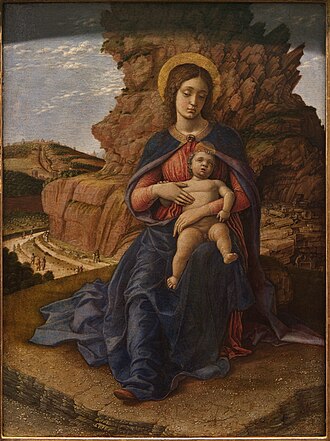 La Madone de la carrière - Andrea Mantegna (1489)
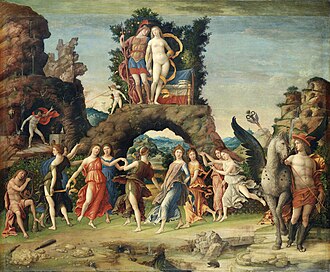 Le Parnasse - Andrea Mantegna
 L'Introduction du culte de Cybèle à Rome - Andrea Mantegna (1500s)
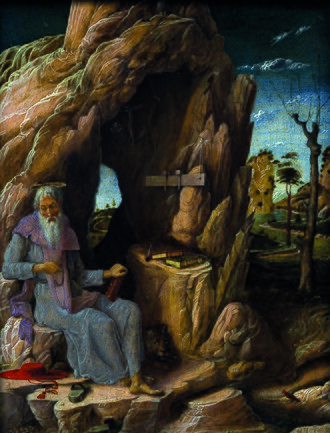 Saint Jérôme dans le désert - Andrea Mantegna
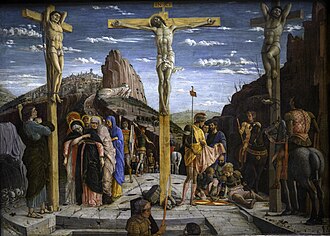 La Crucifixion - Andrea Mantegna (1450s)
Œuvres d'artistes liés
 La Naissance de Vénus - Sandro Botticelli (c. 1485)
 Le Printemps - Sandro Botticelli (1480s)
 La Flagellation du Christ - Piero della Francesca (1450s)
 La Conversation sacrée - Piero della Francesca (1472)
 La Joconde - Leonardo da Vinci (1503-1519)
 La Dame à l'hermine - Leonardo da Vinci (1490)
 L'Annonciation - Fra Angelico (1425)
 Tondo Cook - Fra Angelico (1430)