Adoration of the Shepherds
Andrea Mantegna · 1450
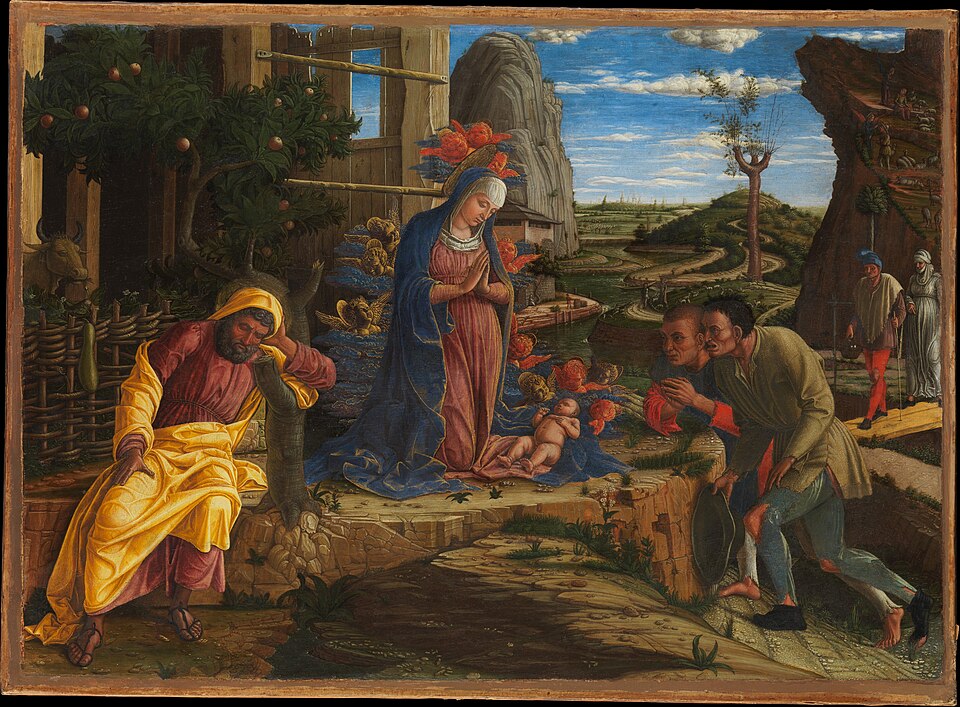
The Virgin kneels on stony ground, adoring her child, while Joseph sleeps and two rough faced shepherds pray. Young Mantegna packed this small picture with signs of birth, death and renewal.
The story behind the painting
The Adoration of the Shepherds is generally placed in Andrea Mantegna's youth and dated around 1450 to 1451. It was probably commissioned by Borso d'Este during the artist's stay in Ferrara in those years. Some flaws in the perspective have led scholars to date it close to Mantegna's first frescoes in the Ovetari Chapel, especially the early scenes of the Life of Saint James, painted from 1448 to 1450. Originally on panel, it was later moved to canvas at an unknown date, losing a small section on the far right.
What to look for
In the centre the Madonna kneels on a stony patch inside a crumbling wall, adoring the Child, who is cradled by twelve cherubs on a cloud. To her right Saint Joseph sleeps, leaning on a blasted tree that bears fruit on a single branch. To her left two shepherds pray, their wrinkles and realistic faces close to grotesque. Behind the Virgin are the boards of the ruined stable; an ox stands by, and faint traces of an ass hide in the dark doorway. A gourd hangs on the wattle fence. On the right a wide landscape opens between two steep mountains, where more shepherds meet angels.
Meaning and intent
Almost every detail carries meaning. Joseph's sleep may hint at his role as mere guardian of the Virgin and Child. The dead tree with one fruiting branch is usually read as the mystic renewal of nature under the new dispensation. A large tree resembling the Cross of Calvary foretells the Passion, the ox is the traditional silent witness of the Nativity, and the gourd symbolises the Resurrection and pilgrimage. The close attention to detail and the realistic shepherds have been linked to Flemish painting, which Mantegna could study in the Este collection, perhaps including Rogier van der Weyden.
Legacy
The picture's travels are long. It may be the Nativity by Mantegna listed in a 1586 inventory of Margherita Gonzaga d'Este. By 1603 Cardinal Pietro Aldobrandini owned it, and it passed through the Pamphilj and Borghese families. In 1792 the painter and dealer Alexander Day took it to London; it went to Richard Payne Knight at Downton Castle, then to Joseph Duveen. Clarence Mackay acquired it in 1925, and an anonymous donor bought it for the Metropolitan Museum of Art in New York, where it is today.
Le saviez-vous ?
- Dated around 1450 to 1451, from Mantegna's youth.
- Probably commissioned by Borso d'Este in Ferrara.
- Transferred from panel to canvas, losing a strip on the right.
- Now in the Metropolitan Museum of Art, New York.
À propos de l'artiste
Andrea Mantegna (1431-1506)
art religieux · femme · Marie · Enfant Jésus · garçon · Jésus-Christ · Metropolitan Museum of Art · sainte Famille
Autres œuvres de Andrea Mantegna
 Lamentation sur le Christ mort - Andrea Mantegna (1483)
 La Vierge de la Victoire - Andrea Mantegna
 retable de San Zeno - Andrea Mantegna (1457)
 La Madone de la carrière - Andrea Mantegna (1489)
 Le Parnasse - Andrea Mantegna
 L'Introduction du culte de Cybèle à Rome - Andrea Mantegna (1500s)
 Saint Jérôme dans le désert - Andrea Mantegna
 La Crucifixion - Andrea Mantegna (1450s)
Œuvres d'artistes liés
 La Naissance de Vénus - Sandro Botticelli (c. 1485)
 Le Printemps - Sandro Botticelli (1480s)
 La Flagellation du Christ - Piero della Francesca (1450s)
 La Conversation sacrée - Piero della Francesca (1472)
 La Joconde - Leonardo da Vinci (1503-1519)
 La Dame à l'hermine - Leonardo da Vinci (1490)
 L'Annonciation - Fra Angelico (1425)
 Tondo Cook - Fra Angelico (1430)