Saint Laurent distribue l'aumône
Fra Angelico · 1447
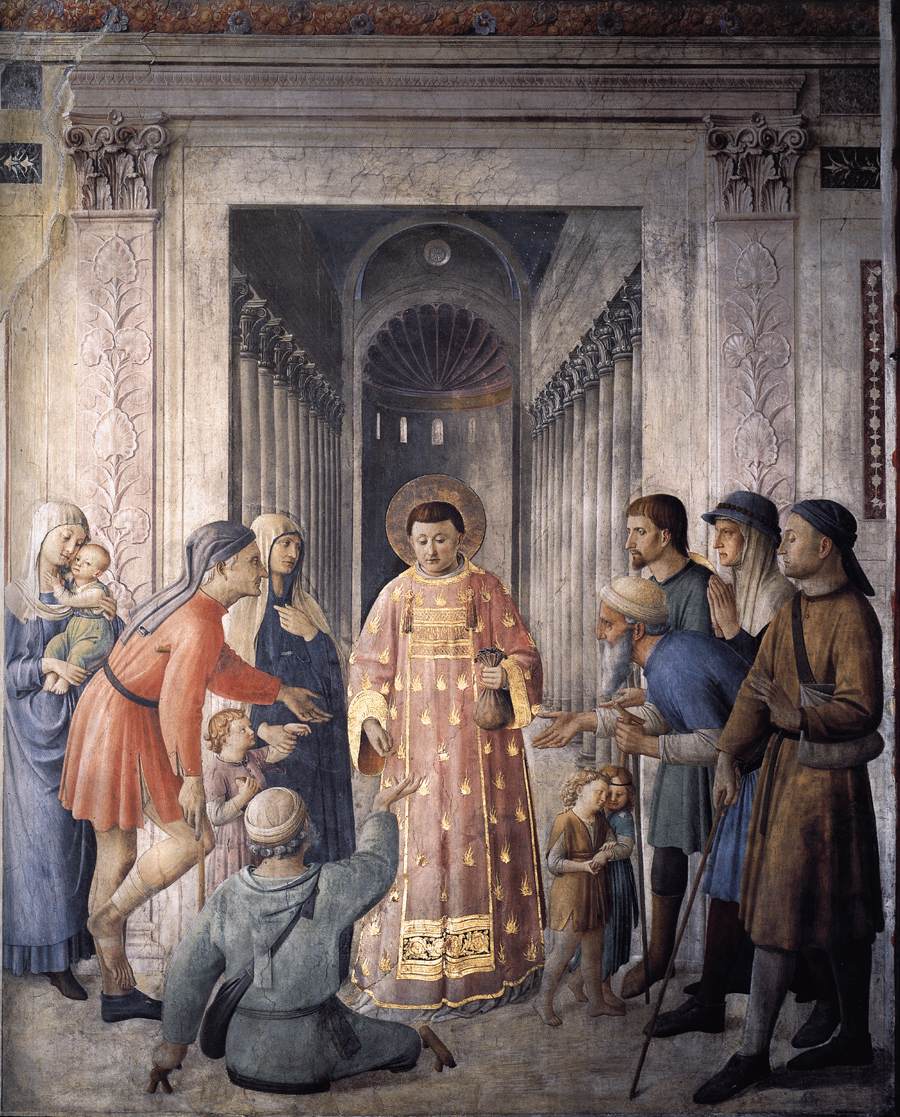
A young deacon stands in the doorway of a great basilica, handing out the Church's treasure to the lame, the blind, mothers and ragged orphans. Fra Angelico painted this act of charity in the pope's private chapel.
The story behind the painting
Fra Angelico and his assistants, including Benozzo Gozzoli, painted this fresco, about 271 by 205 cm, in the Niccoline Chapel of the Apostolic Palace in the Vatican between 1447 and 1448. It is the third episode of the Stories of Saint Lawrence, on the right of the middle register of the central wall. Angelico worked on the chapel during his stay in Rome from 1445 to 1450. The first documents are dated 9 May and 1 June 1447, under Pope Nicholas V, though work may have begun earlier under Eugene IV. After a pause in summer 1447, when the painter went to Orvieto, the frescoes were finished by the end of 1448.
What to look for
Lawrence stands in the sacristy of a basilica. Behind him, through the bold rectangle of the doorway, the perspective runs the whole length of an early Christian nave, with columns carrying architraves and a great central apse, framing the saint. Around him crowds a varied group of people in need: a lame man, a man without legs dragging himself with wooden grips, a blind man, a pilgrim, a beggar, two mothers with children, and two little orphans in rags. In the foreground the doorway is framed by Corinthian pilasters with unusual plant motifs, found elsewhere in the chapel but unlike any classical or Renaissance architecture of the time.
Meaning and intent
The legend tells that Lawrence received the goods of Pope Sixtus II before the pope was killed, and gave them to the poor before Emperor Valerian could seize them. Despite the realistic poor and sick, the source finds that the fresco's dominant feeling is general order and harmony. John Pope-Hennessy and others explain that these frescoes differ from Angelico's at San Marco in Florence not because his style changed, but because of their purpose: at San Marco they aided monks' meditation, while in the Vatican they had to celebrate the power and intellectual horizons of the papacy, renewing ancient Rome after the long absence of the popes in Avignon.
Legacy
Central perspective was introduced to Rome by Angelico, and this colonnade inside a basilica is used here at monumental scale, after small experiments in predella panels such as the Presentation in the Temple from the Cortona Annunciation and a scene from the Louvre Coronation of the Virgin. The scene mirrors Saint Stephen Distributing Alms in the lunette of the left wall, and sits beside Saint Lawrence Receiving the Treasures of the Church, separated by a cornice. As in all Angelico's work, the key element is clear, diffused light, which here seems to fall equally on the saint and on every person who comes to him.
Le saviez-vous ?
- Painted 1447 to 1448 in the Niccoline Chapel, Vatican.
- Assisted by Benozzo Gozzoli.
- Third episode of the Stories of Saint Lawrence.
- Lawrence gives the Church's goods to the poor before the emperor seizes them.
À propos de l'artiste
Fra Angelico (1400-1455)
art religieux · Renaissance italienne · palais du Vatican
Autres œuvres de Fra Angelico
 L'Annonciation - Fra Angelico (1425)
 Tondo Cook - Fra Angelico (1430)
 Pala di San Marco - Fra Angelico
 La Descente de Croix - Fra Angelico (1432)
 Pala di Fiesole - Fra Angelico (1422)
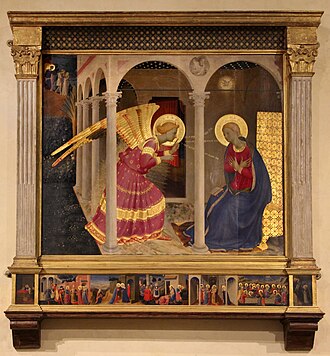 L'Annonciation de Cortone - Fra Angelico (1430s)
 Madonna dell'Umiltà - Fra Angelico (1433)
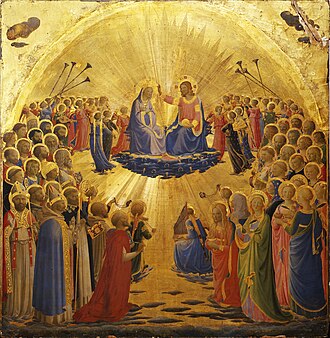 Le Couronnement de la Vierge - Fra Angelico (1430s)
Œuvres d'artistes liés
 La Joconde - Leonardo da Vinci (1503-1519)
 La Dame à l'hermine - Leonardo da Vinci (1490)
 Tondo Doni - Michelangelo (1500s)
 Le Tourment de saint Antoine - Michelangelo (1487)
 La Flagellation du Christ - Piero della Francesca (1450s)
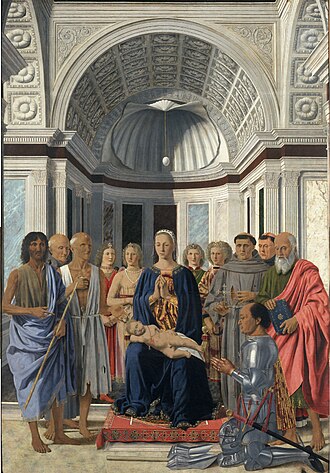 La Conversation sacrée - Piero della Francesca (1472)