La oración antes de la comida
Jan Havicksz Steen · 1660
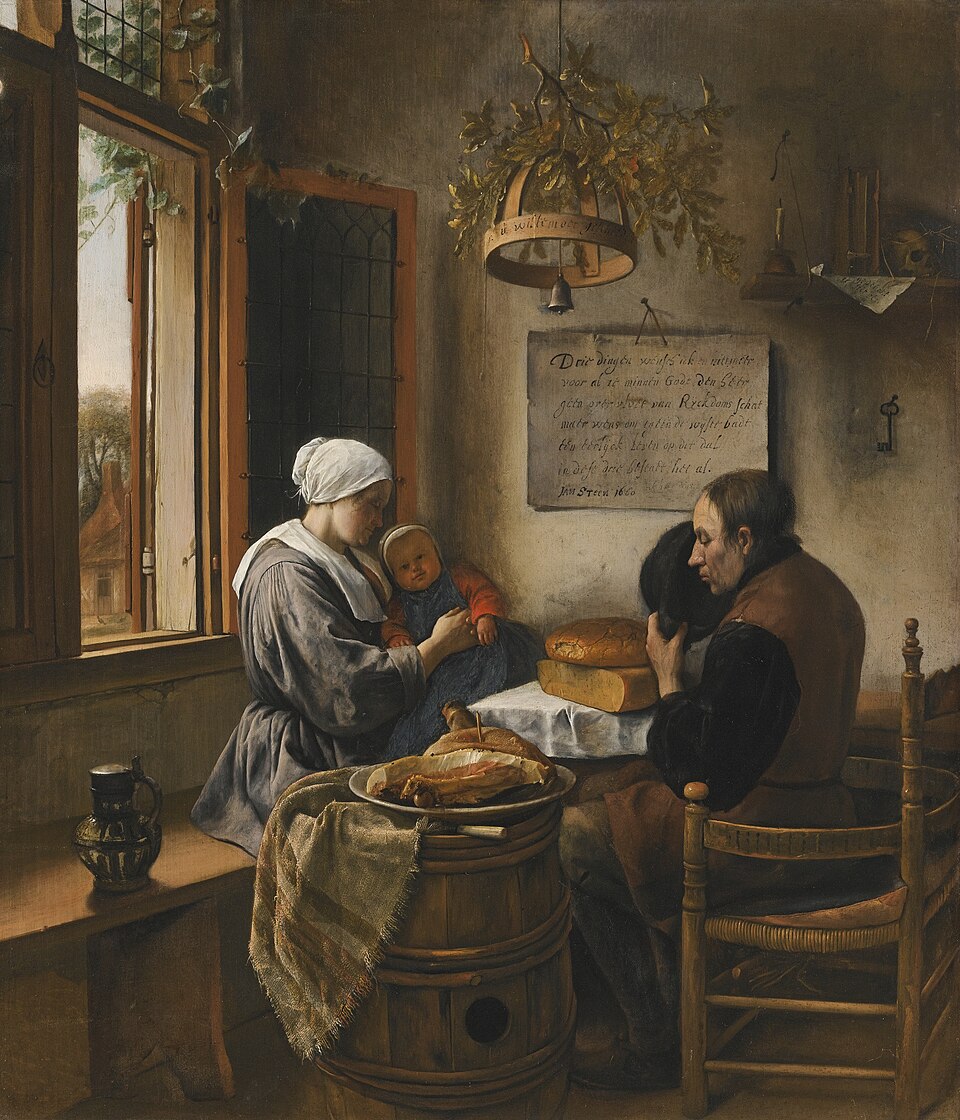
A humble Dutch family bows over bread, cheese and ham, the father bareheaded, the mother holding her child close, afternoon light falling through an open window. Jan Steen, better known for rowdy households, painted here a moment of complete stillness.
The story behind the painting
Jan Steen made four paintings on the theme of prayer before a meal, and this is the earliest of them. The subject belonged to a long tradition: from the early 17th century, paintings and prints of families saying grace were popular among both Catholic and Protestant Dutch viewers. Until about mid-century they usually showed wealthy households; later they turned more to people of modest means, as here. Wikidata dates the work to 1660. The Spanish Wikipedia article, our main source, does not give a year in its text.
What to look for
The father has taken off his hat and lowers his eyes, while the mother holds her child comfortably in her arms. Steen painted the food and setting with remarkable care, from the ham cut on the barrel to the soft, ragged cloth beneath it. A key hangs behind the father. Above the family a small wooden chandelier with a little bell bears words from the Lord's Prayer, Thy will be done. On a shelf to the right stand a snuffed candle, a large worn book that seems to be a Bible, and a skull, beneath a note reading Remember that you must die.
Meaning and intent
The picture reflects the ideal of a pious, harmonious Dutch family. A biblical text on the wall sets out its creed: to love God the Father, to reject the greed for riches and to lead an honest life. The key stands for the father's reliability and integrity. Candle, book and skull remind the family that earthly life passes, while a green oak sprig over the lamp and ears of wheat crowning the skull bring hope, since in Christian tradition death is a step toward eternal life.
Legacy
Which faith the family follows is not made clear, and the scene speaks across religious lines. Steen was Catholic, and he seems at first to have leaned that way: modern technical study revealed that a crucifix originally hung above the father's head. Steen later covered it, painting over it a memento mori with symbols of death and resurrection suited to Catholics and Protestants alike. The painting was sold at Sotheby's in London on 5 December 2012, and it can be compared with similar scenes such as Nicolaes Maes's Saying Grace.
¿Sabías que…?
- The earliest of Jan Steen's four paintings of prayer before a meal.
- Shows a modest family rather than a wealthy one.
- A crucifix was painted over with a memento mori.
- Sold at Sotheby's in London in December 2012.
Sobre el artista
Jan Havicksz Steen (1626-1679)
arte religioso · mujer · varón · escena de género · niño · oración · comida
Más obras de Jan Havicksz Steen
 La fiesta de San Nicolás - Jan Steen (1660s)
 Joven comiendo ostras - Jan Steen (1658)
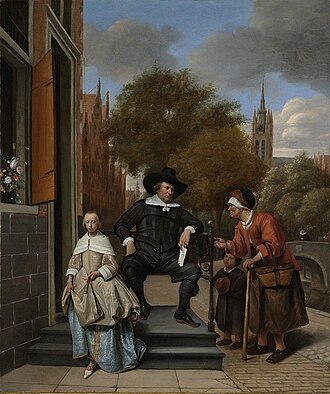 Retrato doble de Adolf y Catharina Croeser - Jan Steen (1655)
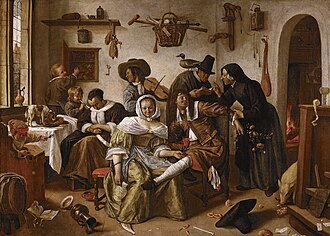 El mundo al revés - Jan Steen (1663)
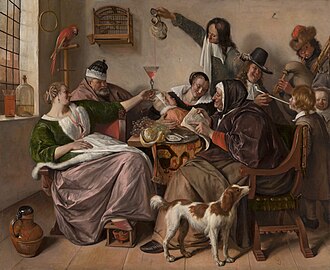 Como cantan los viejos, tocan los niños - Jan Steen (1665)
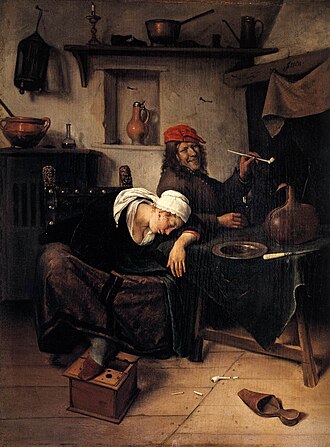 Borrachos - Jan Steen (1660s)
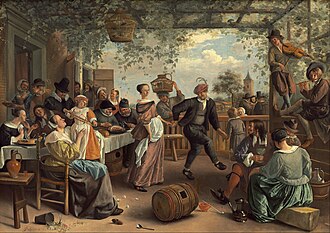 La pareja bailando - Jan Steen (1663)
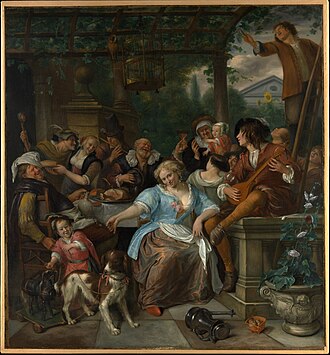 Alegre compañía en una terraza - Jan Steen (1670)
Obras de artistas relacionados
 La ronda de noche - Rembrandt van Rijn (1642)
 Autorretrato - Rembrandt van Rijn (1659)
 La joven de la perla - Johannes Vermeer (1665)
 La lechera - Johannes Vermeer (c. 1658)
 El alegre bebedor - Frans Hals (1620s)
 Caballero sonriente - Frans Hals (1624)
 El molino de Wijk bij Duurstede - Jacob van Ruisdael (1670)
 El cementerio judío - Jacob van Ruisdael (1650s)
 Patio de una casa de Delft - Pieter de Hooch (1658)
 Mujer pelando manzanas - Pieter de Hooch (1663)