Como cantan los viejos, tocan los niños
Jan Havicksz Steen · 1665
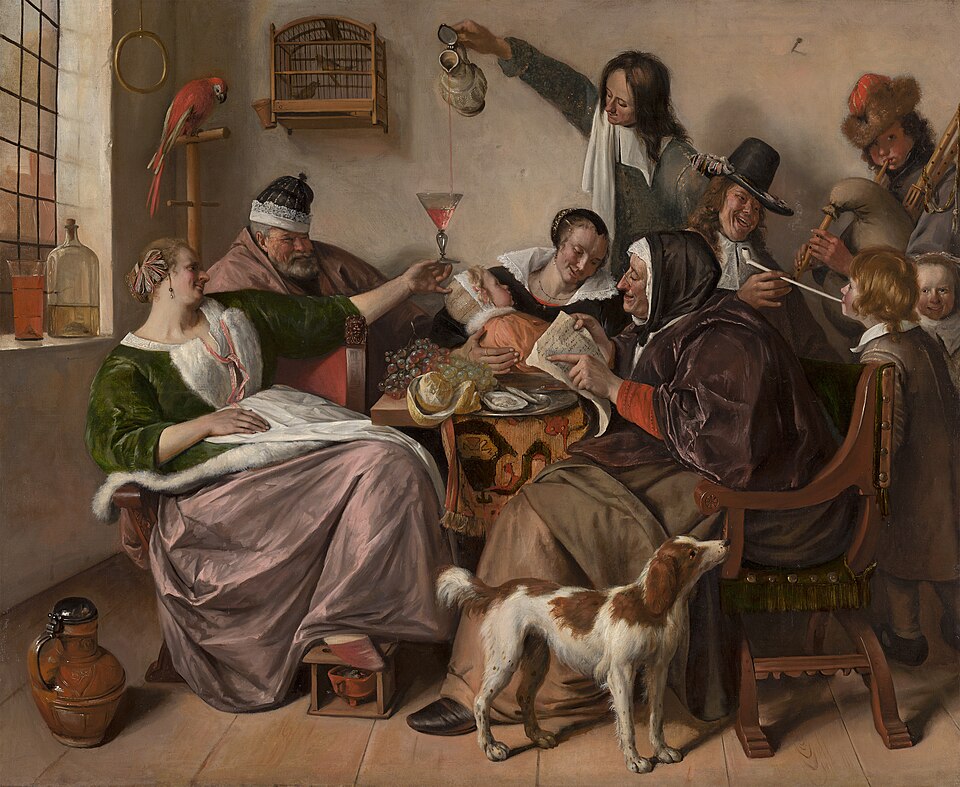
Three generations crowd around a festive table: grandmother sings, a son blows the bagpipe, and the laughing father, Jan Steen himself, lets his little boy smoke a pipe. It is a joke, and a warning, painted with real warmth.
The story behind the painting
The title comes from a well known proverb of Jacob Cats: the vices of the young are learned from the example of their elders, or in short, like father, like son. Steen painted this subject an estimated thirteen times, always in a household setting, and the theme has also been called The Cat Family or Jan Steen's Family. The Mauritshuis version is considered the finest of the series. Wikipedia dates it about 1668 to 1670, while Wikidata gives 1665. Steen often put himself and his own family into his comic scenes.
What to look for
On a canvas of about 133.7 by 162.5 cm, Steen in a black hat laughs at the right while teaching his younger son to smoke. His older son plays the bagpipe. In the right foreground sits an old woman thought to be Steen's mother, holding an open music sheet we can almost read. At the left, Steen's wife in a green coat and lavender skirt holds out her glass as a servant pours. She wears a pink ribbon in her hair, he wears one on his hat. Notice the parrot, the small cage with two birds, the oyster on the table, the dog, and the window light gliding over clothes and furniture.
Meaning and intent
Almost every object repeats the lesson. The parrot stands for mimicry, the caged pair of birds for two parents in a small home. Pipe can mean a clay pipe, singing, or a drinking vessel. The bagpipe was seen by the Dutch as a lowly, obnoxious instrument, so here it marks bawdiness that the parents encourage. The oyster, linked to Aphrodite and pleasure, returned to Dutch genre painting after 1660. Yet the scene is open and inviting, warm with orange, pink, purple and brown, and Steen's laughing face can be read as foolishness, human fault, or a lesson learned.
Legacy
The painting belongs to the merry company genre, showing family life as part of popular culture in seventeenth century Holland. It shows Steen's mastery of light on surfaces and his realistic faces, and reveals that this comic painter had a sophisticated knowledge of proverbs and symbols. Steen came from a Leiden family whose father owned a brewery; he married Margariet, or Grietje, joined the painters' guild in The Hague, and struggled with money. His grin in his own pictures has become a kind of folk character that museum visitors delight in finding. The painting is in the Mauritshuis in The Hague.
¿Sabías que…?
- Named after a proverb by Jacob Cats.
- Steen painted the subject about thirteen times.
- Dated c. 1668-1670 by Wikipedia, 1665 by Wikidata.
- In the Mauritshuis, The Hague.
Sobre el artista
Jan Havicksz Steen (1626-1679)
escena de género · pintura del Siglo de oro neerlandés · familia · Mauritshuis
Más obras de Jan Havicksz Steen
 La fiesta de San Nicolás - Jan Steen (1660s)
 Joven comiendo ostras - Jan Steen (1658)
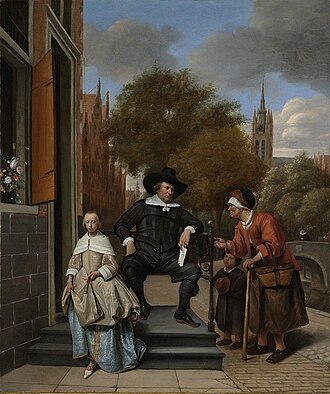 Retrato doble de Adolf y Catharina Croeser - Jan Steen (1655)
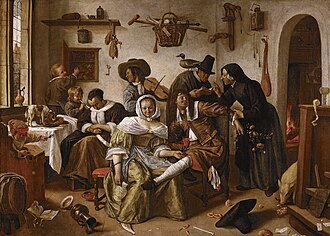 El mundo al revés - Jan Steen (1663)
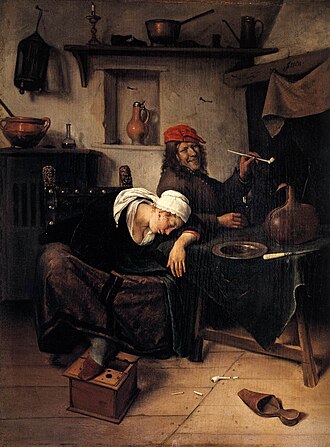 Borrachos - Jan Steen (1660s)
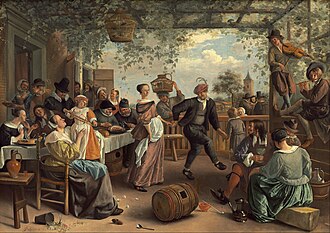 La pareja bailando - Jan Steen (1663)
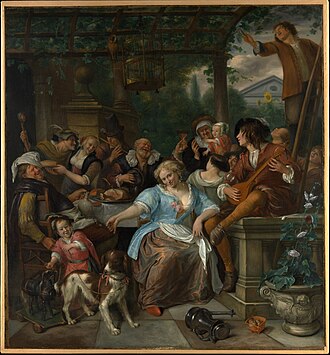 Alegre compañía en una terraza - Jan Steen (1670)
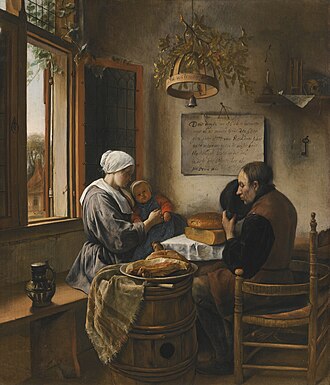 La oración antes de la comida - Jan Steen (1660)
Obras de artistas relacionados
 La ronda de noche - Rembrandt van Rijn (1642)
 Autorretrato - Rembrandt van Rijn (1659)
 La joven de la perla - Johannes Vermeer (1665)
 La lechera - Johannes Vermeer (c. 1658)
 El alegre bebedor - Frans Hals (1620s)
 Caballero sonriente - Frans Hals (1624)
 El molino de Wijk bij Duurstede - Jacob van Ruisdael (1670)
 El cementerio judío - Jacob van Ruisdael (1650s)
 Patio de una casa de Delft - Pieter de Hooch (1658)
 Mujer pelando manzanas - Pieter de Hooch (1663)