Jan Havicksz Steen
1626-1679
A messy, joyful household is still called a Jan Steen household in Dutch. Jan Steen filled his canvases with humour, colour and keen insight into people, and behind the merry chaos he often slipped a gentle warning.
Origins
Jan Havickszoon Steen was born in Leiden around 1626, the eldest of eight or more children. His family was well-to-do and Catholic; they were brewers who ran a tavern called The Red Halbert for two generations. Like Rembrandt before him, he attended the Latin school and became a student in Leiden. No official records of his artistic training survive, but contemporary sources name three teachers: Nicolaes Knupfer, a German painter of historical scenes working in Utrecht, Adriaen van Ostade, and Jan van Goyen, who would later become his father-in-law. Knupfer's influence can be seen in his composition and colour, and the rural scenes of Isaac van Ostade in Haarlem were another source of inspiration.
Life and turning points
In 1648 Steen and Gabriël Metsu founded the painters' Guild of Saint Luke in Leiden. Soon after he became an assistant to the landscape painter Jan van Goyen, lived in his house in The Hague, and on 3 October 1649 married his daughter Margriet; they had eight children. From 1654 he ran a brewery in Delft, De Slang, for three years without much success. He then lived in Warmond and, from 1660 to 1670, in Haarlem, both very productive periods. After Margriet died in 1669 and his father in 1670, he returned to Leiden. When the art market collapsed in the disaster year of 1672, he opened a tavern. In 1673 he married Maria van Egmont, and in 1674 became president of the guild. He was buried in the Pieterskerk on 3 February 1679.
Style and technique
Daily life was Steen's main theme. His works are known for psychological insight, a sense of humour and an abundance of colour, and their satire pokes fun at the habits of the Dutch middle class. Scenes such as The Feast of Saint Nicholas are lively to the point of chaos, yet subtle hints suggest he meant to warn viewers rather than invite them to copy such behaviour, and many pictures refer to old Dutch proverbs. He did not limit himself to genre: he also painted history, mythology, religious scenes, portraits, still lifes and nature, and his portraits of children are famous. He is admired for his mastery of light and fine detail, especially in Persian rugs and other textiles.
Stories and anecdotes
In 1945 the scholar Sturla Gudlaugsson showed how much Steen owed to the theatre and to the Rederijkers, the amateur rhetoricians' societies; Steen's own uncle belonged to the one in Leiden. His many versions of The Doctor's Visit tell a simple story: a doctor called to a young woman finds she is not ill but pregnant. The doctor wears clothes in the fashion of 1570, not 1670, while the girl wears the height of contemporary fashion. Gudlaugsson read this as a sign that the doctor is really an actor in a traditional stage costume. Steen often used his family as models, and in his many self-portraits he showed no trace of vanity.
Legacy
Steen was prolific, producing about 800 paintings, of which roughly 350 survive. His contemporaries valued his work, and he was reasonably well paid for it. Only one pupil, Richard Brakenburgh, is recorded, yet his pictures inspired many other painters. The proverb een huishouden van Jan Steen, a Jan Steen household, keeps his name alive in everyday Dutch speech, for any home in cheerful disorder. His paintings are often taken as a realistic record of 17th-century Dutch life, but they are also full of idyllic fantasy and theatrical flair. Looking at them today, one feels both the laughter and the warmth he found in ordinary people.
¿Sabías que…?
- In The way you hear it and As old men sing, so children squeal, six of the figures are identical in person and pose.
- His father leased him a brewery of his own in Delft from 1654 to 1657.
- Frans van Mieris was one of his drinking companions.
- Rhetoricians at a Window is held by the Philadelphia Museum of Art.
pintura del Siglo de oro neerlandés
Artistas relacionados
Rembrandt van Rijn · Johannes Vermeer · Frans Hals · Jacob Ruysdael · Pieter de Hooch
Obras de Jan Havicksz Steen
 La fiesta de San Nicolás - Jan Steen (1660s)
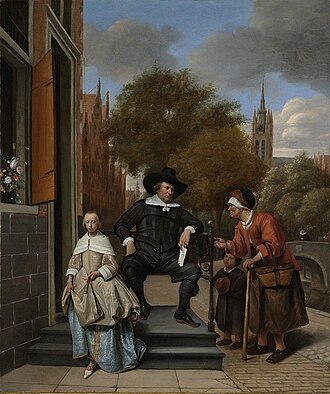 Retrato doble de Adolf y Catharina Croeser - Jan Steen (1655)
 Joven comiendo ostras - Jan Steen (1658)
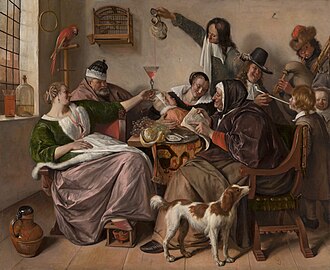 Como cantan los viejos, tocan los niños - Jan Steen (1665)
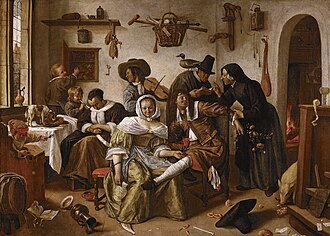 El mundo al revés - Jan Steen (1663)
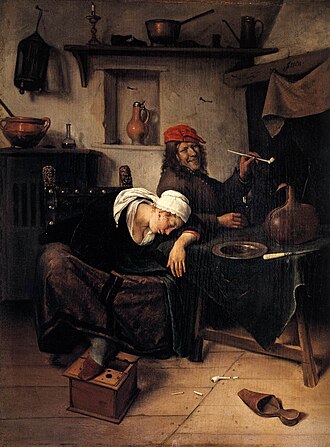 Borrachos - Jan Steen (1660s)
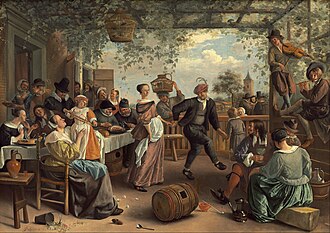 La pareja bailando - Jan Steen (1663)
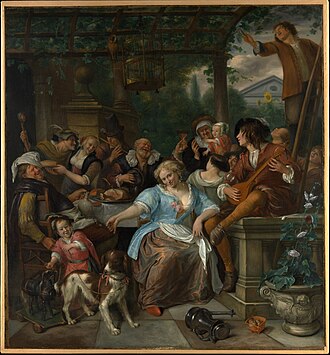 Alegre compañía en una terraza - Jan Steen (1670)
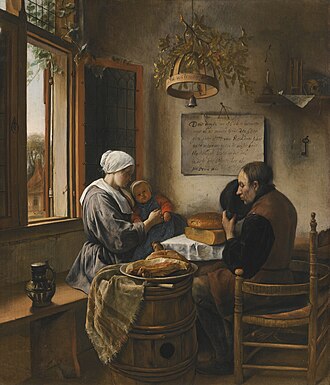 La oración antes de la comida - Jan Steen (1660)
Esther, Ahasuerus, and Haman - Jan Steen (1668)
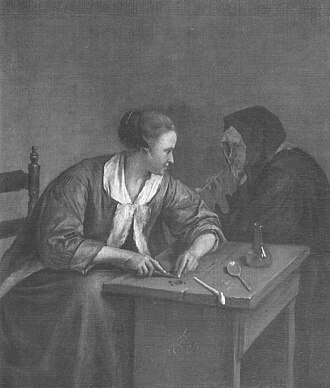 Smoking women - Jan Steen
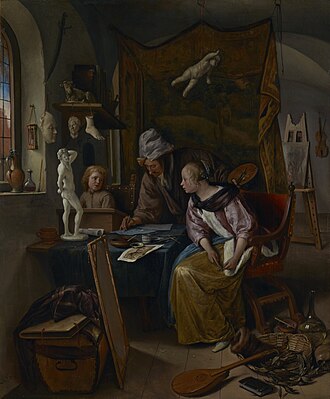 The Drawing Lesson - Jan Steen (1665)