Joven comiendo ostras
Jan Havicksz Steen · 1658
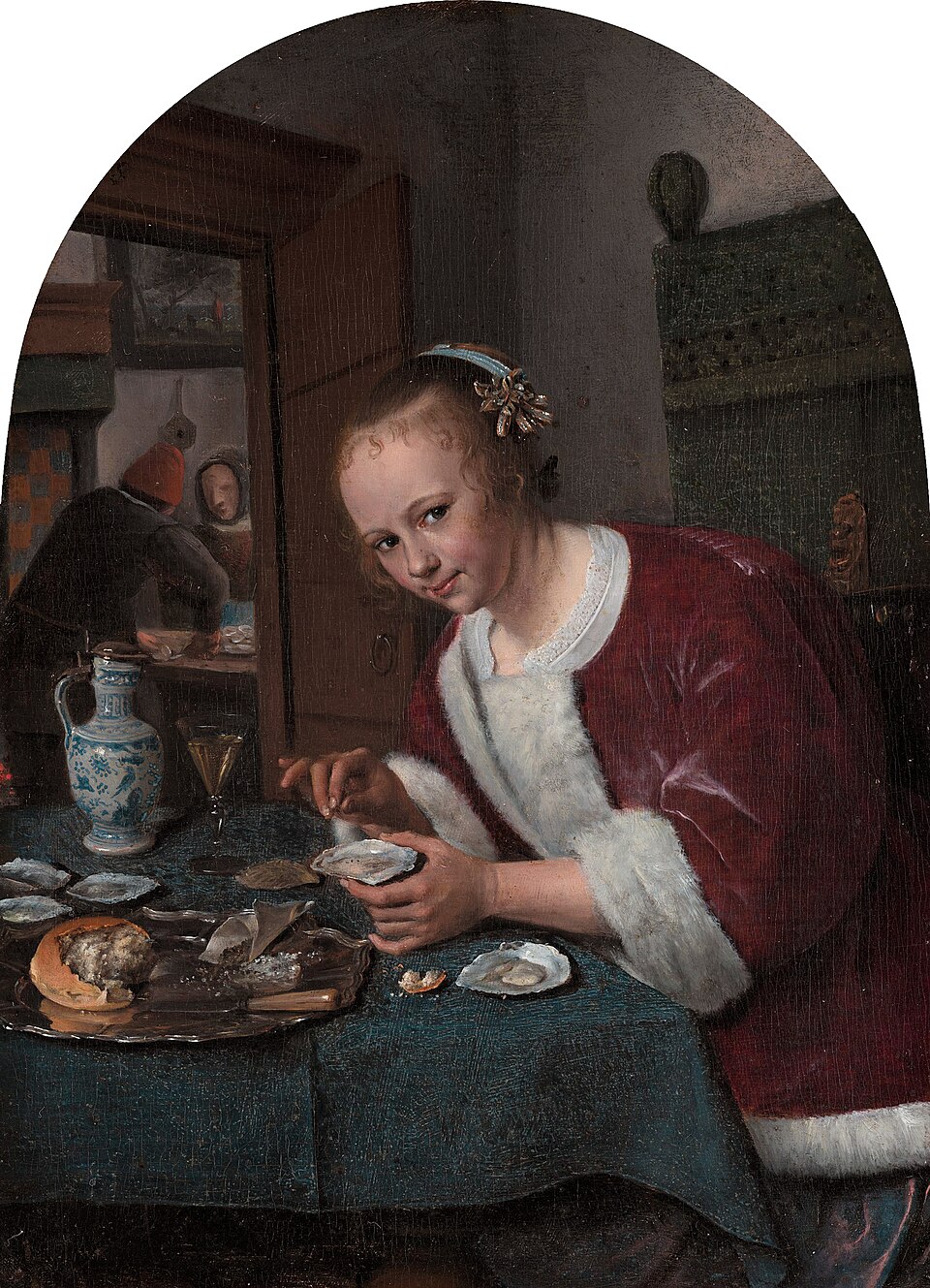
A young woman salts an oyster and looks straight at us, as if the oyster were meant for the viewer. Jan Steen packed a whole flirtation into a panel only about 20 by 15 cm.
The story behind the painting
Jan Steen painted this small oil on panel around 1658 to 1660; Wikidata gives 1658. In Dutch it is called Het oestereetstertje, and it is also known as Girl Offering Oysters. Where it was before 1783 is unknown. That September, Pieter Locquet sold it to Pieter van Winter in Amsterdam, and it then passed down through his daughter Lucretia Johanna van Winter and the Six family, including Professor Jan Six, until the 1920s. In 1936 Sir Henri Deterding gave it to the Mauritshuis in The Hague, where it has been ever since.
What to look for
The girl salts the oysters while looking directly at you, with a flirtatious expression that suggests they are being prepared for the viewer. Steen frames her with the vertical and horizontal lines of a door frame, bed curtains and the edge of the table, and the arched top of the panel echoes the curve of her head and left shoulder. Objects such as the oyster point the eye into a back room where men are seen. This view through a doorway, called doorsien in Dutch, adds depth and balances the men behind against the young woman in front.
Meaning and intent
Here the oysters carry an erotic meaning. They were thought to be an aphrodisiac, and since antiquity they had been linked with Aphrodite, goddess of love and pleasure. Empty shells or half-eaten food beside them could also hint at how brief earthly pleasures are, a theme often repeated in Dutch art. After 1658, when the Dutch took control of pearl fisheries in Indian waters, oyster scenes moved from noisy merry companies into private interiors that suggested a romantic meeting. Steen liked to show love's passion and folly with humour, and he used oysters as a symbol of lust in other works too.
Legacy
The painting shows how close Steen could come to the refined style of Frans van Mieris the Elder. The arched top, the small size and the extreme care given to every tiny detail recall Gerrit Dou, the great master of fine painting in Leiden and the teacher of Van Mieris. It also shows two sides of Steen at once: the polished craftsman and the storyteller of earthy humour who painted homes, families and moral lessons, sometimes with a satirical edge. It is a classic example of his intricate style and his love of domestic settings.
¿Sabías que…?
- Small oil on panel, about 20.5 by 14.5 cm.
- Dated about 1658-1660; Wikidata gives 1658.
- In the Mauritshuis since a gift by Sir Henri Deterding in 1936.
- Oysters here symbolise earthly lust.
Sobre el artista
Jan Havicksz Steen (1626-1679)
mujer · escena de género · pintura del Siglo de oro neerlandés · mesa · Mauritshuis · pan · mantel · pelaje · comida
Más obras de Jan Havicksz Steen
 La fiesta de San Nicolás - Jan Steen (1660s)
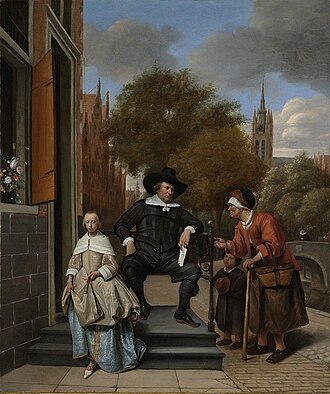 Retrato doble de Adolf y Catharina Croeser - Jan Steen (1655)
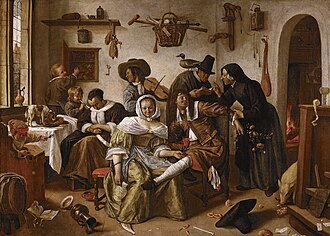 El mundo al revés - Jan Steen (1663)
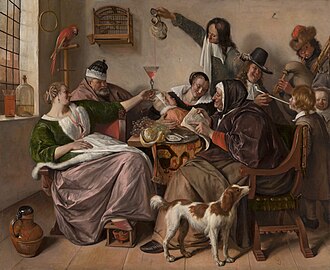 Como cantan los viejos, tocan los niños - Jan Steen (1665)
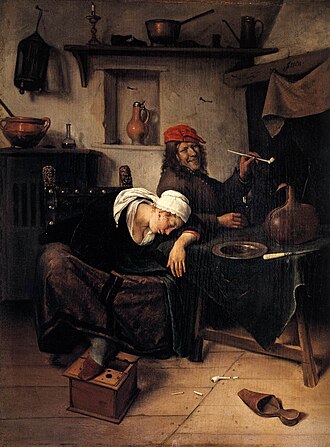 Borrachos - Jan Steen (1660s)
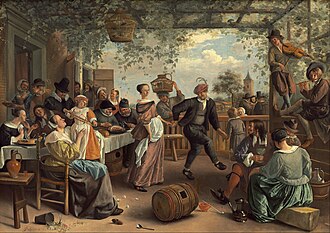 La pareja bailando - Jan Steen (1663)
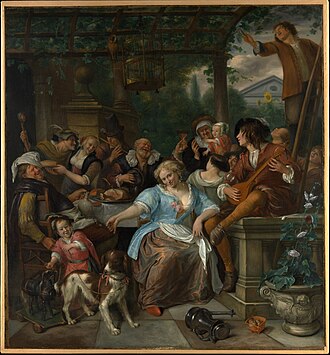 Alegre compañía en una terraza - Jan Steen (1670)
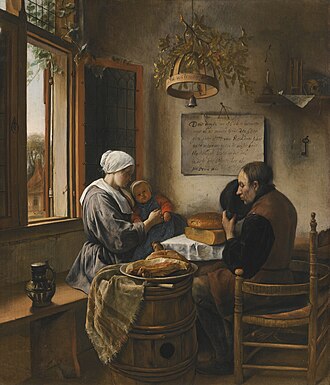 La oración antes de la comida - Jan Steen (1660)
Obras de artistas relacionados
 La ronda de noche - Rembrandt van Rijn (1642)
 Autorretrato - Rembrandt van Rijn (1659)
 La joven de la perla - Johannes Vermeer (1665)
 La lechera - Johannes Vermeer (c. 1658)
 El alegre bebedor - Frans Hals (1620s)
 Caballero sonriente - Frans Hals (1624)
 El molino de Wijk bij Duurstede - Jacob van Ruisdael (1670)
 El cementerio judío - Jacob van Ruisdael (1650s)
 Patio de una casa de Delft - Pieter de Hooch (1658)
 Mujer pelando manzanas - Pieter de Hooch (1663)