Mujer pelando manzanas
Pieter de Hooch · 1663
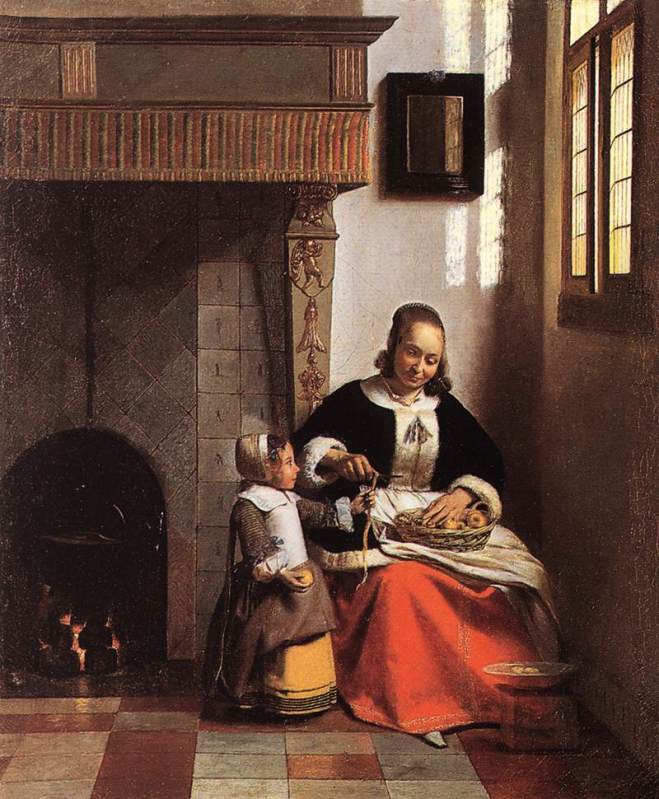
A mother peels apples by the fire and holds out a long ribbon of rind to her little girl. The light in this de Hooch interior is so tender that nineteenth century critics believed it was a Vermeer.
The story behind the painting
A Woman Peeling Apples dates to around 1663 and, like most of Pieter de Hooch's works, shows a quiet domestic scene of his time. It is sometimes called A Woman Peeling Apples, with a Small Child. The sources differ slightly on its size: Wikipedia gives 67 by 55 cm, Hofstede de Groot in 1908 measured 26 by 21 inches, and Wikidata records 71 by 54 cm. The Marquis of Hertford bought it from C. Perrier in 1848, which is how it came to the collection now known as the Wallace Collection.
What to look for
The woman sits in the right hand corner of the room, facing us, in a black velvet jacket trimmed with fur, a red skirt and a white apron. A basket of apples rests in her lap, and she holds out a long peel to a little girl seen in profile. A tub stands at her feet. To the left is a fireplace lined with Delft tiles and framed by pilasters in low relief, with a kettle over the fire. Behind her hangs a mirror in a black frame. Sunlight enters through a window high on the right, lighting the wall and a corner of the mirror above a floor of brown and white tiles.
Meaning and intent
The fine fireplace and the fur and embroidery of the mother's clothes describe a prosperous household, and the cupid placed between the two figures suggests a happy one. Nothing dramatic happens: the meaning lies in the small gesture of a mother sharing a peel with her child. The painting's sensitive handling of natural light, filtered into an otherwise unlit room, is what gives that gesture its warmth. Unlike Vermeer, who usually showed a woman working alone, de Hooch here chose a family scene.
Legacy
That light misled people for decades. In 1866 the critic Burger, writing in the Gazette des Beaux-Arts, described the picture as a Vermeer, and other nineteenth century art historians agreed. Most scholars now think de Hooch was influenced by Vermeer rather than the reverse. Hofstede de Groot found the canvas very dirty in 1908 but judged its general effect fine. The work was shown at the Royal Academy Winter Exhibition in London in 1893 and remains in the Wallace Collection in London.
¿Sabías que…?
- Painted around 1663.
- Once described as a Vermeer by the critic Burger in 1866.
- Bought by the Marquis of Hertford in 1848.
- Now in the Wallace Collection, London.
Sobre el artista
Pieter de Hooch (1629-1684)
mujer · escena de género · Colección Wallace · manzana
Más obras de Pieter de Hooch
 Patio de una casa de Delft - Pieter de Hooch (1658)
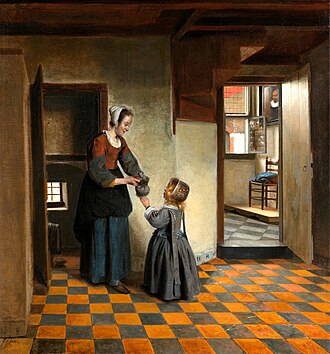 Mujer con una niña en la despensa - Pieter de Hooch
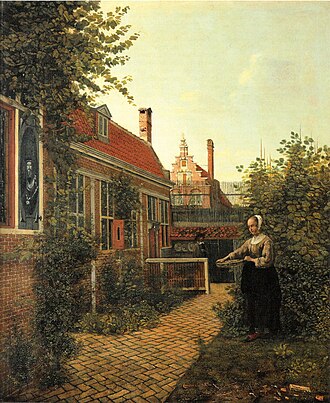 Mujer con una cesta de judías en un huerto - Pieter de Hooch (1651)
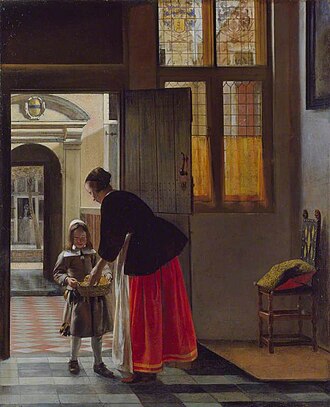 Niño trayendo pan - Pieter de Hooch (1663)
 A Dutch Courtyard - Pieter de Hooch (1658)
 Jugadores de cartas en una habitación soleada - Pieter de Hooch (1658)
 Mujer preparando pan con mantequilla para un niño - Pieter de Hooch (1661)
 A Couple Walking in the Amsterdam Town Hall - Pieter de Hooch (1660s)