Alegre compañía en una terraza
Jan Havicksz Steen · 1670
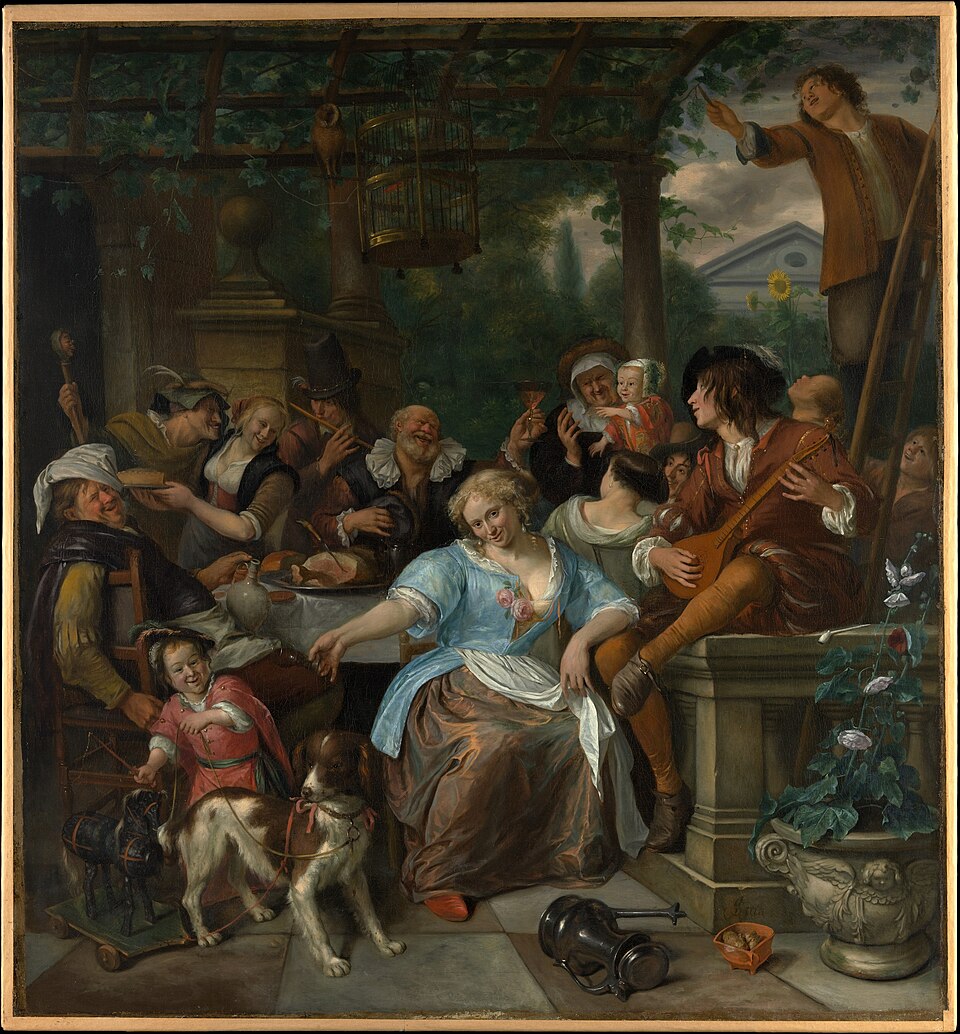
Wine on a terrace, a flute, a kiss stolen in the background, and the painter himself grinning at the edge. Jan Steen's Merry Company looks like a family party, but every detail carries a joke.
The story behind the painting
Jan Steen painted Merry Company on a Terrace around 1670. It shows a group of people, probably three generations of one family, drinking wine around a table on a terrace. Before 1819 it belonged to the Dutch statesman Gerrit Schimmelpenninck. It then passed through English and American collections, returned to the Netherlands at the Museum Boijmans Van Beuningen, and was acquired by the Metropolitan Museum of Art in New York in 1958, where it hangs today. The canvas measures about 141 by 131.4 cm.
What to look for
At the centre a young blond woman turns toward us; she may be Margareta van Goyen, daughter of the painter Jan van Goyen and Steen's first wife. At the far left, the man in a cap is Steen himself. In the background at left, a man trying to kiss a maid is Hans Wurst, a stock figure of improvised German comedy. Watch the hands: the maid lifts a dish, a young man plays the flute, an old man clutches his fur cap. A brown and white dog stands before the table, and an owl perches on a beam near a cage. Note the salmon or coral pink of the front woman's shoe.
Meaning and intent
The painting is meant to be humorous and ironic. The child with a dog and a toy parodies the children's portraits of the day, in which a pet stood for a good upbringing. The jug held by the innkeeper and the young woman's glass are read as a sexual allusion. The sunflower at the right stands for lust, and the owl for stupidity and drunkenness. Steen uses a palette typical of his style, a range of browns lit with touches of pink, and renders the different textures with delicacy, so the moral joke is wrapped in genuine charm.
Legacy
Few paintings show so clearly why Steen's name became a byword for lively disorder: he puts himself and possibly his wife in the middle of a scene of drinking and flirting, and invites us to laugh with them. This story draws on the French Wikipedia article, which identifies the figures and symbols described here. From a Dutch statesman's collection to the Met, the picture has crossed the Atlantic and back again, and still asks viewers to look past the cheerful surface to the playful warnings beneath.
¿Sabías que…?
- Painted by Jan Steen around 1670.
- Steen painted himself at the far left, in a cap.
- The owl stands for stupidity and drunkenness, the sunflower for lust.
- Acquired by the Metropolitan Museum of Art in 1958.
Sobre el artista
Jan Havicksz Steen (1626-1679)
mujer · varón · escena de género · Museo Metropolitano de Arte · perro · niño · músico · Museo Boymans Van Beuningen
Más obras de Jan Havicksz Steen
 La fiesta de San Nicolás - Jan Steen (1660s)
 Joven comiendo ostras - Jan Steen (1658)
 Retrato doble de Adolf y Catharina Croeser - Jan Steen (1655)
 El mundo al revés - Jan Steen (1663)
 Como cantan los viejos, tocan los niños - Jan Steen (1665)
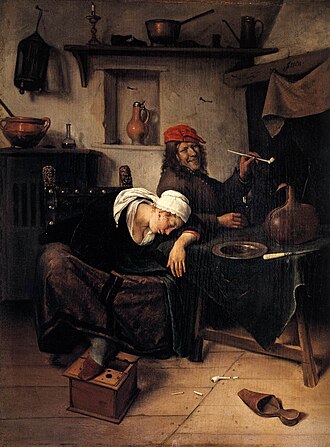 Borrachos - Jan Steen (1660s)
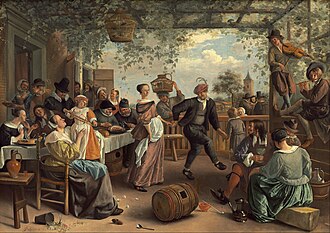 La pareja bailando - Jan Steen (1663)
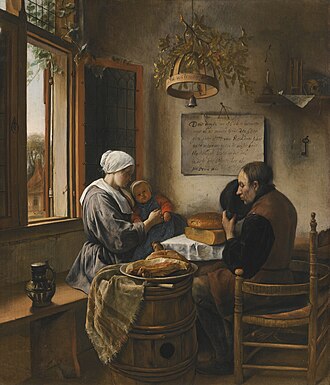 La oración antes de la comida - Jan Steen (1660)
Obras de artistas relacionados
 La ronda de noche - Rembrandt van Rijn (1642)
 Autorretrato - Rembrandt van Rijn (1659)
 La joven de la perla - Johannes Vermeer (1665)
 La lechera - Johannes Vermeer (c. 1658)
 El alegre bebedor - Frans Hals (1620s)
 Caballero sonriente - Frans Hals (1624)
 El molino de Wijk bij Duurstede - Jacob van Ruisdael (1670)
 El cementerio judío - Jacob van Ruisdael (1650s)
 Patio de una casa de Delft - Pieter de Hooch (1658)
 Mujer pelando manzanas - Pieter de Hooch (1663)