Charles de Solier, conde de Morette
Hans Holbein the Younger · 1530s
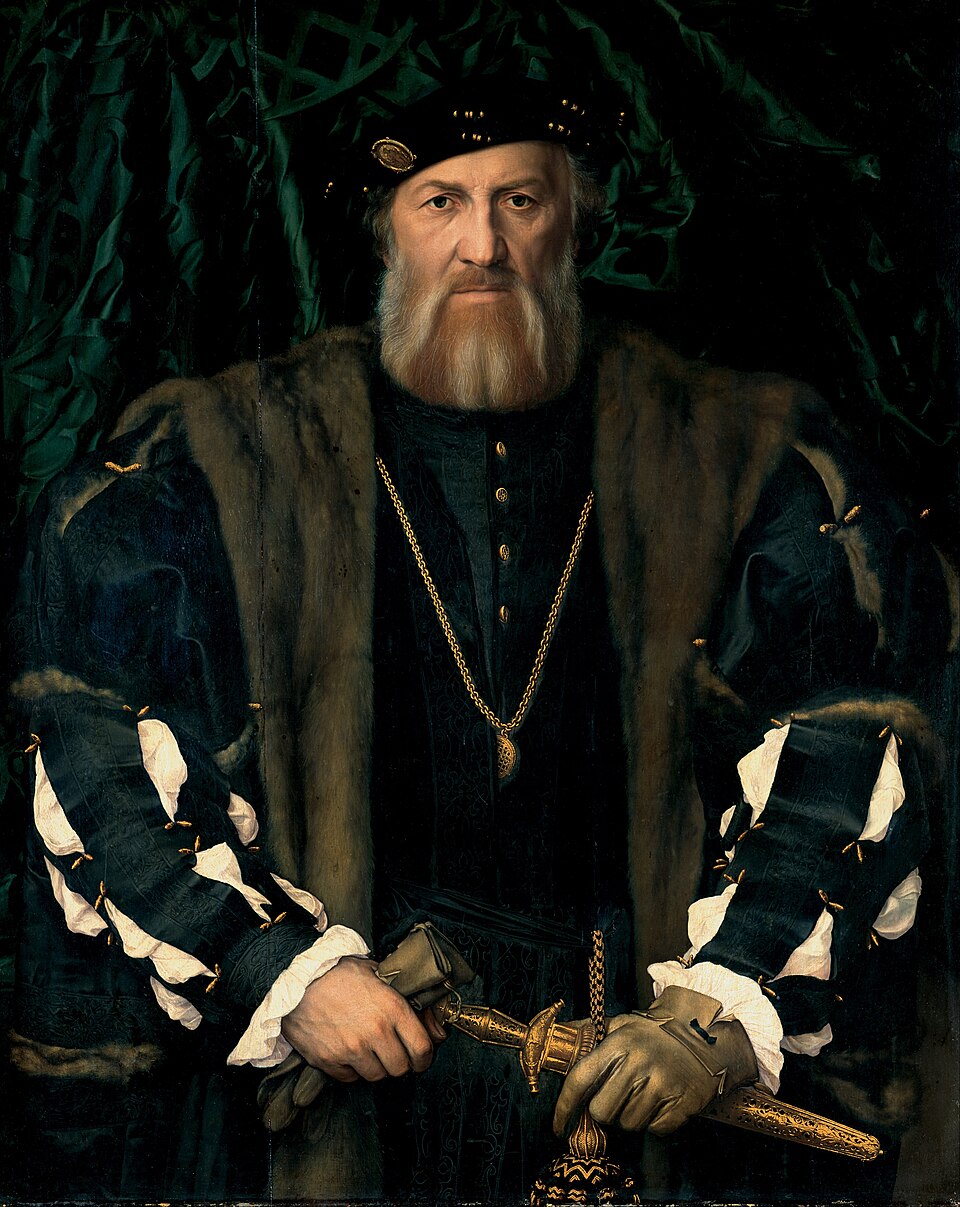
A French ambassador in black satin and fur stands life-size before a sea-green curtain, one hand on his dagger. For centuries nobody knew who he was, and Dresden even believed the picture was a Leonardo.
The story behind the painting
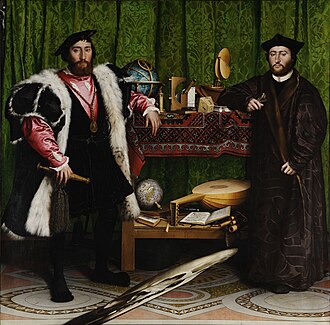
Charles de Solier, Sieur de Morette, was Francis I's ambassador to England. He replaced Jean de Dinteville, one of the men in Holbein's The Ambassadors, arriving in London on 3 April 1534 and staying until 26 July 1535, and the portrait was commissioned during that stay. Holbein painted it in oil on oak around 1534 to 1535; Wikidata simply gives the 1530s. A preliminary drawing of the head is in the Kupferstich-Kabinett in Dresden. The Earl of Arundel later tried in vain to buy the painting.
What to look for
The composition is remarkably simple. He stands half-length and life-size, facing us, before a curtain of sea-green damask. His black satin doublet has sleeves slashed with white silk and gold buttons with a motif of two M's; his surcoat has a heavy fur collar. His cap badge shows John the Baptist and the words DOCE ME FACERE VOLVNTATEM. His right hand holds a glove, his gloved left grasps the chased gilt sheath of a dagger hanging from a chain with a big tassel, like the one Dinteville wears. His long reddish beard is streaked with grey.
Meaning and intent
Art historian Susan Foister called it one of the greatest of all Holbein's individual portraits. The pose, the glove and the half-hidden medallion recall Titian's Man with a Glove in the Louvre. Franny Moyle finds the figure unquestionably regal and sees the portrait as a prototype for Holbein's next cycle of work, his portraits of Henry VIII. The power comes from restraint: one man, one colour behind him, and every texture, satin, fur, gold, rendered with full attention.
Legacy
Over time the sitter's name was lost, then the artist's too. The painting passed to Duke Francesco I of Modena, and in 1746 Francesco III sold it to Augustus III, King of Poland and Elector of Saxony, as a portrait of Ludovico Sforza by Leonardo da Vinci. In the 19th century Carl Friedrich von Rumohr recognised Holbein's hand, and the sitter was first misidentified as the goldsmith Hubert Morett. In 1881 Sophus Larpent showed he was the French diplomat, and a boxwood medallion model by Christoph Weiditz, found in 1903, gave conclusive proof. It hangs in the Gemäldegalerie Alte Meister, Dresden.
¿Sabías que…?
- Painted around 1534-1535 while de Solier was ambassador in London.
- Once sold as a Leonardo portrait of Ludovico Sforza.
- Identity confirmed by a medallion model found in 1903.
- In the Gemäldegalerie Alte Meister, Dresden.
Sobre el artista
Hans Holbein the Younger (1497-1543)
retrato · Staatliche Kunstsammlungen Dresden
Más obras de Hans Holbein the Younger
 Los embajadores - Hans Holbein the Younger (1533)
 El cuerpo de Cristo en la tumba - Hans Holbein the Younger (1520s)
 Retrato de Cristina de Dinamarca - Hans Holbein the Younger (1538)
 Retrato del mercader Gisze - Hans Holbein the Younger (1532)
 Una alegoría del Antiguo y Nuevo Testamento - Hans Holbein the Younger (1530)
01.jpg) Retrato de Thomas Cromwell - Hans Holbein the Younger (1530s)
Retrato de Thomas Cromwell - Hans Holbein the Younger (1530s) Retrato de la esposa del artista con sus dos hijos - Hans Holbein the Younger (1528)
 Portrait of a Young Merchant - Hans Holbein the Younger (1541)
Obras de artistas relacionados
 El entierro del Conde de Orgaz - El Greco (1586)
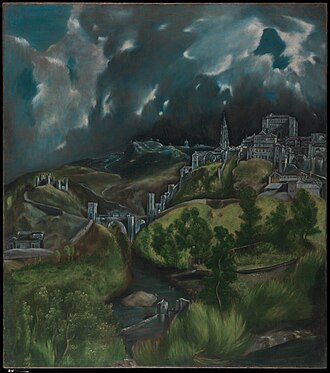 Vista de Toledo - El Greco (1596)
.jpg) Venus de Urbino - Titian (1538)
Venus de Urbino - Titian (1538)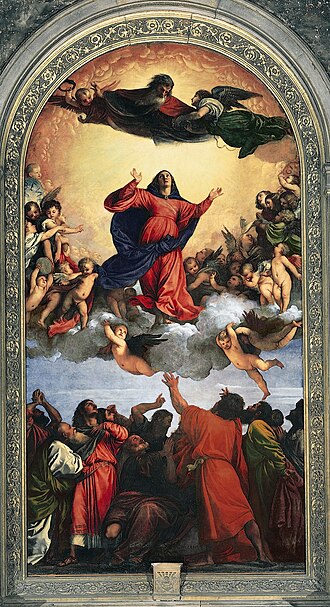 La Asunción de la Virgen - Titian (1510s)
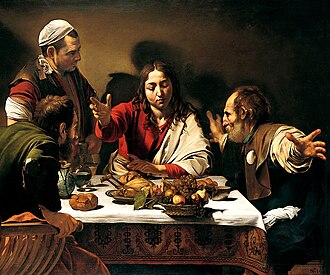 La cena de Emaús - Caravaggio (1601)
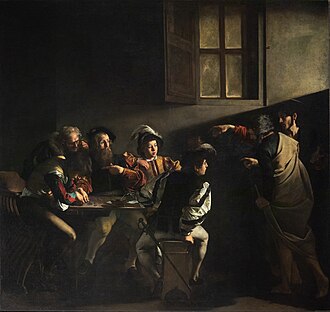 La vocación de San Mateo - Caravaggio (1609)