Una alegoría del Antiguo y Nuevo Testamento
Hans Holbein the Younger · 1530
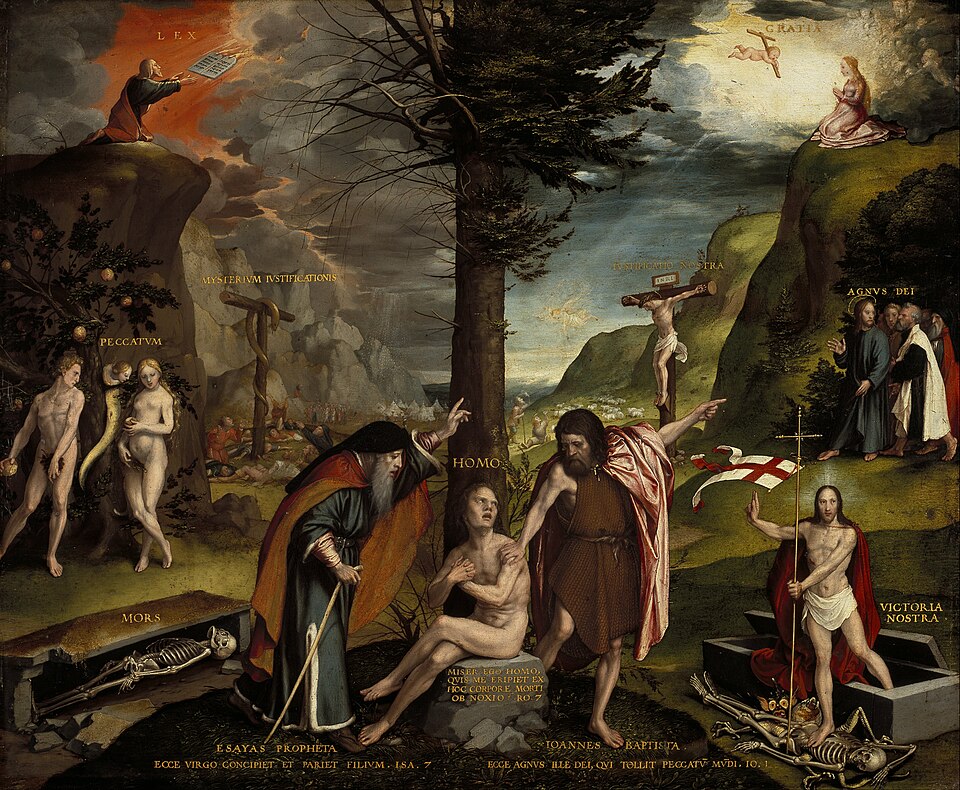
A man sits beneath a tree that is dead on one side and alive on the other, while two prophets point him toward Christ. Holbein turned the whole Bible into one small panel you can read like a page.
The story behind the painting
Holbein painted this oil on panel as an allegory of the whole Bible. Wikipedia dates it between 1532 and 1536, while Wikidata gives 1530. It draws on Lucas Cranach the Elder, especially his versions of Law and Grace in Prague and Gotha, both made in 1529 and both shaped by Martin Luther's teaching on justification by faith. Cranach's busy workshop and woodcut pamphlets spread those images quickly; copies even appeared as the frontispiece of the Luther Bible in 1541 and 1545. Holbein's panel continues and refines these themes.
What to look for
A tree divides the picture. At its foot sits Man, labelled HOMO, spoken to by Isaiah on the left and John the Baptist, both pointing to Christ, with their scripture passages written below. The leaves on the Old Testament side are withered; those facing the New are full of life. On the left, Adam and Eve's fall (PECCATUM) stands above a skeleton in a tomb (MORS), and Moses receives the law (LEX) on Mount Sinai. On the right are the Annunciation (GRATIA), the shepherds, the Lamb of God, the Crucifixion, and Christ trampling a skeleton as he leaves the tomb.
Meaning and intent
The two halves follow a Protestant reading of the Bible: the Old Testament as a time of sin and punishment, the New as the way to salvation. The panel can be read column by column, from the law given to Moses down through temptation to death, and on the right from grace down to resurrection. It can also be read across, each scene answering its partner: grace answers law, the Crucifixion answers the brazen serpent, the Lamb of God takes away sin, and the resurrection, labelled VICTORIA NOSTRA, our victory, overcomes death.
Legacy
The Latin labels make the painting work almost like a diagram of belief, yet it stays a picture of one seated man between despair and hope, turning his head between two voices. Cranach's images of Law and Grace had already become representative of Lutheran doctrine, appearing on pulpits and as architectural decoration, and Holbein's version gathers that tradition into a compact, carefully balanced design. In 1981 the painting was acquired by the Scottish National Gallery in Edinburgh, where it belongs to National Galleries Scotland.
¿Sabías que…?
- Inspired by Lucas Cranach the Elder's Law and Grace.
- Dated 1532-1536 by Wikipedia, 1530 by Wikidata.
- Latin labels name each scene, from LEX to VICTORIA NOSTRA.
- Acquired by the Scottish National Gallery in 1981.
Sobre el artista
Hans Holbein the Younger (1497-1543)
arte religioso · Galerías nacionales de Escocia
Más obras de Hans Holbein the Younger
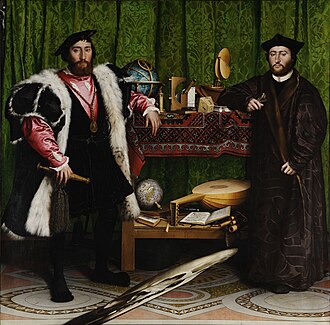 Los embajadores - Hans Holbein the Younger (1533)
 El cuerpo de Cristo en la tumba - Hans Holbein the Younger (1520s)
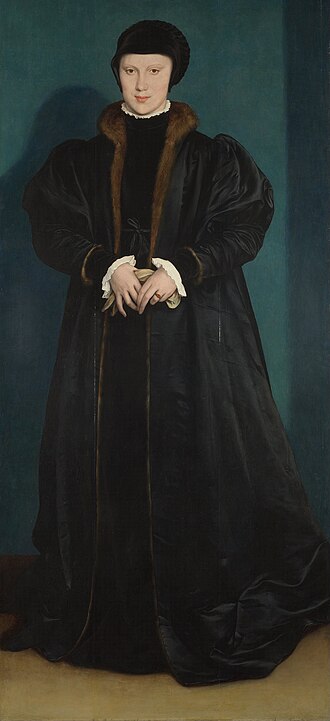 Retrato de Cristina de Dinamarca - Hans Holbein the Younger (1538)
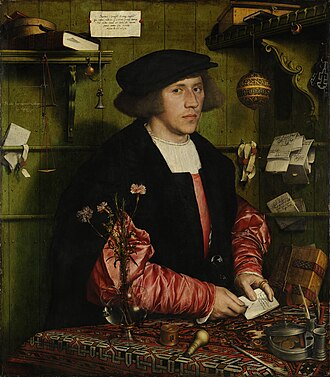 Retrato del mercader Gisze - Hans Holbein the Younger (1532)
01.jpg) Retrato de Thomas Cromwell - Hans Holbein the Younger (1530s)
Retrato de Thomas Cromwell - Hans Holbein the Younger (1530s)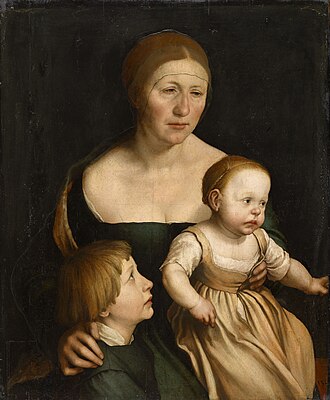 Retrato de la esposa del artista con sus dos hijos - Hans Holbein the Younger (1528)
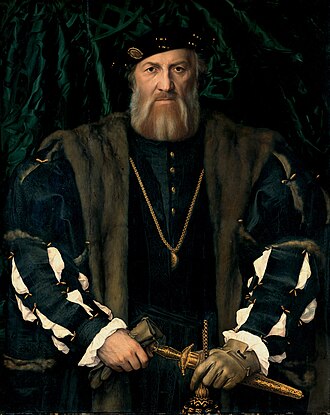 Charles de Solier, conde de Morette - Hans Holbein the Younger (1530s)
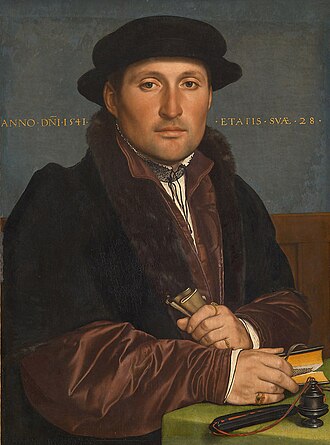 Portrait of a Young Merchant - Hans Holbein the Younger (1541)
Obras de artistas relacionados
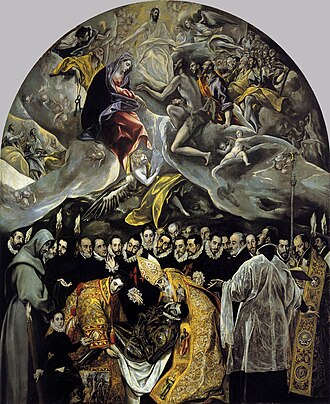 El entierro del Conde de Orgaz - El Greco (1586)
 Vista de Toledo - El Greco (1596)
.jpg) Venus de Urbino - Titian (1538)
Venus de Urbino - Titian (1538) La Asunción de la Virgen - Titian (1510s)
 La cena de Emaús - Caravaggio (1601)
 La vocación de San Mateo - Caravaggio (1609)