Judith and Maidservant with Head of Holofernes
Artemisia Gentileschi · 1620s
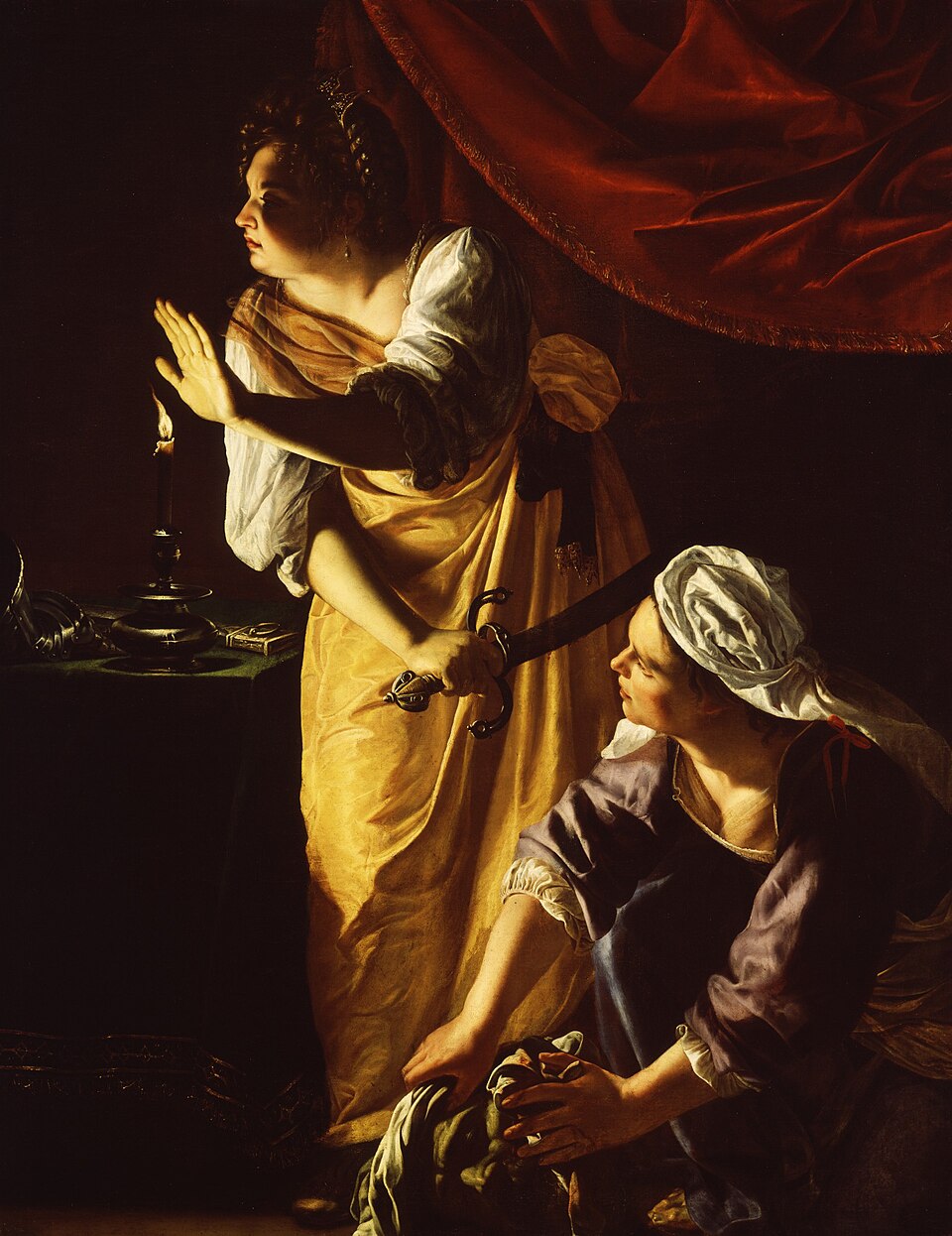
A single candle, a raised hand shading its glow, and a maidservant wrapping a severed head in cloth. This dark, glowing canvas in Detroit is often called Artemisia Gentileschi's finest work.
The story behind the painting
Artemisia painted the biblical story of Judith and Holofernes many times, and this version, made around 1623 to 1625, is one of four showing Judith and her maidservant. The others are in Naples, Florence and Cannes. In the Book of Judith, the widow goes with her maid Abra to a feast given by the Assyrian general besieging her city, waits until he falls asleep drunk, and beheads him. The exact date is debated because Artemisia was travelling around Italy at the time, but most scholars place it in the mid-1620s.
What to look for
Here Abra kneels to wrap the head in a bag while Judith keeps watch, a hand raised against the candle, her face half in light. The shadow on her face looks like a crescent moon, a symbol of Artemis that the artist often linked to her heroines. Her golden dress glows against a deep crimson curtain, colours more vivid than Caravaggio's, whose dark shadows she followed. Judith holds a weapon ready and wears armour-like clothing and heavy shoes, not the sandals biblical women usually wear. Scholars compare the single-candle lighting and the drapery to Adam Elsheimer's Judith.
Meaning and intent
Mary Garrard links the careful realism to Caravaggio's influence, and Jesse Locker sees in this canvas the drama of Baroque art at its purest. Elizabeth Cropper suggests Artemisia gave her heroines a heroic, tragic light while justifying their acts. Many writers connect the force of her Judiths to her rape by Agostino Tassi and the trial that followed, and the painting is often read as an endorsement of female strength. Judith's warrior dress shifts power away from the seductive body towards decisive action.
Legacy
The 2001 exhibition catalogue on Artemisia and her father Orazio called it generally recognised as her finest work, and Letizia Treves wrote that with it she rightly takes her place among the leading artists of the Italian Baroque. Its history before 1952 is unknown; that year it was held by Prince Brancaccio and co-owned by Alessandro Morandotti and Adolph Loewi, then bought by Leslie H. Green and given to the Detroit Institute of Arts. The painting and frame were cleaned and restored in 2020 to 2021.
Did you know?
- One of four Artemisia paintings of Judith and her maidservant.
- Painted around 1623 to 1625, the date is debated.
- Often called her finest work.
- Given to the Detroit Institute of Arts in 1952.
About the artist
Artemisia Gentileschi (1593-1653)
religious art · Judith · Detroit Institute of Arts
More by Artemisia Gentileschi
 Judith Slaying Holofernes - Artemisia Gentileschi (1613)
 Judith and Her Maidservant - Artemisia Gentileschi (1618)
 Susanna and the Elders - Artemisia Gentileschi (1610)
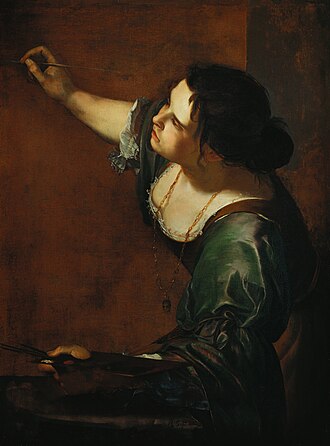 Self-Portrait as the Allegory of Painting - Artemisia Gentileschi (1638)
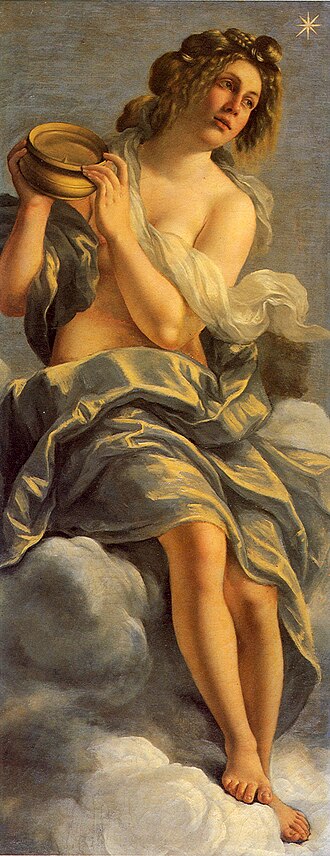 Allegory of Inclination - Artemisia Gentileschi (1615)
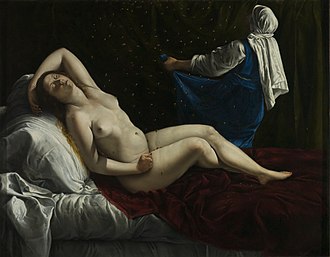 Danaë - Artemisia Gentileschi (1612)
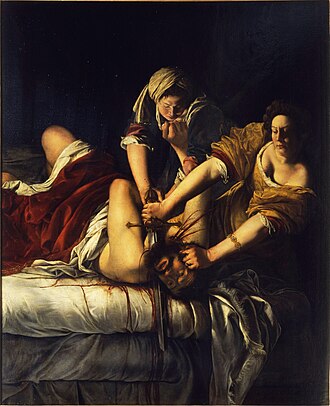 Judith Beheading Holofernes - Artemisia Gentileschi (1620)
 Esther before Ahasuerus - Artemisia Gentileschi (1620s)
Paintings by related artists
 Supper at Emmaus - Caravaggio (1601)
 The Calling of Saint Matthew - Caravaggio (1609)
 Las Meninas - Diego Velázquez (1656)
 The Surrender of Brea - Diego Velázquez (1635)
 Saint Francis in Meditation - Francisco de Zurbarán (1639)
 The Immaculate Conception - Francisco de Zurbarán (1661)
 Charles I in Three Positions - Anthony van Dyck (1635)
 Charles I (1600-1649) with M. de St Antoine - Anthony van Dyck (1636)
 The Elevation of the Cross - Peter Paul Rubens (1609)
 The Rape of the Daughters of Leucippus - Peter Paul Rubens (1618)
 The Night Watch - Rembrandt van Rijn (1642)
 Self-Portrait - Rembrandt van Rijn (1659)