Paul Cézanne
1839-1906
Paul Cézanne was mocked by the critics and rejected by the Salon year after year. Building his pictures from patient planes of colour, the banker's son from Aix became the bridge to modern art, the painter Matisse and Picasso are said to have called the father of us all.
Origins
Cézanne was born on 19 January 1839 in Aix-en-Provence, the son of Louis-Auguste Cézanne, a milliner who became a banker, and Anne-Elisabeth-Honorine Aubert. His father's bank prospered throughout the painter's life, giving him a financial security few of his contemporaries had. His mother was described as vivacious and romantic, but quick to take offence, and from her he took his vision of life. He had two younger sisters, Marie and Rose. At the Collège Bourbon in Aix he became friends with Émile Zola and Baptistin Baille, known as the Three Inseparables. They swam and fished on the banks of the Arc, read Homer and Virgil and wrote poems, Cézanne often in Latin. In 1857 he began studying drawing at the free municipal school in Aix.
Life and turning points
His authoritarian father wanted an heir for his bank, so in 1859 Cézanne enrolled in law at Aix, but he neglected his studies for drawing and poetry. Urged by Zola, he left for Paris in 1861, where the École des Beaux-Arts turned him down. At the Académie Suisse he met Camille Pissarro. Discouraged, he went home and worked in his father's bank, then returned to Paris in 1862. The Salon rejected his work every year from 1864 to 1869. In 1869 he met Hortense Fiquet; their son Paul was born in 1872, though his father was not told of her for years. He worked beside Pissarro in Pontoise and lived in Auvers-sur-Oise. In 1895 Ambroise Vollard gave him his first solo exhibition. He died on 22 October 1906.
Style and technique
Cézanne's early works were influenced by Romanticism and Realism, but through intense examination of Impressionism he arrived at a new pictorial language. He altered conventional approaches to perspective and broke the rules of academic art by emphasising the underlying structure of objects and the formal qualities of painting. His repetitive, exploratory brushstrokes are highly recognisable: he used planes of colour and small strokes that build up into complex fields, conveying his intense study of each subject. Pissarro persuaded him to turn away from darker colours, to paint with the primary colours and their close relatives, and to define shapes through gradations of tone rather than outlines. Pissarro later said that they were always together, yet each kept what counts alone: his own feelings.
Stories and anecdotes
In 1860 Cézanne painted murals of the four seasons on the walls of the drawing room at the Jas de Bouffan, his father's estate, and signed them ironically as Ingres, a painter he did not admire. He painted a portrait of Zola at his friend's request, was unhappy with it and destroyed it. In 1882 his friend Antoine Guillemet, a Salon juror, passed him off as his student to get a painting accepted; it was hung in a poorly lit spot on the top row and received no attention, his first and last success at the Salon. In 2022 a conservator at the Cincinnati Art Museum noticed odd cracking in his 1865 Still Life with Bread and Eggs, and an X-ray revealed a hidden portrait, possibly a self-portrait.
Legacy
Cézanne's paintings at first provoked incomprehension and ridicule. Until the late 1890s, it was mainly fellow artists such as Pissarro, and the dealer Ambroise Vollard, who discovered his work and became some of his first buyers. Vollard's exhibition in Paris in 1895 led to a broader look at what he had done. Today he is seen as the bridge between late 19th-century Impressionism and early 20th-century Cubism, and his work influenced the avant-garde movements of the new century. Both Henri Matisse and Pablo Picasso are said to have remarked that Cézanne is the father of us all. His stubborn, solitary search, stroke by stroke, for the structure beneath what he saw changed the way painters look at the world.
Did you know?
- Zola's debut novel La Confession de Claude was dedicated to Cézanne and Baille.
- Cézanne was best man at Zola's wedding on 31 May 1870.
- He met Paul Gachet, later Van Gogh's doctor, who lent him his studio in Auvers.
- His murals of the four seasons are today in the Petit Palais in Paris.
Proto-Cubism · Post-impressionism · Impressionism
Related artists
Vincent van Gogh · Claude Monet · Édouard Manet · Pierre-Auguste Renoir · Edgar Degas · J. M. W. Turner · Paul Gauguin
Paintings by Paul Cézanne
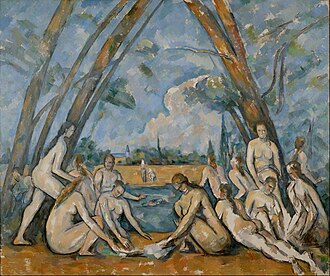 Les Grandes Baigneuses - Paul Cézanne (1900s)
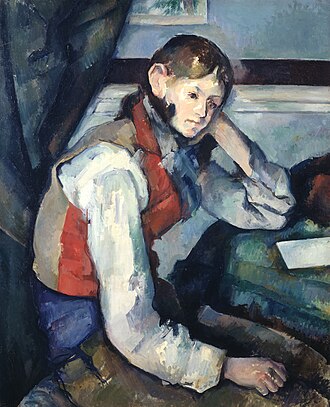 The Boy in the Red Vest - Paul Cézanne
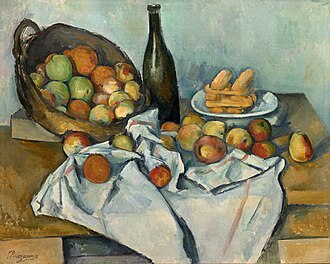 The Basket of Apples - Paul Cézanne (1893)
%201893-94%20FWN%20854.jpg) Rideau, Cruchon et Compotier - Paul Cézanne (1890s)
Rideau, Cruchon et Compotier - Paul Cézanne (1890s)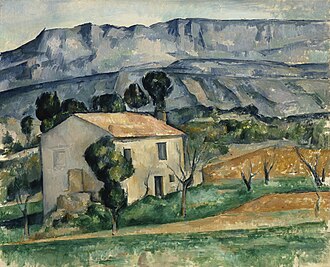 Maison devant la Sainte-Victoire près de Gardanne - Paul Cézanne (1880s)
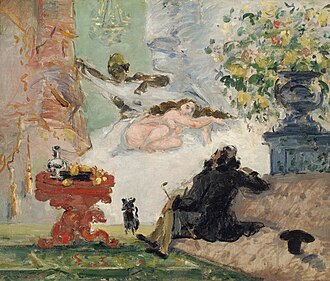 A Modern Olympia - Paul Cézanne (1873)
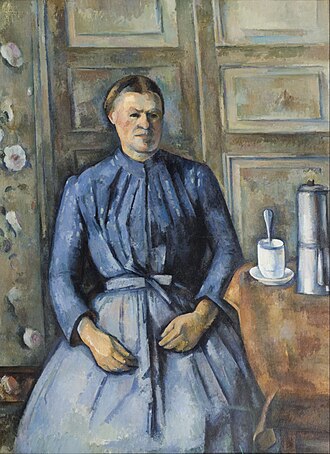 La Femme à la cafetière - Paul Cézanne (1895)
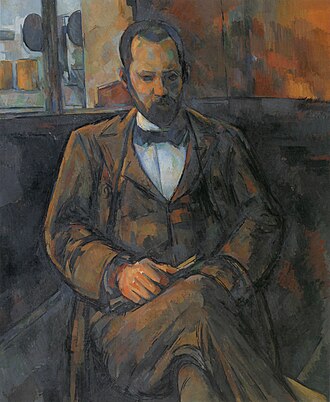 Portrait of Ambroise Vollard - Paul Cézanne (1899)
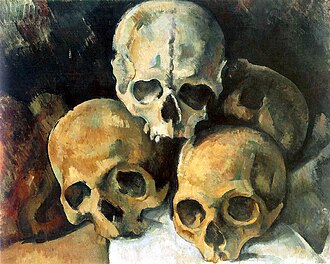 Pyramid of Skulls - Paul Cézanne (1899)
.jpg) Mont Sainte-Victoire and the Viaduct of the Arc River Valley - Paul Cézanne (1880s)
Mont Sainte-Victoire and the Viaduct of the Arc River Valley - Paul Cézanne (1880s)