Joaquín Sorolla
1863-1923
Joaquín Sorolla, orphaned as a toddler in Valencia, grew up to become the painter of Spanish sunlight: beaches, sea and people glowing under a bright Mediterranean sky.
Origins
Joaquín Sorolla y Bastida was born in Valencia on 27 February 1863, the eldest child of a tradesman, also named Joaquín Sorolla, and his wife Concepción Bastida. His sister Concha was born a year later. In August 1865 both children lost their parents, possibly to cholera, and were raised by their maternal aunt and her husband, a locksmith. Sorolla began his art education at nine in Valencia, studying with a series of teachers including Cayetano Capuz and Salustiano Asenjo. At eighteen he went to Madrid and studied the old masters in the Prado with great energy.
Life and turning points
After military service, a grant at twenty two let him study in Rome, and a long stay in Paris in 1885 gave him his first taste of modern painting, notably Jules Bastien-Lepage and Adolph von Menzel. In 1888 he married Clotilde García del Castillo, whom he had met in her father's studio; they had three children. Another Marguerite won a gold medal in Madrid in 1892, and Sad Inheritance brought the Grand Prix at the Paris Universal Exhibition of 1900. A 1906 show in Paris of nearly 500 works was a triumph, and in 1909 he exhibited 356 paintings in New York. He suffered a stroke in 1920 and died on 10 August 1923.
Style and technique
Sorolla excelled at portraits, landscapes and monumental works on social and historical themes, but his most typical pictures capture people and landscape under bright Spanish sun and shimmering water. The oil sketches for Sad Inheritance, painted with great luminosity and bravura, foretold his growing love of shimmering light and deft handling. He preferred outdoor settings even for portraits: his daughter in María at La Granja and King Alfonso XIII both posed in sun dappled landscapes. In My Wife and Daughters in the Garden, traditional portraiture gives way to thick passages of colour. His Portrait of Dr. Simarro at the microscope contrasts the reddish light of a gas burner with weak afternoon light from a window.
Stories and anecdotes
Sorolla thought so well of his sketches for Sad Inheritance that he gave two of them away, one to John Singer Sargent and one to William Merritt Chase. After that painting he never returned to such an openly social theme. In My Family he paid homage to Velázquez, showing himself at work in a distant mirror, as in Las Meninas. His greatest commission, The Provinces of Spain for the Hispanic Society of America in New York, consists of 14 murals totalling 227 feet. Despite their size, he painted all but one in the open air, travelling to each region with models in local costume, and by 1917 admitted he was exhausted.
Legacy
Sorolla became the acknowledged head of the modern Spanish school in his lifetime. Painters he influenced, such as Alberto Pla y Rubio and Julio Romero de Torres, are called sorollista. After his death his widow left many of his paintings to the Spanish public, and they formed the Museo Sorolla, in the artist's own house in Madrid, which opened in 1932. The Sorolla Room in New York has shown his Provinces of Spain since 1926. Major exhibitions followed in Paris, Madrid, Dallas, Munich, London and Milan, and the high speed railway station in Valencia bears his name, a fitting tribute to the painter of light.
Did you know?
- He was elected a member of the Académie des Beaux-Arts in Paris.
- In 1933 J. Paul Getty bought ten of his beach scenes.
- He painted a portrait of President Taft at the White House.
- He was paralysed for over four years before his death.
Post-impressionism · Impressionism
Related artists
Claude Monet · Édouard Manet · Pierre-Auguste Renoir · Edgar Degas · Camille Pissarro · Gustave Caillebotte · Vincent van Gogh · J. M. W. Turner
Paintings by Joaquín Sorolla
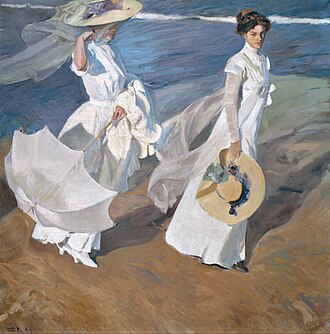 Walk on the mountain - Joaquín Sorolla (1909)
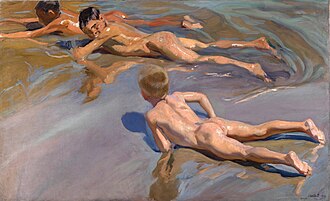 Chicos en la playa - Joaquín Sorolla (1910)
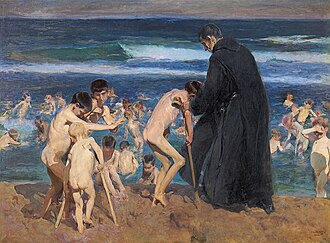 Sad Inheritance - Joaquín Sorolla (1898)
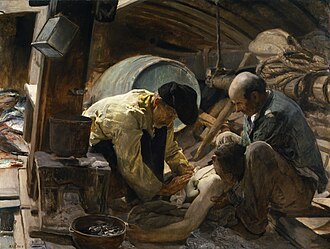 And They Still Say Fish is Expensive! - Joaquín Sorolla (1894)
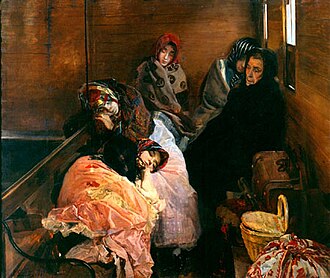 White slave trade - Joaquín Sorolla (1894)
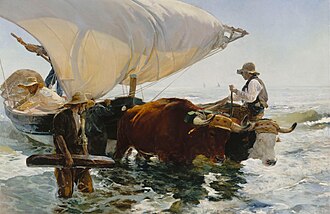 The Return from Fishing - Joaquín Sorolla (1894)
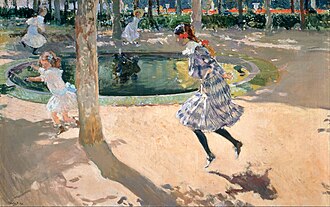 The Skipping Rope - Joaquín Sorolla (1911)
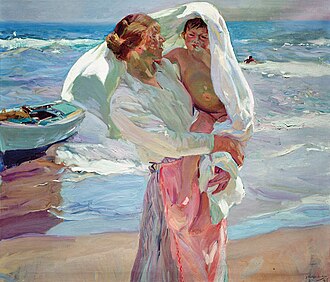 After Bathing - Joaquín Sorolla (1915)
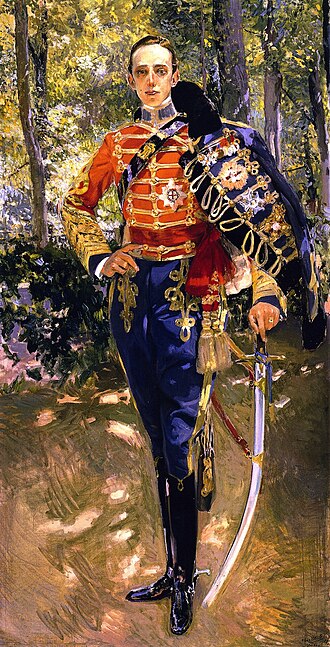 Portrait of King Alfonso XIII in a Hussar's Uniform - Joaquín Sorolla (1917)
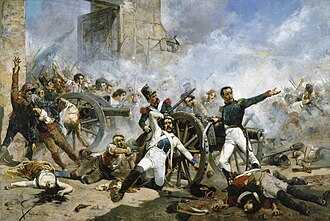 The death of Pedro Velarde y Santillán during the defence of the Monteleon Artillery Barracks. - Joaquín Sorolla (1886)