Nature morte aux cerises
Paul Cézanne · 1890
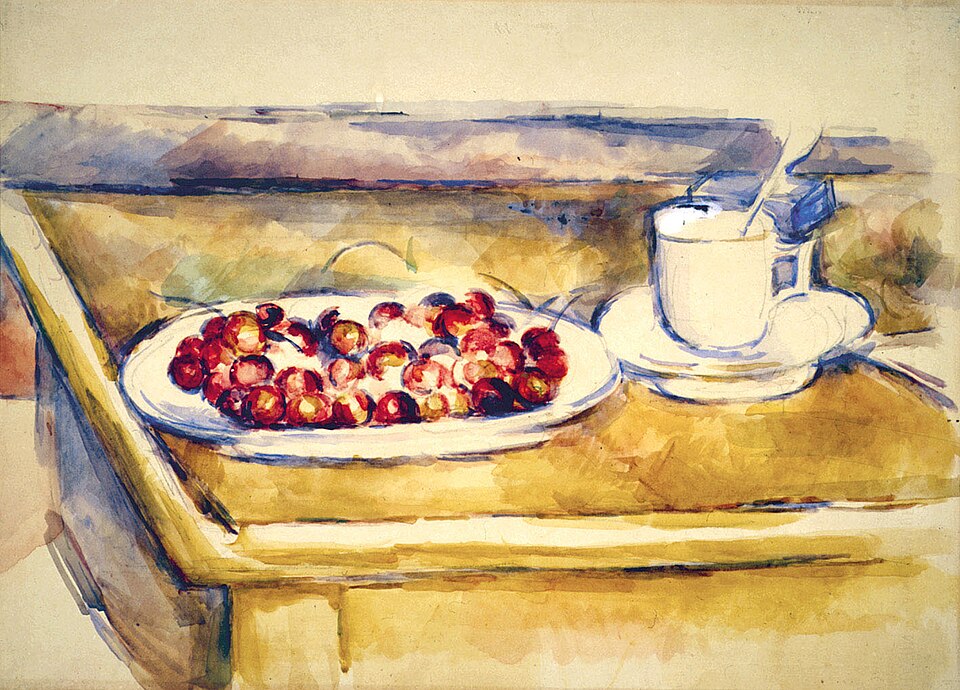
A plate of cherries and a blue and white cup on an ochre table, in watercolour and pencil. This small Cezanne is one of the rare works by him in an Italian collection, and in March 2026 it was stolen in under three minutes.
The story behind the painting
Cezanne made this still life around 1890, in watercolour heightened with pencil on white paper. It was acquired by the collector and musicologist Luigi Magnani for his private collection, before his villa near Parma opened to the public in 1990. The work matters in Italy because the country's national museums hold so little by Cezanne. Early in the twentieth century the collector Paolo Egisto Fabbri owned around thirty of his canvases, but that collection was dispersed in the 1920s without any intervention by the Italian State.
What to look for
The composition is spare: everyday objects set on an ochre table, a plate of cherries and a ceramic cup in white and blue. The watercolour balances warm and cool tones, and Cezanne leaves parts of the white paper bare so that it reads as light and space. Look at the contours: vibrant and broken, they build the forms without locking them in, and they give the small sheet a sense of depth. The volumes are simplified into geometry, giving the cup and fruit a firm, structural weight.
Meaning and intent
Here Cezanne moves away from the domestic tradition of still life toward something purely aesthetic. According to the art historian Meyer Schapiro, the objects are not arranged for their use but organised by a rigorous method of construction that masters the apparent disorder. Through the geometric synthesis of volumes, Cezanne tries to set down his coloured sensations and give the objects structural solidity. Modern critics see a cerebral work that goes beyond Impressionism, a kind of laboratory in which the artist tries to grasp the world through its primary elements.
Legacy
The watercolour is kept at the Magnani-Rocca Foundation in Mamiano di Traversetolo, near Parma, and is considered a key piece for the study of Post-Impressionism in Italy, alongside works at the GNAM in Rome and the GAM in Milan. On the night of 22 to 23 March 2026, four masked people stole it from the foundation in less than three minutes, together with Matisse's Odalisque on the Terrace and Renoir's The Fish, and escaped through the park. All three works were later recovered.
Did you know?
- Watercolour heightened with pencil on white paper, around 1890.
- One of the rare works by Cezanne in an Italian collection.
- Stolen with a Matisse and a Renoir on 22-23 March 2026, then recovered.
- Kept at the Magnani-Rocca Foundation near Parma.
About the artist
Paul Cézanne (1839-1906)
still life · Fondazione Magnani-Rocca
More by Paul Cézanne
 Les Grandes Baigneuses - Paul Cézanne (1900s)
 The Boy in the Red Vest - Paul Cézanne
 The Basket of Apples - Paul Cézanne (1893)
 Rideau, Cruchon et Compotier - Paul Cézanne (1890s)
 Maison devant la Sainte-Victoire près de Gardanne - Paul Cézanne (1880s)
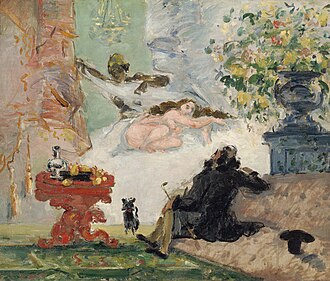 A Modern Olympia - Paul Cézanne (1873)
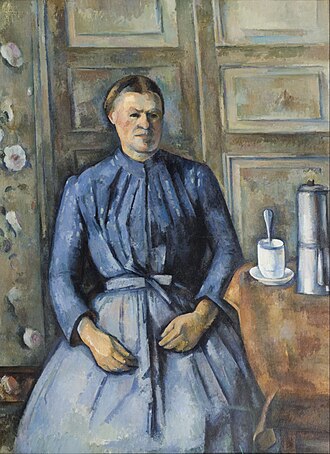 La Femme à la cafetière - Paul Cézanne (1895)
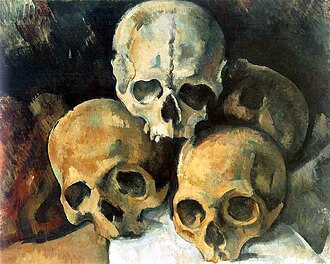 Pyramid of Skulls - Paul Cézanne (1899)
Paintings by related artists
 The Starry Night - Vincent van Gogh (1889)
 Café Terrace at Night - Vincent van Gogh (1888)
 Where Do We Come From? What Are We? Where Are We Going? - Paul Gauguin (1897-1898)
 The Yellow Christ - Paul Gauguin (1889)
 Walk on the mountain - Joaquín Sorolla (1909)
 Sad Inheritance - Joaquín Sorolla (1898)
 Dance at Le Moulin de la Galette - Pierre-Auguste Renoir (1876)
 Luncheon of the Boating Party - Pierre-Auguste Renoir (1881)
 At the Moulin Rouge - Henri de Toulouse-Lautrec (1892)
 La Toilette - Henri de Toulouse-Lautrec (1896)