Le Meurtre
Paul Cézanne · 1870
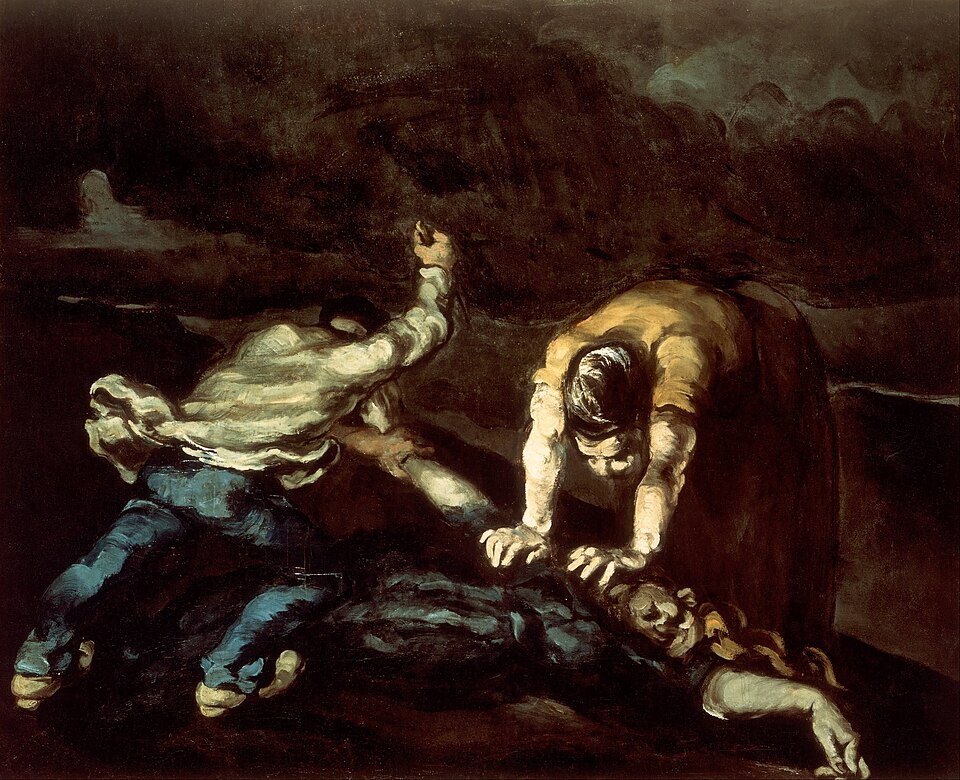
Two figures pin a woman down beside dark, churning water. Long before his apples and mountains, the young Cézanne painted this nightmare.
The story behind the painting
The Murder belongs to Cézanne's early period, when he often painted dramatic, erotic or violent subjects, very different from the landscapes and still lifes that later made him famous. It was made between 1867 and 1870; Wikidata gives 1870, the end of that range. It has been linked to his youthful taste for Romantic literature and to the violent themes in the novels of his childhood friend Émile Zola. It is a youthful work.
What to look for
On a canvas about 64 by 81 cm, two assailants attack a woman beside a turbulent body of water: one holds her down while the other seems to prepare the fatal blow. The figures are packed into a compressed, unstable composition. Cézanne laid the paint on in broad, forceful strokes, some with a palette knife, with dark colours and dramatic light. Nothing in the picture is calm; even the water seems to take part in the struggle.
Meaning and intent
No literary source for the scene has been established. Rather than a real event, it is usually read as an imagined act of violence meant to convey emotional and physical intensity. The agitated surface and sombre colours make the brutality felt, and the nightmarish mood has been compared with the violent, unsettling images of Francisco Goya. The painting asks the viewer to feel the violence rather than to follow a plot.
Legacy
The Walker Art Gallery in Liverpool acquired the painting in 1964 with help from the Art Fund, and it remains there. It shows a side of Cézanne many visitors never expect, the turbulent young painter before the calm order of his later work. Painted between 1867 and 1870, it is a reminder that the dramatic, erotic and violent subjects of his early years came before the landscapes and still lifes for which he became best known.
Did you know?
- Painted between 1867 and 1870.
- From Cézanne's early period of violent subjects.
- Compared with the work of Goya.
- Acquired by the Walker Art Gallery, Liverpool, in 1964.
About the artist
Paul Cézanne (1839-1906)
More by Paul Cézanne
 Les Grandes Baigneuses - Paul Cézanne (1900s)
 The Boy in the Red Vest - Paul Cézanne
 The Basket of Apples - Paul Cézanne (1893)
 Rideau, Cruchon et Compotier - Paul Cézanne (1890s)
 Maison devant la Sainte-Victoire près de Gardanne - Paul Cézanne (1880s)
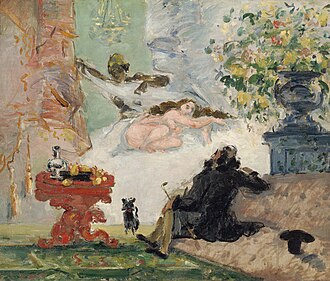 A Modern Olympia - Paul Cézanne (1873)
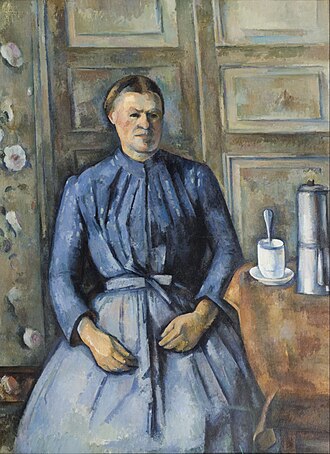 La Femme à la cafetière - Paul Cézanne (1895)
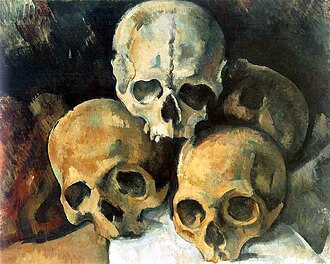 Pyramid of Skulls - Paul Cézanne (1899)
Paintings by related artists
 The Starry Night - Vincent van Gogh (1889)
 Café Terrace at Night - Vincent van Gogh (1888)
 Where Do We Come From? What Are We? Where Are We Going? - Paul Gauguin (1897-1898)
 The Yellow Christ - Paul Gauguin (1889)
 Walk on the mountain - Joaquín Sorolla (1909)
 Sad Inheritance - Joaquín Sorolla (1898)
 Dance at Le Moulin de la Galette - Pierre-Auguste Renoir (1876)
 Luncheon of the Boating Party - Pierre-Auguste Renoir (1881)
 At the Moulin Rouge - Henri de Toulouse-Lautrec (1892)
 La Toilette - Henri de Toulouse-Lautrec (1896)