View of Auvers-sur-Oise
Paul Cézanne · 1878
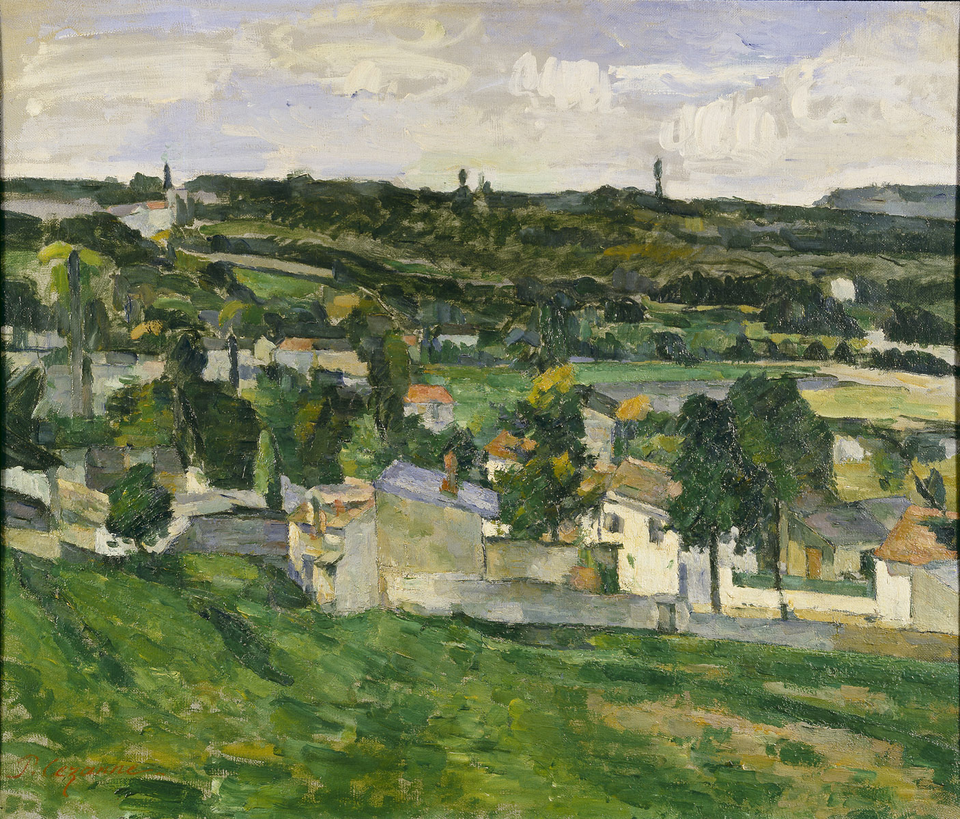
White houses, a church spire, a sky of smeared clouds. On the first minutes of the year 2000, while Oxford watched the fireworks, someone climbed through a skylight and cut this Cezanne from its frame. It has never been found.
The story behind the painting
View of Auvers-sur-Oise is the common English name; Cezanne's catalogue raisonne calls it Group of houses, landscape of the Ile-de-France. Wikipedia dates it 1879 to 1880, while Wikidata gives 1878. In 1872 Camille Pissarro, Cezanne's friend and mentor, settled in Pontoise; the next year Cezanne moved to neighbouring Auvers-sur-Oise, and the two often painted side by side outdoors. This canvas came later, when Cezanne was preparing to leave Paris for Aix-en-Provence. Despite the title, the exact place shown has never been identified. Victor Chocquet, a champion of Impressionism, bought it from the artist.
What to look for
The canvas is 46 by 55 cm. A rolling landscape lies beneath a blue sky whose clouds are simply smears of paint. Down a green slope from where you stand sit white houses with blue or orange roofs, not drawn in detail. Trees are scattered among them, mostly green, some with a yellowish tint. Beyond, another hillside of houses and trees rises to a church spire at its crest. Cezanne's signature is in red at lower left. A neighbour who watched him and Pissarro said Pissarro dabbed while Cezanne daubed or smeared the paint.
Meaning and intent
With Pissarro, Cezanne was trying to capture the perception of sensation; he began to use brighter colours with less stark contrasts. A 2006 Musee d'Orsay catalogue called the two Impressionism's painters of the earth, beside Monet and Sisley as painters of water, and noted that Cezanne openly invites us to watch how he builds surfaces, simplifying shapes and amplifying each stroke. Ashmolean director Christopher Brown saw the picture as key to his career, showing the move from early work towards the mature style of his later paintings.
Legacy
After Chocquet it passed to Thadee Natanson, then to the publisher Bruno Cassirer, who lent it to shows in Berlin, Zurich and Basel under different names. His daughter Sophie, whose family had moved to Oxford after Nazi persecution, kept it private; after her death in 1979 it was accepted in lieu of inheritance tax and given to the Ashmolean. At midnight on 31 December 1999 a thief climbed scaffolding, broke a skylight, dropped a smoke bomb, descended a rope ladder, cut the canvas out and left the frame smashed. It was the only painting taken, and it has not been recovered.
Did you know?
- Stolen from the Ashmolean Museum, Oxford, on the night of the millennium.
- The only painting taken, and never recovered.
- The exact landscape shown has never been identified.
- Dated 1879-1880 by Wikipedia, 1878 by Wikidata.
About the artist
Paul Cézanne (1839-1906)
landscape painting · Ashmolean Museum · Auvers-sur-Oise
More by Paul Cézanne
 Les Grandes Baigneuses - Paul Cézanne (1900s)
 The Boy in the Red Vest - Paul Cézanne
 The Basket of Apples - Paul Cézanne (1893)
 Rideau, Cruchon et Compotier - Paul Cézanne (1890s)
 Maison devant la Sainte-Victoire près de Gardanne - Paul Cézanne (1880s)
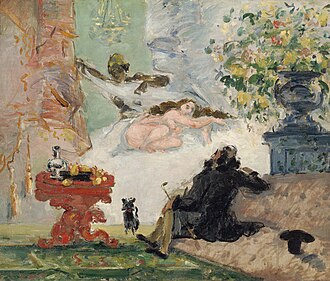 A Modern Olympia - Paul Cézanne (1873)
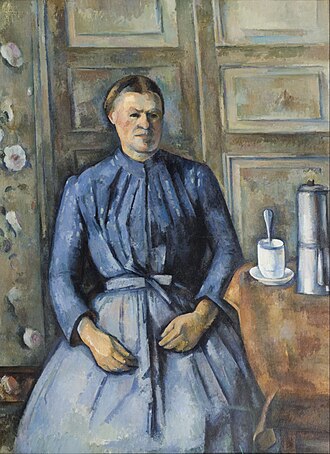 La Femme à la cafetière - Paul Cézanne (1895)
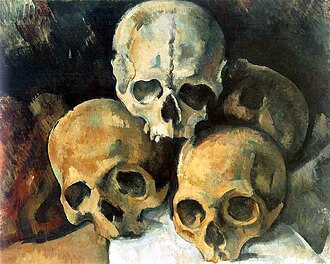 Pyramid of Skulls - Paul Cézanne (1899)
Paintings by related artists
 The Starry Night - Vincent van Gogh (1889)
 Café Terrace at Night - Vincent van Gogh (1888)
 Where Do We Come From? What Are We? Where Are We Going? - Paul Gauguin (1897-1898)
 The Yellow Christ - Paul Gauguin (1889)
 Walk on the mountain - Joaquín Sorolla (1909)
 Sad Inheritance - Joaquín Sorolla (1898)
 Dance at Le Moulin de la Galette - Pierre-Auguste Renoir (1876)
 Luncheon of the Boating Party - Pierre-Auguste Renoir (1881)
 At the Moulin Rouge - Henri de Toulouse-Lautrec (1892)
 La Toilette - Henri de Toulouse-Lautrec (1896)