Whalers
J. M. W. Turner · 1845
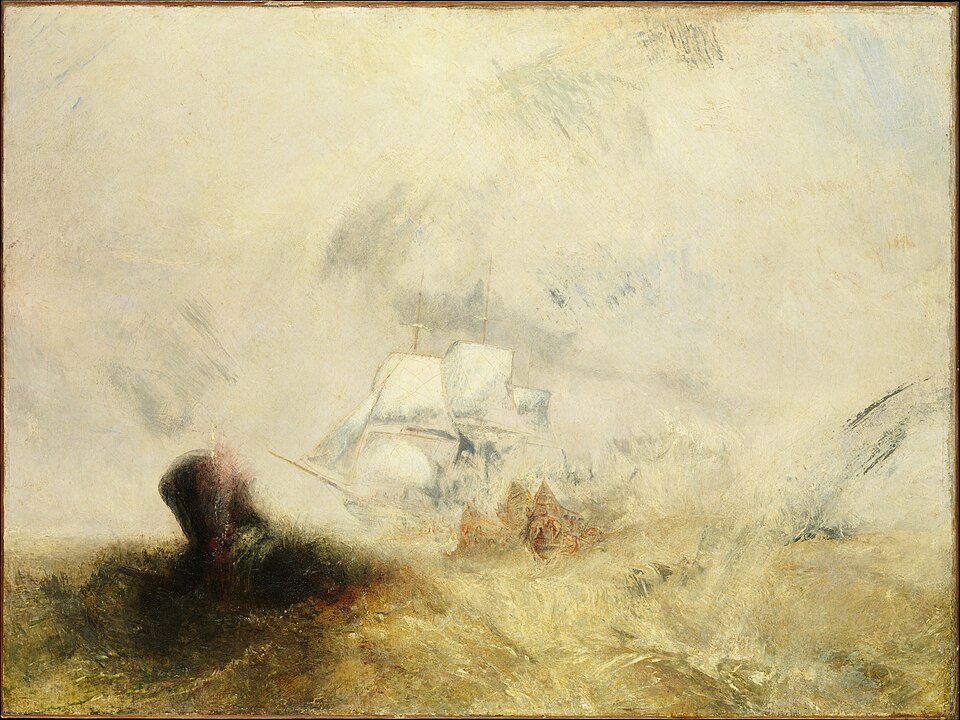
Out of a haze of foam and blood, the huge head of a wounded whale breaks the surface while a tiny boat is flung about beside it. Turner, near the end of his life, turned a hunt into a storm of paint.
The story behind the painting
Turner painted Whalers in 1845 in oil on canvas. He showed it at the Royal Academy Exhibition that year, together with a second, different painting of the same title. He hoped to sell both, along with two further whaling pictures shown in 1846, to the collector Elhanan Bicknell, a wealthy investor in the whaling business. In the end Bicknell bought only one of them. The other 1845 Whalers stayed with Turner, passed to the nation in the Turner Bequest of 1856 and is now in Tate Britain. The canvas described here, about 92 by 123 centimetres, is the one in the Metropolitan Museum of Art in New York.
What to look for
At first the picture seems to be all mist and spray. Give it time. On the left, the massive head of a wounded sperm whale breaks through the surface of the sea. To the right, its tail thrashes in the froth. In the centre foreground, a small boat is tossed by the churning water, its crew at the mercy of the animal. Far behind, almost dissolved into the light, rises a ghostly three-masted whaling ship. Turner paints the sea as foam stained with blood, so that water, air and violence blur together. Notice how little of anything is sharply drawn; the drama lives in colour and movement.
Meaning and intent
The subject is a hunt, and the painting does not hide its cost: the whale is wounded, the sea is red with its blood, and the men in the small boat are in danger too. The sources say little about Turner's own intentions beyond his hope of selling the work to Bicknell, whose fortune was tied to whaling. Yet the choice to show the struggle so closely, with the great animal looming over the fragile boat, lets the viewer feel both the power of nature and the peril of those who challenge it. Turner leaves the outcome uncertain, wrapped in spray.
Legacy
Whalers belongs to a small group of whaling pictures that Turner exhibited in 1845 and 1846. In 2016 it was the centrepiece of the exhibition Turner's Whaling Pictures at the Metropolitan Museum of Art, which brought this late theme of his work into focus. Seen today, the painting is a reminder of an industry that once shaped fortunes and of an artist who, in his last decade, was still experimenting boldly with how much a painting could dissolve and still tell its story. Standing before it, look for the whale's head first, then let the rest emerge from the mist.
Did you know?
- Turner exhibited two different paintings titled Whalers at the Royal Academy in 1845; the other is in Tate Britain.
- He hoped to sell the whaling pictures to the collector Elhanan Bicknell, who bought only one.
- It was the centrepiece of the Met's 2016 exhibition Turner's Whaling Pictures.
Metropolitan Museum of Art · boat · marine art
More by J. M. W. Turner
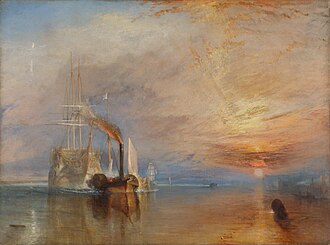 The Fighting Temeraire - J. M. W. Turner (1839)
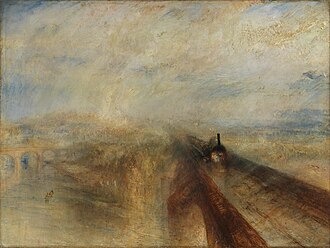 Rain, Steam and Speed - The Great Western Railway - J. M. W. Turner (1844)
Paintings by related artists
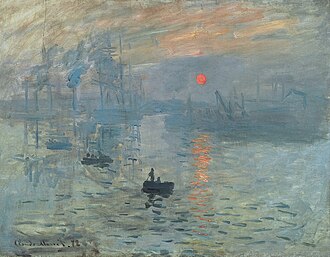 Impression, Sunrise - Claude Monet (1872)
 Water Lilies - Claude Monet (1906)
 The Third of May 1808 - Francisco Goya (1814)
.jpg) La Maja nue - Francisco Goya (1800)
La Maja nue - Francisco Goya (1800) Luncheon on the Grass - Édouard Manet (1863)
 Olympia - Édouard Manet (1863)