The Fountain of Indolence
J. M. W. Turner · 1834
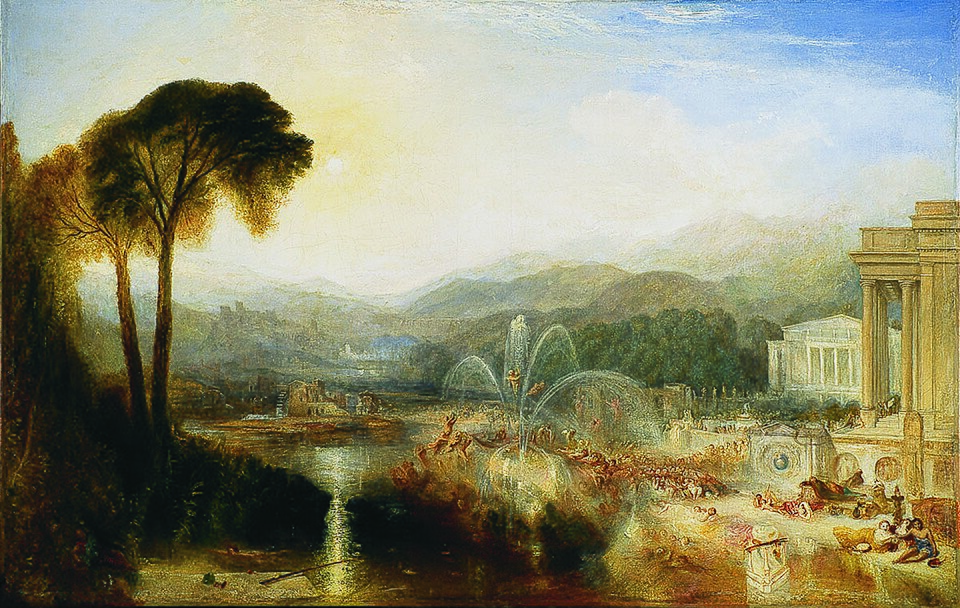
A fountain throws up a stream of forgetfulness, and little winged figures drift around it among dreamlike classical ruins. Turner showed it in 1834, then the painting vanished from the record for almost fifty years, and it may be hiding under a second name.
The story behind the painting
The Fountain of Indolence illustrates Canto 1 of James Thomson's 1748 poem The Castle of Indolence. In the lines Turner chose, easily robed visitors hurry to a fountain in the middle of a court, whose stream spouts high and falls back as drizzly dew. They drink deeply, for it is a rare fountain of nepenthe, bringing pleasure and sweet oblivion of earthly care, glad waking thoughts and joyous dreams. Turner first exhibited the canvas at the 66th Royal Academy Exhibition at Somerset House in May 1834, where it was generally well received.
What to look for
The scene is an imaginary landscape of classical buildings and ruins, centred on the fountain itself. Around it and inside it Turner grouped human figures together with winged, Cupid-like ones, as if the dreamers and their dreams shared the same water. The canvas is large, about 106 by 166 cm, so the eye travels across the architecture before settling on the rising jet at the heart of the picture. Look for the way the figures cluster around the basin, drawn to the stream the poem describes.
Meaning and intent
Between 1834 and 1882 nothing is known of the painting. That gap supports the idea that it is the same work as The Fountain of Fallacy, which Turner showed at the British Institution in 1839 with four lines from his own poem Fallacies of Hope, about rainbow dew falling on each anxious lip and working wild fantasy. Descriptions of the two fit equally well, Turner wrote in 1839 that he had no other painting of that size for sale, and Martin Butlin concluded that there was, and is, only one picture.
Legacy
In 1882 the painting reappeared with Thomas Agnew and Sons, then belonged to the Vanderbilt family until 1958; George W. Vanderbilt lent it to the Metropolitan Museum of Art in 1907. Lord Beaverbrook, seeking a first-rate Turner, bought it in 1958 for the Beaverbrook Art Gallery in Fredericton, New Brunswick, which opened the next year. From 2004 it stood at the centre of a dispute with the Beaverbrook UK Foundation over 133 paintings. Arbitration in 2007, upheld on appeal in 2009, ruled that it belonged to the Gallery.
Did you know?
- Based on James Thomson's 1748 poem The Castle of Indolence.
- First exhibited at the Royal Academy in May 1834.
- Probably the same painting as The Fountain of Fallacy of 1839.
- Confirmed as the Beaverbrook Art Gallery's own after arbitration in 2007 and appeal in 2009.
About the artist
J. M. W. Turner (1775-1851)
More by J. M. W. Turner
 The Fighting Temeraire - J. M. W. Turner (1839)
 Rain, Steam and Speed - The Great Western Railway - J. M. W. Turner (1844)
 The Slave Ship - J. M. W. Turner (1840)
 Dido building Carthage - J. M. W. Turner (1815)
 The Battle of Trafalgar - J. M. W. Turner (1820s)
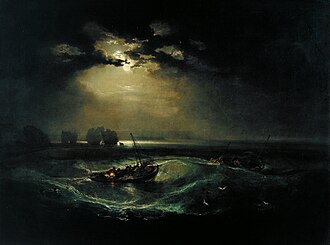 Fishermen at Sea - J. M. W. Turner (1796)
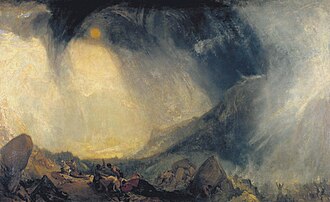 Snow Storm: Hannibal and his Army Crossing the Alps - J. M. W. Turner (1812)
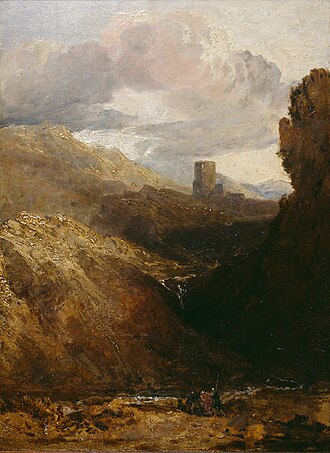 Dolbadarn Castle - J. M. W. Turner (1800)
Paintings by related artists
 The Ladies Waldegrave - Joshua Reynolds (1780)
 Captain George K. H. Coussmaker - Joshua Reynolds (1782)
 Impression, Sunrise - Claude Monet (1872)
 Water Lilies - Claude Monet (1906)
 The Third of May 1808 - Francisco Goya (1814)
 La Maja nue - Francisco Goya (1800)
 Wanderer above the Sea of Fog - Caspar David Friedrich (c. 1818)
 The Abbey in the Oakwood - Caspar David Friedrich (1800s)
 Liberty Leading the People - Eugène Delacroix (1830)
 Death of Sardanapalus - Eugène Delacroix (1827)
 The Blue Boy - Thomas Gainsborough (1770)
 Mr and Mrs Andrews - Thomas Gainsborough (1748)