Madonna mit Kind
Rogier van der Weyden · 1454
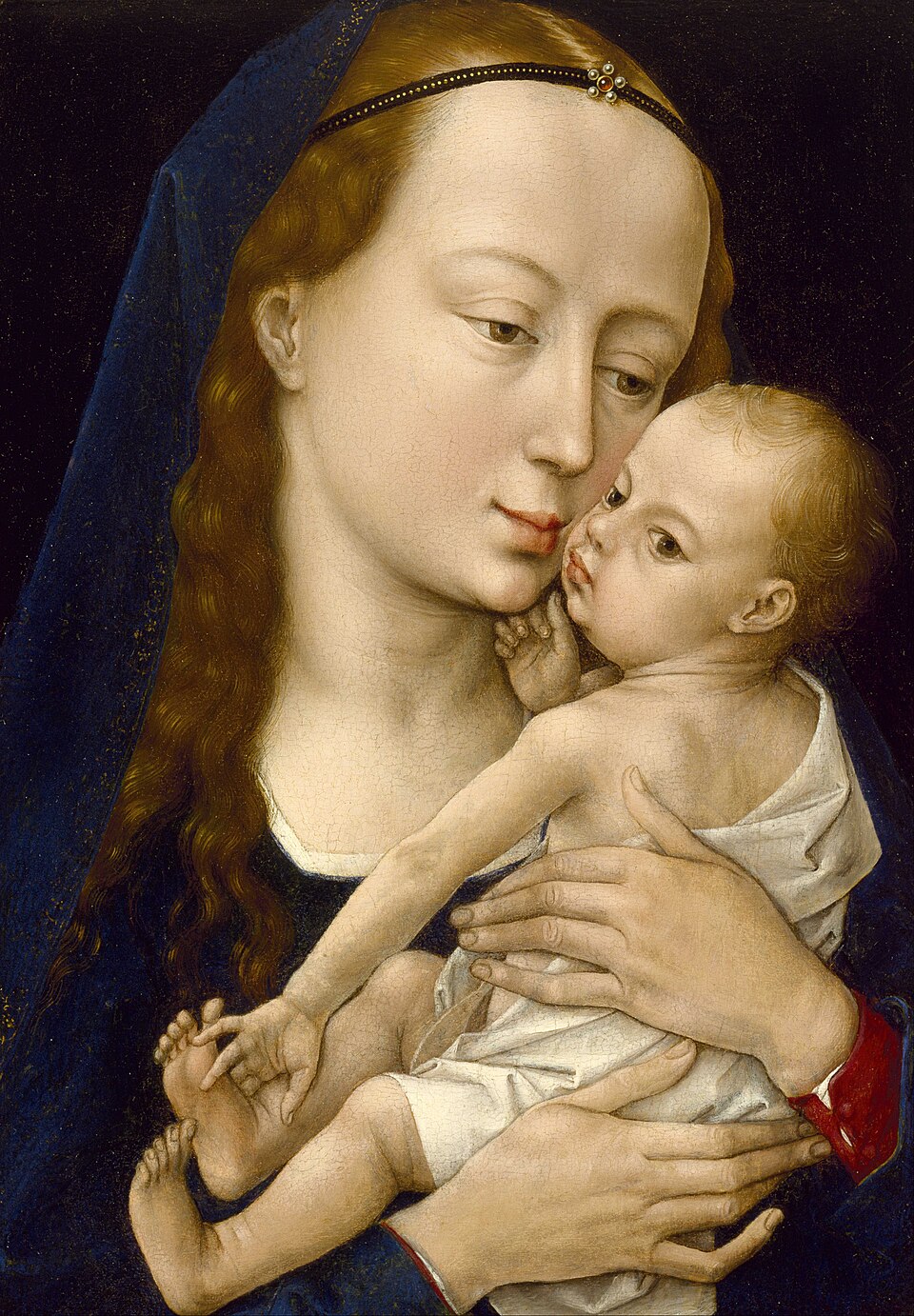
A baby twists round in his mother's arms, cheek pressed to hers, eyes lost in thought. Late in life, Rogier van der Weyden took an old icon of tenderness and made it new.
The story behind the painting
This small Virgin and Child in the Museum of Fine Arts, Houston, dates from after 1454, according to Wikipedia, and Wikidata gives 1454. It grew out of an event near Rogier's childhood home of Tournai. In 1440 a monk of Cambrai brought back from Rome an Italo-Byzantine icon, and in 1451 it was installed with great ceremony in Cambrai cathedral, about 30 miles south. A cult grew around it as a picture painted by Saint Luke himself, and copies were ordered from Hayne of Brussels and from Petrus Christus. Hayne simply copied it; Rogier transformed it.
What to look for
The panel is about 31.9 by 22.9 cm and is probably the last of Rogier's half-length Madonnas, smaller than the others. Half-length Madonnas had gone out of fashion in the Low Countries, and it was Rogier who brought them back. Look at the embrace: the child is anchored against his mother's shoulder and turns his body round, an example of contrapposto, while his gaze is pensive. Dekeyzer notes the Virgin's broad forehead and narrow heavy-lidded eyes, very like the Virgin in the Diptych of Philip de Croy, which can be dated to 1460.
Meaning and intent
The Cambrai icon belongs to the Eleusa type, a tenderness icon in which the infant nestles against the Virgin's cheek. Rogier kept that feeling of closeness but gave it new life. The source says the tenderness of the embrace, the twisting child and his thoughtful look set the painting apart from all its predecessors. A sacred image believed to come from Saint Luke became, in his hands, a mother and a child who seem to feel and think, without losing the devotion that made the icon famous.
Legacy
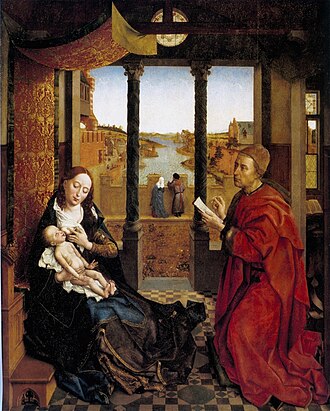
Its standing has changed. Erwin Panofsky thought it only an excellent replica of a Rogier design, and the technical evidence then available seemed to agree; more recent studies confirm it as Rogier's own work. Dating is debated too. Panofsky placed it after 1455, when the Abbey of Saint Aubert in Cambrai commissioned Rogier's Saint John Altarpiece, delivered in person in 1459. The article notes he would have known the icon anyway, having painted a Saint Luke Drawing the Virgin for Brussels. Dekeyzer dates it about 1460, to the last years of his career.
Schon gewusst?
- Based on the Cambrai Madonna, an Eleusa icon installed in 1451.
- Probably Rogier's last half-length Madonna.
- Once called a replica by Panofsky, now confirmed as autograph.
- In the Museum of Fine Arts, Houston.
Über den Künstler
Rogier van der Weyden (1390s-1464)
religiöse Kunst · Maria · Jesuskind · Flämische Primitive · Museum of Fine Arts Houston
Mehr von Rogier van der Weyden
 Kreuzabnahme - Rogier van der Weyden (1440s)
 Porträt einer Dame - Rogier van der Weyden (1460)
 Das Jüngste Gericht - Rogier van der Weyden (1443)
 Lukas-Madonna - Rogier van der Weyden (1490)
 Columba-Altar - Rogier van der Weyden (1450s)
 Die lesende Magdalena - Rogier van der Weyden (1435)
 Der Miraflores-Altar - Rogier van der Weyden (1443)
 Braque Triptychon - Rogier van der Weyden (1452)
Werke verwandter Künstler
 Arnolfini-Porträt - Jan van Eyck (1434)
 Genter Altar - Jan van Eyck (1432)
 Die Verkündigung - Hans Memling (1480s)
 Szenen der Passion Christi - Hans Memling (1470)
 Der Garten der Lüste - Hieronymus Bosch
 Das Narrenschiff - Hieronymus Bosch (1500s)
 Die Jäger im Schnee - Pieter Bruegel the Elder (1565)
 Die niederländischen Sprichwörter - Pieter Bruegel the Elder (1551)