Die Verkündigung
Hans Memling · 1480s
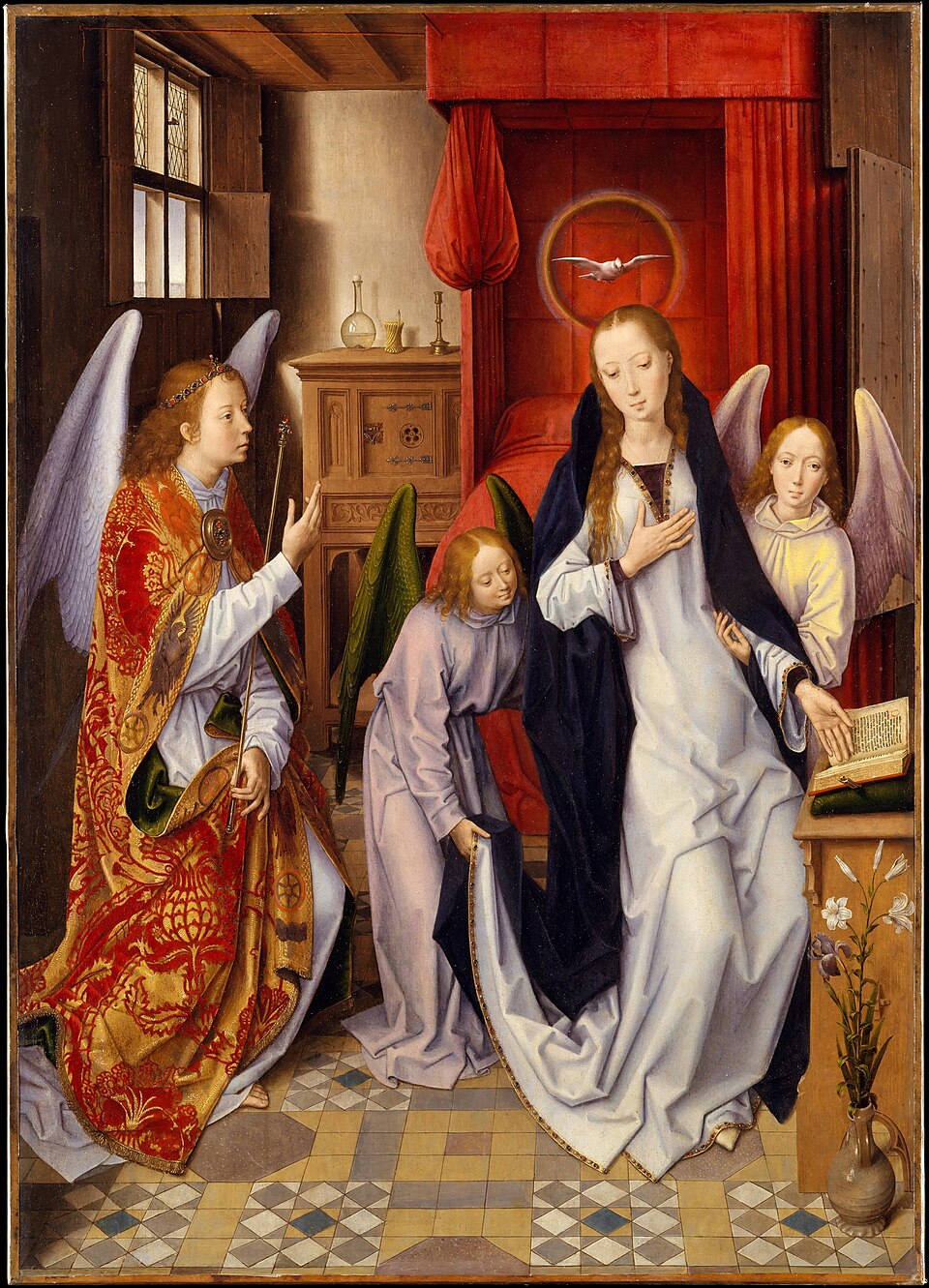
In a Flemish bedroom flooded with light, the Virgin seems to rise or swoon as Gabriel kneels before her. Memling's Annunciation once hung forgotten on a family estate, pierced by an arrow.
The story behind the painting
Hans Memling painted this Annunciation in the 1480s on an oak panel; it was transferred to canvas sometime after 1928. Its original frame survived until the nineteenth century, inscribed with a date read as 1482, though modern art historians suggest the last digit was a 9, giving 1489. It may have belonged to the Radziwiłł family since the sixteenth century. Antoni Radziwiłł found it on a family estate in the early nineteenth century, pierced through with an arrow and in need of restoration. The banker Philip Lehman bought it in 1920.
What to look for
Gabriel stands in three-quarter view, wearing a small jewelled diadem and a red and gold brocade cope over a white alb, bending his knees with bare feet set just behind hers. Mary faces us before a red-curtained bed that frames her like a canopy of honour, in a plain white shift under a blue mantle, a purple underdress showing at her neck and wrists. Two small angels hold her; one looks straight at us. Above her head a dove hovers in a rainbow circle of light. Notice the open prayer book, the vase of white lilies with one blue iris, and the water flask glowing in light from the window.
Meaning and intent
Memling sets the sacred event in an ordinary upper merchant class bedchamber, following Robert Campin, Jan van Eyck and Rogier van der Weyden, and his scene is nearly identical to van der Weyden's Saint Columba Altarpiece. Yet Mary's pose is new: she seems to rise or to swoon, a posture Shirley Neilsen Blum says you will search for in vain in other Netherlandish panels, and Penny Jolly reads as a birthing position. Her swoon foreshadows the Crucifixion. Lilies speak of purity, the iris of suffering, and light through the clear flask echoes the old image of the Holy Spirit passing through her like sunlight through glass.
Legacy
In 1847 the art historian Gustav Friedrich Waagen called it one of Memling's finest and most original works. In 1902 it was shown at the exhibition of Flemish primitives in Bruges and was then cleaned and restored. Maryan Ainsworth calls it a startlingly original image, and Charles Sterling sees in it Memling's gift for taking an inherited convention and filling it with heightened emotion. Today it belongs to the Robert Lehman Collection at the Metropolitan Museum of Art in New York.
Schon gewusst?
- Painted by Hans Memling in the 1480s, perhaps 1482 or 1489.
- Found on a Radziwiłł estate, pierced by an arrow.
- Bought by Philip Lehman in 1920.
- Now in the Robert Lehman Collection at the Met.
Über den Künstler
Hans Memling (1435-1494)
religiöse Kunst · Metropolitan Museum of Art · Flämische Primitive · Engel · Buch · Fenster · Vorhang · Verkündigung des Herrn
Mehr von Hans Memling
 Szenen der Passion Christi - Hans Memling (1470)
 Diptychon des Maarten Nieuwenhove - Hans Memling (1487)
 Maria und Johannesaltar - Hans Memling (1479)
 Porträt der Maria Maddalena Portinari - Hans Memling (1470)
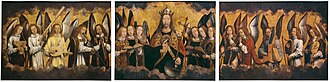 Christus umgeben von musizierenden Engeln - Hans Memling (1480s)
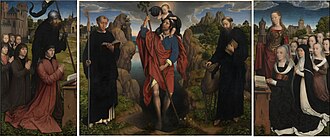 Moreel Triptychon - Hans Memling (1484)
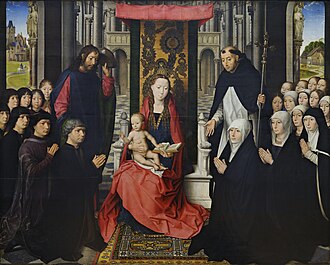 Madonna of Jacob Floreins - Hans Memling (1485)
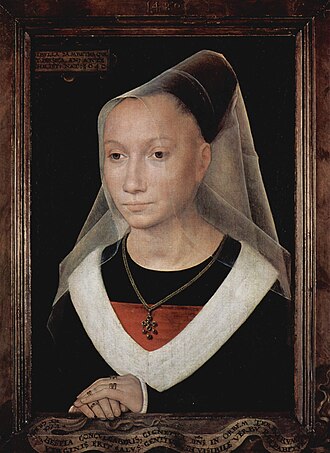 Die Sibylle Sambetha - Hans Memling (1480)
Werke verwandter Künstler
 Kreuzabnahme - Rogier van der Weyden (1440s)
 Porträt einer Dame - Rogier van der Weyden (1460)
 Arnolfini-Porträt - Jan van Eyck (1434)
 Genter Altar - Jan van Eyck (1432)
 Der Garten der Lüste - Hieronymus Bosch
 Das Narrenschiff - Hieronymus Bosch (1500s)
 Die Jäger im Schnee - Pieter Bruegel the Elder (1565)
 Die niederländischen Sprichwörter - Pieter Bruegel the Elder (1551)