Lukas-Madonna
Rogier van der Weyden · 1490
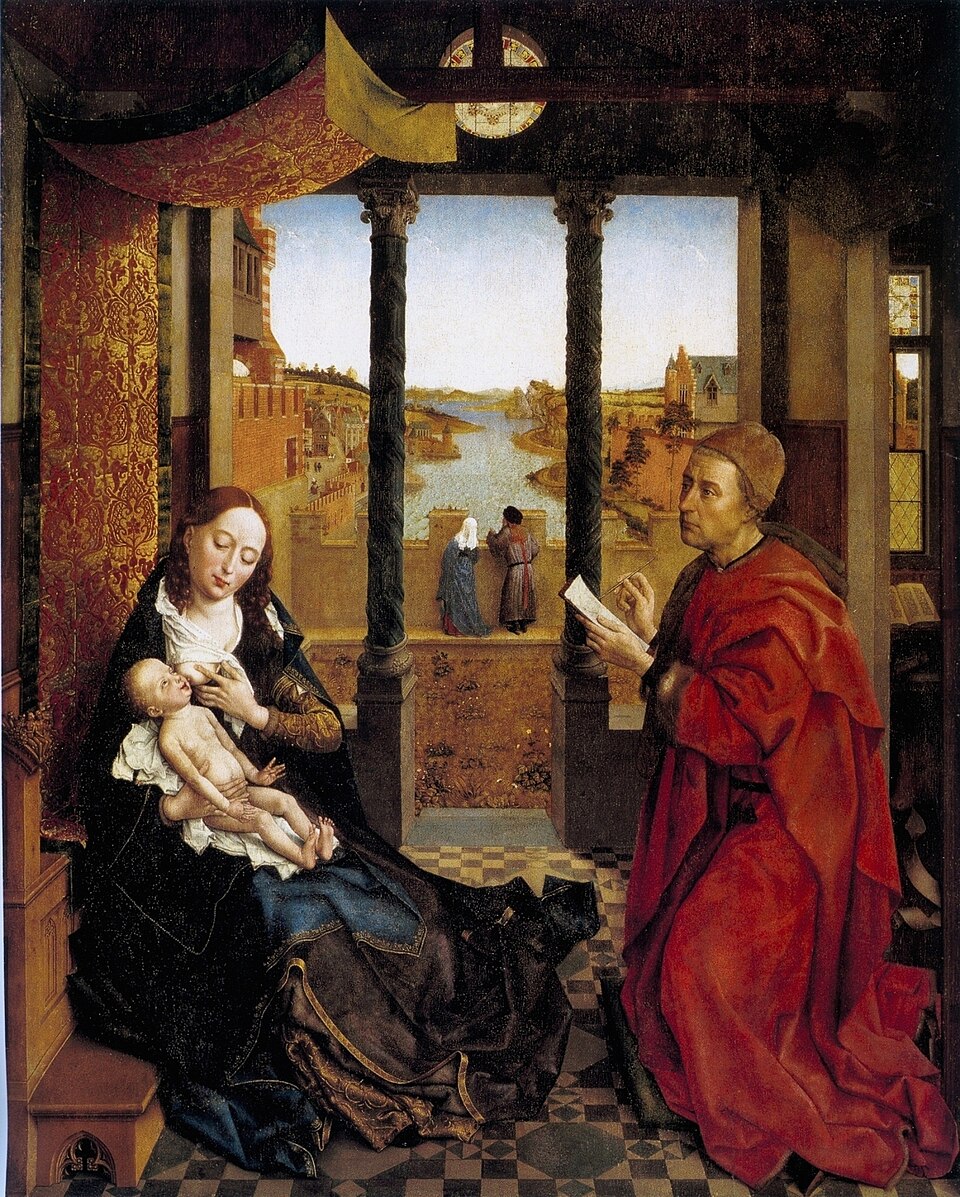
A painter kneels before the Virgin as she nurses her child, drawing tool in hand, almost hypnotised. The painter is Saint Luke, patron of artists, and his face is accepted as Rogier van der Weyden's own.
The story behind the painting
No contemporary documents survive, but art historians agree the panel was almost certainly painted for the Brussels painters' guild, for their chapel in the church of St. Michael and St. Gudula, where van der Weyden is buried. It may celebrate his appointment as city painter. Luke was believed to have painted the Virgin, and painters' guilds were under his protection. The work is usually dated between 1435 and 1440; the oak was dated to around 1410, supporting the mid-1430s. Wikidata gives 1490, which conflicts with this dating. The Boston panel is widely considered the original, with near contemporary versions in Saint Petersburg, Munich and Bruges.
What to look for
Mary sits under a brocade canopy, her hair loose, in a fur-lined embroidered dress built from many blues and deep lapis lazuli highlights. Luke, dressed in red, is either rising from a kneel or about to genuflect, his hands holding his tools with great delicacy. Mary turns so he can draw her in near full profile. Behind him, in his small study, are his ox and an open book. Through the columns, two figures stand at a battlement with their backs to us, looking at a river, a detailed town and landscape. The panel is in relatively poor condition, and some greens have turned brown.
Meaning and intent
Van der Weyden closely follows Jan van Eyck's Madonna of Chancellor Rolin but reverses the figures and colours, makes the scene warmer, and shows Mary as a nursing Madonna, stressing Christ's humanity and spiritual nourishment. Luke kneels like a donor, painted with more naturalism than Mary: a man in his early forties with light stubble and greying hair, close to the artist's own age. By placing himself in the same room as the Madonna, in the act of painting, van der Weyden puts artistic creativity at the heart of a sacred scene. The two watching figures turn looking itself into devotion.
Legacy
The painting's significance rests on the skill of its design and its merging of the earthly and the divine. It became widely influential, with near copies by the Master of the Legend of Saint Ursula and Hugo van der Goes. Underdrawings in the Boston panel, heavily reworked and absent from the other versions, are the key reason it is seen as the original. Despite extensive restoration and cleaning, damage remains, yet the scene still makes its quiet claim: that the painter's gaze, fixed on what he loves, is itself a kind of prayer.
Schon gewusst?
- Usually dated 1435-1440 and attributed to Rogier van der Weyden.
- Almost certainly made for the Brussels painters' guild.
- Luke's face is accepted as the artist's self-portrait.
- Versions exist in Saint Petersburg, Munich and Bruges.
Über den Künstler
Rogier van der Weyden (1390s-1464)
religiöse Kunst · Frau · Maria · Jesuskind · Junge · Flämische Primitive · Mutter · Museum of Fine Arts Boston
Mehr von Rogier van der Weyden
 Kreuzabnahme - Rogier van der Weyden (1440s)
 Porträt einer Dame - Rogier van der Weyden (1460)
.jpg) Das Jüngste Gericht - Rogier van der Weyden (1443)
Das Jüngste Gericht - Rogier van der Weyden (1443) Columba-Altar - Rogier van der Weyden (1450s)
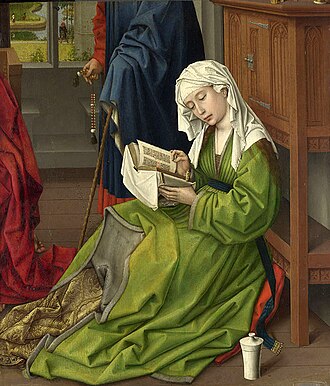 Die lesende Magdalena - Rogier van der Weyden (1435)
 Braque Triptychon - Rogier van der Weyden (1452)
%20-%20Prado%20P02722.jpg) Durán Madonna - Rogier van der Weyden (1430s)
Durán Madonna - Rogier van der Weyden (1430s) Kreuzigungstriptychon - Rogier van der Weyden (1440s)
Werke verwandter Künstler
 Der Garten der Lüste - Hieronymus Bosch
 Das Narrenschiff - Hieronymus Bosch (1500s)
 Arnolfini-Porträt - Jan van Eyck (1434)
 Genter Altar - Jan van Eyck (1432)
%20-%20Google%20Art%20Project.jpg) Die Jäger im Schnee - Pieter Bruegel the Elder (1565)
Die Jäger im Schnee - Pieter Bruegel the Elder (1565) Die niederländischen Sprichwörter - Pieter Bruegel the Elder (1551)