Genter Altar
Jan van Eyck · 1432
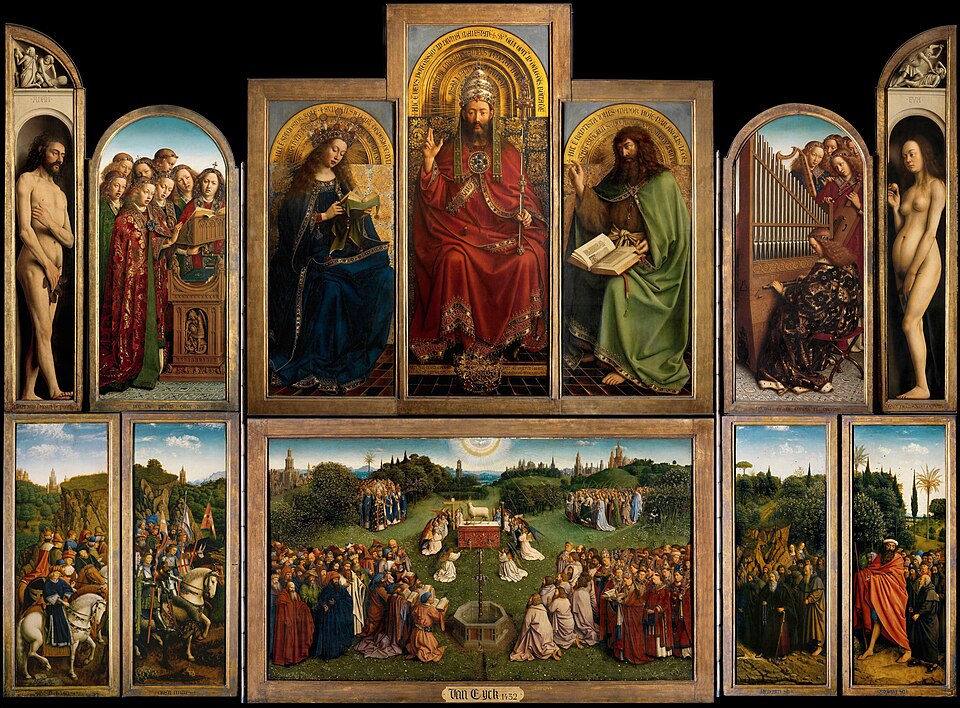
Behind folding wings in a Ghent cathedral waits a whole world in oil paint: angels, prophets, Adam and Eve, and a meadow of saints gathered around a lamb.
The story behind the painting
The Ghent Altarpiece, also called the Adoration of the Mystic Lamb, was begun around the mid-1420s and completed by 1432 for St Bavo's Cathedral in Ghent. It was commissioned by the merchant and Ghent mayor Jodocus Vijd and his wife Lysbette, and its installation was celebrated on 6 May 1432. It is attributed to the brothers Hubert and Jan van Eyck. A now lost inscription on the frame said that Hubert, greater than anyone, began it, and that Jan, calling himself second best in the art, completed it. Historians broadly agree that Hubert designed the structure and Jan painted most panels, yet no convincing separation of their hands has ever been established.
What to look for
The polyptych has two registers and folding wings painted inside and out. When open, the upper level shows God, identified either as Christ the King or God the Father, between the Virgin Mary and John the Baptist, flanked by singing and music-making angels, with Adam and Eve on the outer panels. Below, a landscape runs continuously across five panels: saints, sinners, clergy and soldiers gather to adore the Lamb of God, watched over by the dove of the Holy Spirit. Closed, the altar shows the Annunciation, prophets and sibyls, grisaille figures of the two Saints John, and portraits of the kneeling donors. Light glints on armour and ripples in the fountain, and plants are observed with almost scientific accuracy.
Meaning and intent
The upper register represents heavenly redemption, while the lower one shows all of humanity drawn toward the Lamb. Yet the altarpiece gives as much attention to the beauty of earthly things as to its sacred theme: clothes, jewels, the fountain, churches and distant landscape are all painted with remarkable care. The contrast between open and closed states carried meaning too. On feast days the wings were opened, and the richness and colour inside stood against the relative austerity of the outer panels, turning a church festival into a revelation. Hundreds of figures fill the inner panels, each with a place in this vision.
Legacy
The altarpiece is seen as a key example of the shift from medieval to Renaissance art, and some have called it the first major oil painting. New handling of oil and transparent glazes produced short, diagonal shadows suggesting a light source beyond the picture itself. Its original carved frame was destroyed during the Reformation, and it may once have had clockwork to move the shutters or even play music. The work remains in its original church, though for security it was moved to the cathedral's principal chapel. Few paintings in European history are as renowned.
Schon gewusst?
- Installation celebrated on 6 May 1432.
- Attributed to Hubert and Jan van Eyck.
- Commissioned by Jodocus Vijd and his wife Lysbette.
- About 350 × 440 cm (Wikidata), in St Bavo's Cathedral, Ghent.
Über den Künstler
Jan van Eyck (1390-1441)
religiöse Kunst · Frau · Maria · Flämische Primitive · Verkündigung des Herrn · Johannes der Täufer · Johannes der Evangelist · Adam · Eva
Mehr von Jan van Eyck
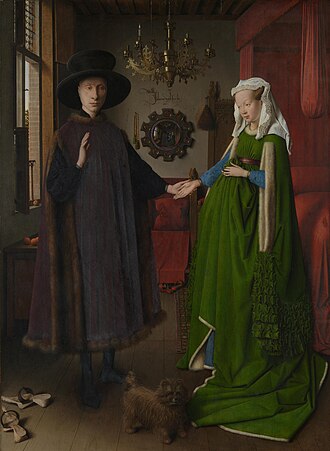 Arnolfini-Porträt - Jan van Eyck (1434)
.webp) Rolin-Madonna - Jan van Eyck
Rolin-Madonna - Jan van Eyck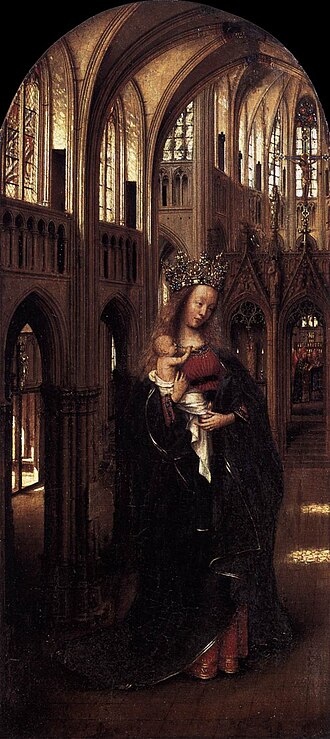 Die Madonna in der Kirche - Jan van Eyck (1440)
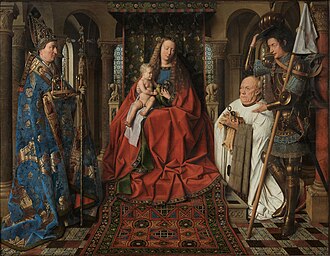 Madonna des Kanonikus Georg van der Paele mit hll. Donatian, Georg und Stifter Paele - Jan van Eyck (1436)
.png) Lucca-Madonna - Jan van Eyck (1437)
Lucca-Madonna - Jan van Eyck (1437)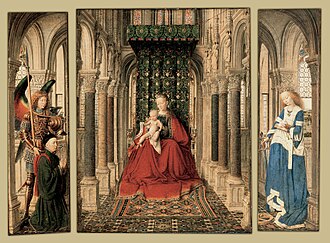 Dresdner Marienaltar - Jan van Eyck (1437)
%201433.jpg) Porträt eines Mannes - Jan van Eyck (1433)
Porträt eines Mannes - Jan van Eyck (1433)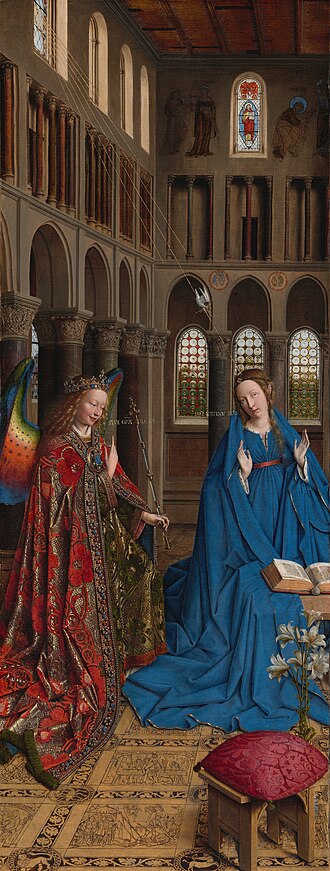 Verkündigung - Jan van Eyck (1430s)
Werke verwandter Künstler
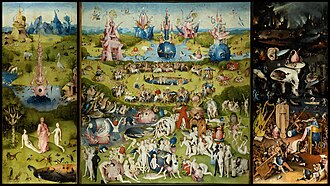 Der Garten der Lüste - Hieronymus Bosch
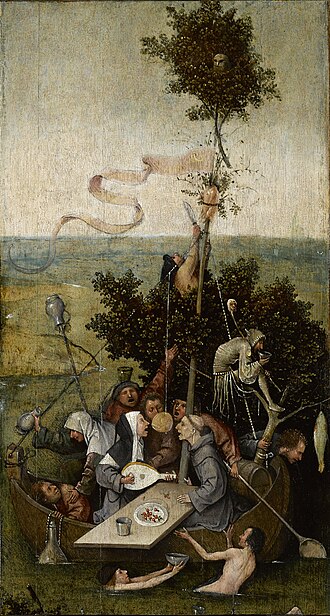 Das Narrenschiff - Hieronymus Bosch (1500s)
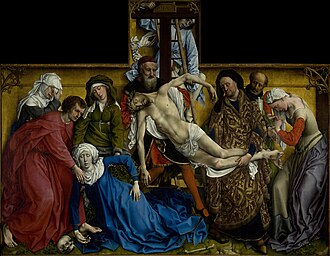 Kreuzabnahme - Rogier van der Weyden (1440s)
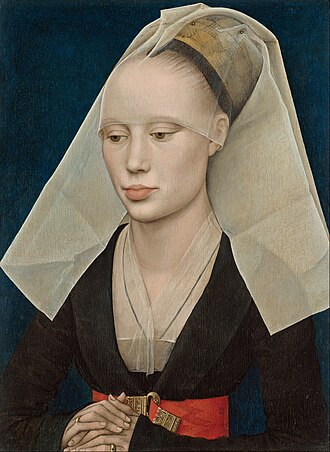 Porträt einer Dame - Rogier van der Weyden (1460)
%20-%20Google%20Art%20Project.jpg) Die Jäger im Schnee - Pieter Bruegel the Elder (1565)
Die Jäger im Schnee - Pieter Bruegel the Elder (1565)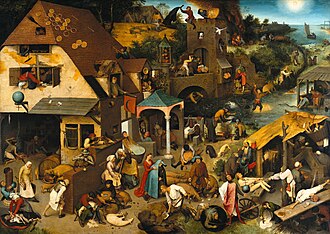 Die niederländischen Sprichwörter - Pieter Bruegel the Elder (1551)