Das Jüngste Gericht
Rogier van der Weyden · 1443
.jpg)
Imagine lying ill in a fifteenth-century hospital bed and seeing, across the hall, Christ enthroned on a rainbow while an archangel weighs souls. Rogier van der Weyden painted this vast altarpiece for exactly those eyes.
The story behind the painting
In 1443 Nicolas Rolin, Chancellor of the Duchy of Burgundy, and his wife Guigone de Salins founded a hospital in Beaune. The town had suffered plague, marauding bands and famine, and Rolin wrote in the founding charter that he acted in the interest of his salvation. Around that time he approached Rogier van der Weyden for an altarpiece to stand at the heart of the chapel. It was painted in the artist's Brussels workshop, most likely with help from apprentices, and was ready by 1451, when the chapel was consecrated. Unusually for a Netherlandish altarpiece, documents survive naming the artist, the patron, the date and the place it was made for.
What to look for
The work is a polyptych of fifteen paintings on nine oak panels, six of them painted on both sides. Opened, it shows the Last Judgement in two registers. In the tall central panel Christ sits on a rainbow, and below him the Archangel Michael holds scales to weigh souls. A radiant gold background spans almost the whole width. Along the lower register the dead rise from their graves in one continuous landscape, ignoring the frames between panels, and move toward the gates of Heaven on one side or the mouth of Hell on the other. Closed, the shutters show the donors and saints painted in grisaille, imitating sculpture.
Meaning and intent
The altarpiece was meant to comfort and to warn. Rolin specified that thirty beds be placed within sight of it, visible through a pierced screen, so that the dying could turn their last thoughts toward the divine. On the exterior, Saints Sebastian and Anthony, both linked to plague, stood as healers and intercessors. Saint Michael was seen in fifteenth-century France as a guardian of the dead. The art historian Barbara Lane noted that patients were unlikely to survive their stay, yet they could gaze on Michael every time the altarpiece was opened. Lynn Jacobs links the theme to the work's dual role, as both altarpiece and funerary monument for the donors.
Legacy
Guigone de Salins served at the hospice until her death in 1470 and is buried in front of the altarpiece's original location. The panels have suffered paint loss, darkening and heavy over-paint from an old restoration, and in the twentieth century the work was moved to shield it from sunlight and from the hospice's many visitors. The two painted sides of the shutters have been separated so both can be seen. Wikidata records the size as 220 by 546 cm, while Wikipedia gives 220 by 548 cm. It remains in the Hospices de Beaune, the place it was made for.
Schon gewusst?
- Commissioned in 1443 by Nicolas Rolin and Guigone de Salins; ready by 1451.
- Fifteen paintings on nine panels, six painted on both sides.
- Thirty hospital beds were placed within sight of it.
- Size: 220 x 546 cm (Wikidata) or 220 x 548 cm (Wikipedia).
Über den Künstler
Rogier van der Weyden (1390s-1464)
religiöse Kunst · Flämische Primitive · Erzengel Michael · Jüngstes Gericht
Mehr von Rogier van der Weyden
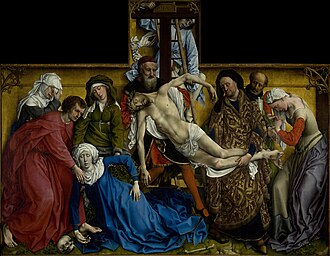 Kreuzabnahme - Rogier van der Weyden (1440s)
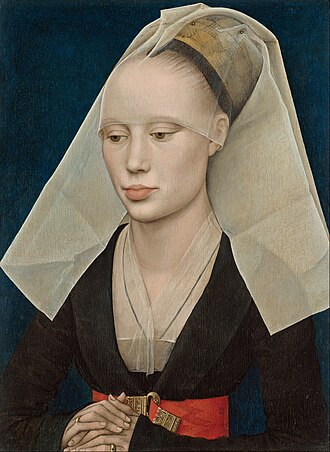 Porträt einer Dame - Rogier van der Weyden (1460)
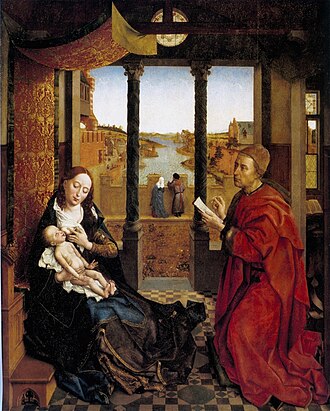 Lukas-Madonna - Rogier van der Weyden (1490)
 Columba-Altar - Rogier van der Weyden (1450s)
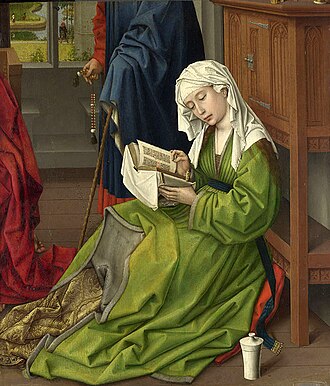 Die lesende Magdalena - Rogier van der Weyden (1435)
 Braque Triptychon - Rogier van der Weyden (1452)
%20-%20Prado%20P02722.jpg) Durán Madonna - Rogier van der Weyden (1430s)
Durán Madonna - Rogier van der Weyden (1430s) Kreuzigungstriptychon - Rogier van der Weyden (1440s)
Werke verwandter Künstler
 Der Garten der Lüste - Hieronymus Bosch
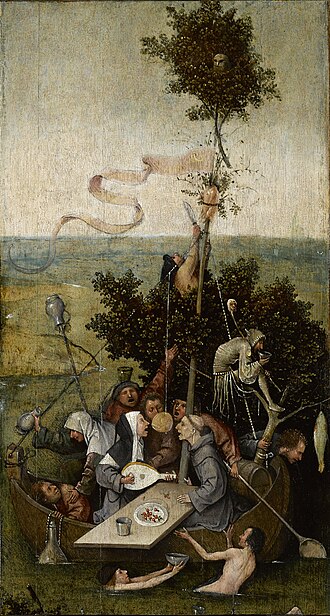 Das Narrenschiff - Hieronymus Bosch (1500s)
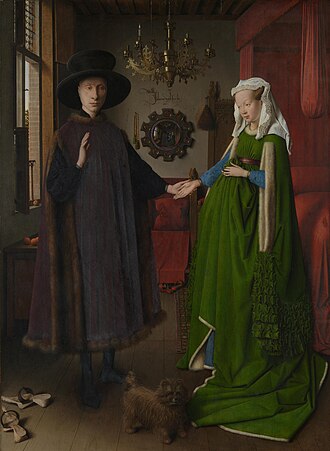 Arnolfini-Porträt - Jan van Eyck (1434)
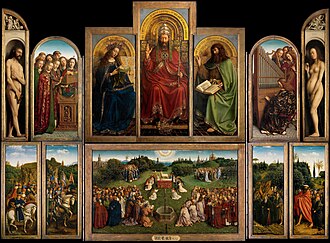 Genter Altar - Jan van Eyck (1432)
%20-%20Google%20Art%20Project.jpg) Die Jäger im Schnee - Pieter Bruegel the Elder (1565)
Die Jäger im Schnee - Pieter Bruegel the Elder (1565)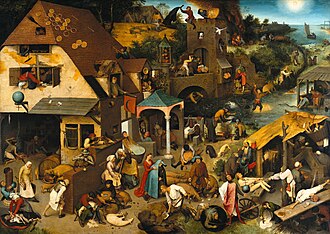 Die niederländischen Sprichwörter - Pieter Bruegel the Elder (1551)