Arnolfini-Porträt
Jan van Eyck · 1434
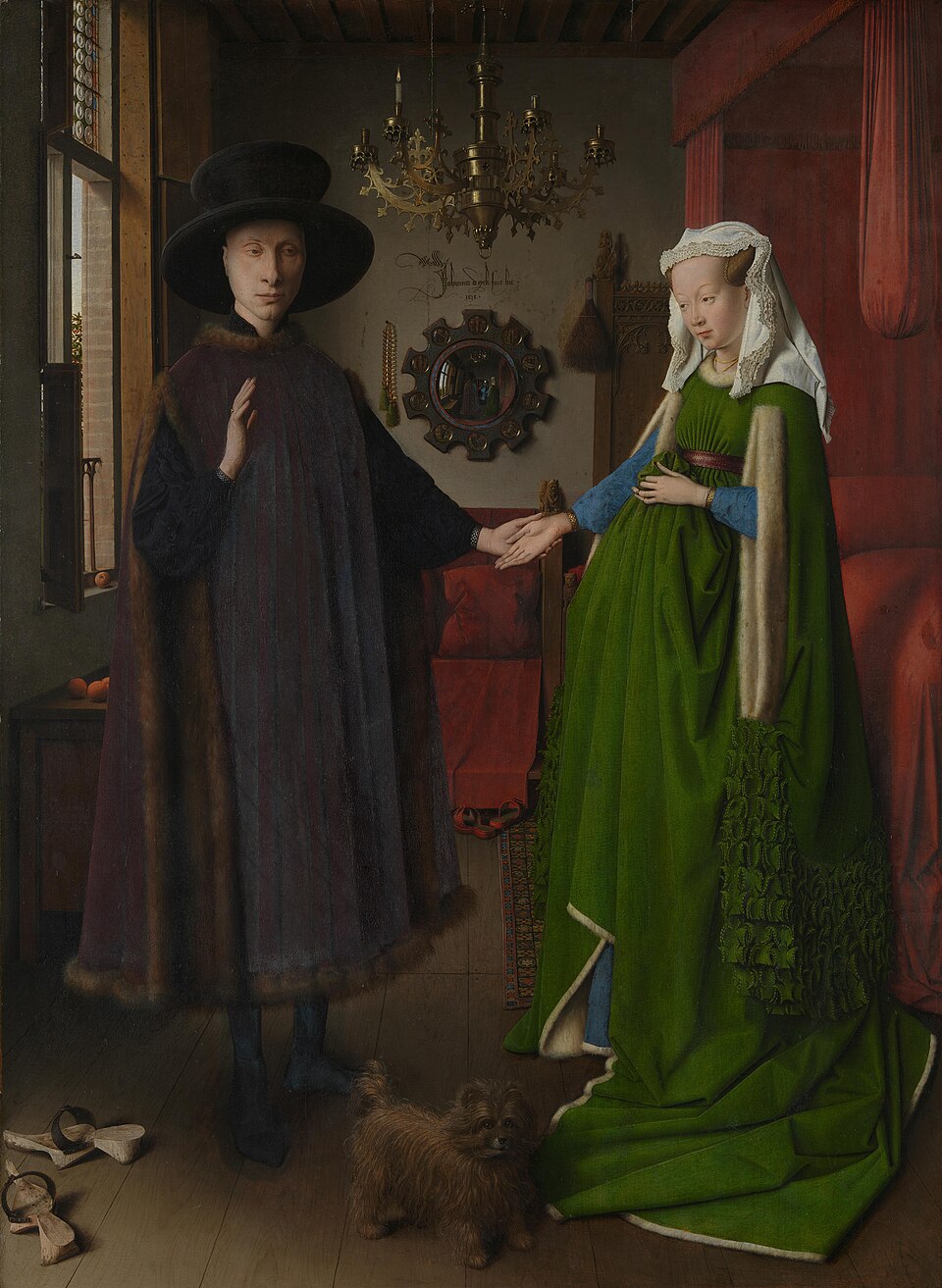
A couple stands in a quiet room in Bruges, a small dog at their feet and a round mirror behind them. Look into that mirror and you find two more people, and above it the words Jan van Eyck was here 1434.
The story behind the painting
Jan van Eyck signed and dated this oil on oak panel in 1434. It is a full-length double portrait, believed to show the Italian merchant Giovanni di Nicolao Arnolfini and his wife, presumably at home in Bruges. Who exactly they are has shifted over time. In 1857 Crowe and Cavalcaselle linked the panel to Giovanni di Arrigo Arnolfini, and James Weale later named his wife as Jeanne Cenami. That view held for a century, until a discovery published in 1997 showed the couple married in 1447, six years after van Eyck's death. The man is now thought to be Giovanni di Arrigo or his cousin Giovanni di Nicolao. One recent proposal identifies the woman as Costanza Trenta, Giovanni di Nicolao's first wife, who had died by February 1433, which would make the picture partly a memorial.
What to look for
Early summer shows in the cherries on the tree outside the window, yet both figures wear fur-lined outer garments, his tabard probably silk velvet, once more purple than it looks now, her gown with elaborately dagged sleeves and a long train. Notice the oranges on the left, costly in Burgundy, the large brass chandelier, the carved furniture and the small Oriental carpet by the bed. The little dog is an early form of the breed now called the Affenpinscher. In the convex mirror, framed by tiny scenes of the Passion, two figures stand just inside the door; the one in red is presumably the artist. Above, the signature is painted like lettering on the wall. Van Eyck even shows individual highlights on the beads beside the mirror, perhaps using a magnifying glass.
Meaning and intent
Erwin Panofsky and others have seen the portrait as a kind of marriage contract recorded in paint, though its meaning has been much debated. What is clear is how it shows wealth: the furs, fabrics and objects would have been recognised as enormously expensive, while a certain restraint in the man's dress suits a merchant. The art historian Craig Harbison calls it the only fifteenth-century northern panel to survive showing the artist's contemporaries engaged in some action in a contemporary interior, tempting him to call it the first genre painting of modern times. Even the mirror is quietly unrealistic, larger than such mirrors could then be made.
Legacy
The painting is considered one of the most original and complex works in Western art, for its beauty, its iconography, its geometric perspective and its use of a mirror to expand space. Ernst Gombrich wrote that a simple corner of the real world had been fixed on to a panel as if by magic. With the Ghent Altarpiece, it is among the oldest very famous panel paintings executed in oils rather than tempera, built from thin translucent glazes and wet-in-wet blending. Infrared images reveal many small changes in the underdrawing. The National Gallery in London bought it in 1842.
Schon gewusst?
- Signed and dated 1434.
- Oil on oak panel, 82.2 x 60 cm.
- Inscription: Johannes de eyck fuit hic 1434.
- Bought by the National Gallery, London, in 1842.
Über den Künstler
Jan van Eyck (1390-1441)
Frau · Porträt · National Gallery · Flämische Primitive · Bett · Haushund · Paar · Spiegel · Schlafzimmer
Mehr von Jan van Eyck
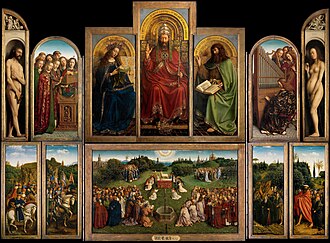 Genter Altar - Jan van Eyck (1432)
.webp) Rolin-Madonna - Jan van Eyck
Rolin-Madonna - Jan van Eyck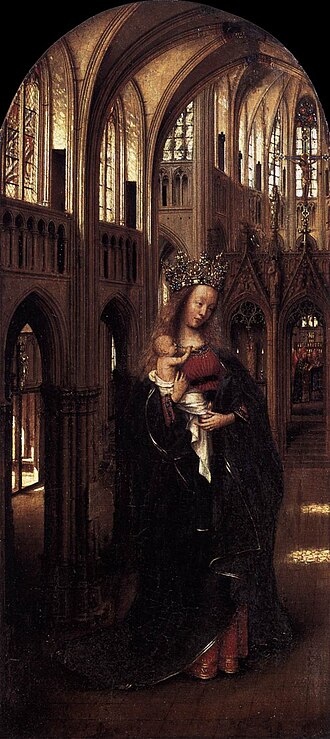 Die Madonna in der Kirche - Jan van Eyck (1440)
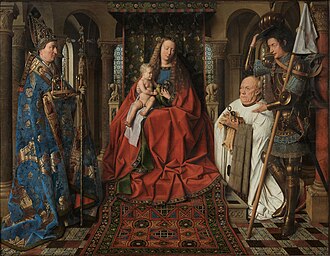 Madonna des Kanonikus Georg van der Paele mit hll. Donatian, Georg und Stifter Paele - Jan van Eyck (1436)
.png) Lucca-Madonna - Jan van Eyck (1437)
Lucca-Madonna - Jan van Eyck (1437)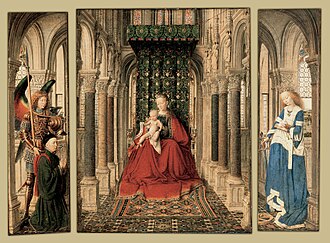 Dresdner Marienaltar - Jan van Eyck (1437)
%201433.jpg) Porträt eines Mannes - Jan van Eyck (1433)
Porträt eines Mannes - Jan van Eyck (1433)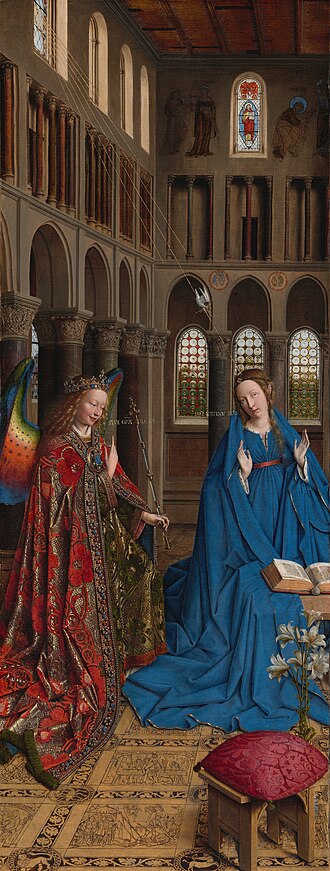 Verkündigung - Jan van Eyck (1430s)
Werke verwandter Künstler
 Der Garten der Lüste - Hieronymus Bosch
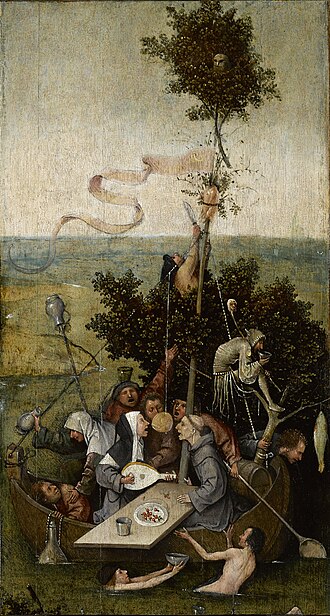 Das Narrenschiff - Hieronymus Bosch (1500s)
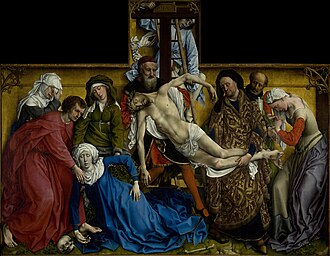 Kreuzabnahme - Rogier van der Weyden (1440s)
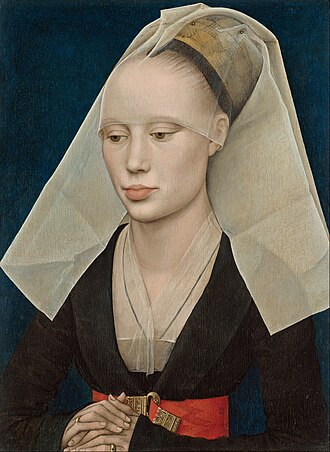 Porträt einer Dame - Rogier van der Weyden (1460)
%20-%20Google%20Art%20Project.jpg) Die Jäger im Schnee - Pieter Bruegel the Elder (1565)
Die Jäger im Schnee - Pieter Bruegel the Elder (1565)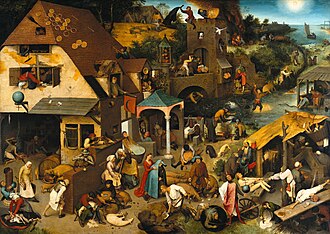 Die niederländischen Sprichwörter - Pieter Bruegel the Elder (1551)