Der Miraflores-Altar
Rogier van der Weyden · 1443
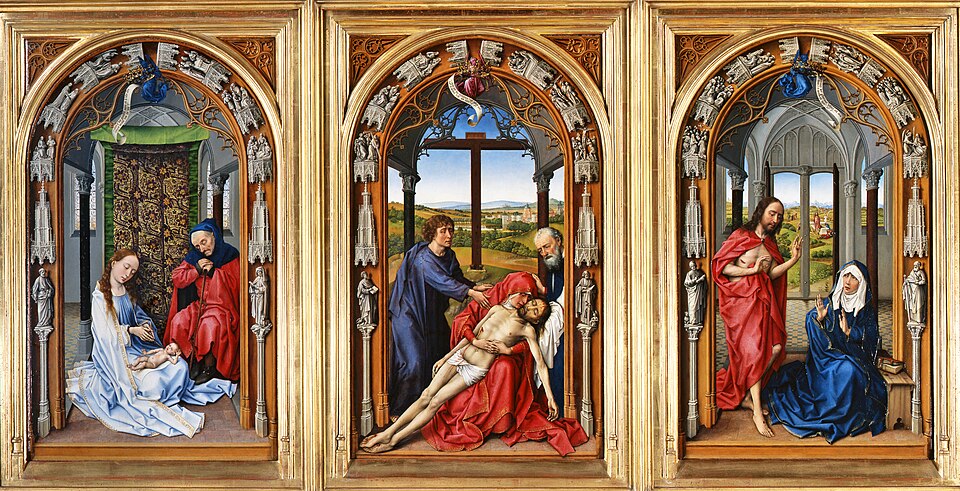
Mary in white with her newborn, Mary in red holding her dead son, Mary in blue as the risen Christ appears to her. Rogier van der Weyden told a mother's whole story in three arched panels, and for centuries the original was mistaken for a copy.
The story behind the painting
Painted around 1442 to 1445 in oil on oak, the triptych was commissioned by John II of Castile, who gave it around 1445 to the Carthusian monastery of Miraflores near Burgos. A document of 1445 describes it as by the hand of the great and famous Fleming Rogel. The panels were originally fixed, not hinged, and were later separated and reassembled. During the Peninsular War the altarpiece was taken by General Darmagnac as part of the Napoleonic looting of art in Spain. It has been in the Gemaldegalerie in Berlin since 1850.
What to look for
Each scene sits behind a painted arch, like a church portal or a stage, with a step at the front inviting the viewer in. Mary's robes change colour: white for purity, red for compassion, blue for perseverance. In the left panel Joseph dozes on his staff while Mary and the infant gaze at each other, and gold letters from the Canticle of Mary run along her hem. In the centre she holds Christ's long, lifeless body between Peter and Luke. On the right, a winding path leads from the tomb to the doorway, and tiny carved reliefs fill every arch.
Meaning and intent
The altarpiece looks at Mary's bond with Christ through his birth, death and resurrection. Much of it was van der Weyden's own invention. The meeting of the risen Christ with his mother appears in none of the Gospels, and the winding path, without precedent in art or scripture, is a device to link the two moments in time. The arch reliefs echo the main scenes with episodes such as the Binding of Isaac. Erwin Panofsky showed that the left panel, long called a Nativity, is a simple Holy Family.
Legacy
Two nearly identical, slightly smaller versions survive, in the Metropolitan Museum of Art in New York and the Royal Chapel of Granada. As late as 1956 Max Friedlander called the Berlin panels an extremely careful workshop replica. Later study reversed this: tree-ring dating places the Granada and New York wood after 1492, long after the painter's death in 1464, while infrared images of the Berlin panels show changes no copyist would make. The work influenced Petrus Christus, Dirk Bouts and Hans Memling.
Schon gewusst?
- Commissioned by John II of Castile and given to Miraflores around 1445.
- Mary wears white, red and blue for purity, compassion and perseverance.
- Taken from Spain during the Napoleonic wars; in Berlin since 1850.
- Two later copies are in New York and Granada.
Über den Künstler
Rogier van der Weyden (1390s-1464)
religiöse Kunst · Flämische Primitive · Gemäldegalerie Berlin · Heilige Familie
Mehr von Rogier van der Weyden
 Kreuzabnahme - Rogier van der Weyden (1440s)
 Porträt einer Dame - Rogier van der Weyden (1460)
 Das Jüngste Gericht - Rogier van der Weyden (1443)
 Lukas-Madonna - Rogier van der Weyden (1490)
 Columba-Altar - Rogier van der Weyden (1450s)
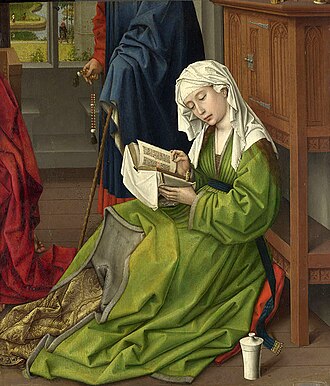 Die lesende Magdalena - Rogier van der Weyden (1435)
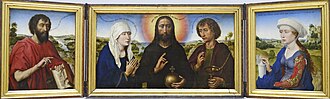 Braque Triptychon - Rogier van der Weyden (1452)
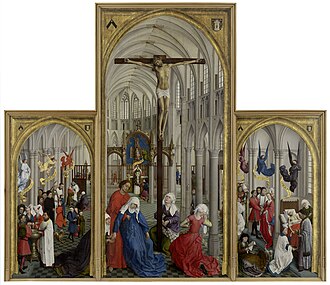 Altar der sieben Sakramente - Rogier van der Weyden (1440s)
Werke verwandter Künstler
 Arnolfini-Porträt - Jan van Eyck (1434)
 Genter Altar - Jan van Eyck (1432)
 Die Verkündigung - Hans Memling (1480s)
 Szenen der Passion Christi - Hans Memling (1470)
 Der Garten der Lüste - Hieronymus Bosch
 Das Narrenschiff - Hieronymus Bosch (1500s)
 Die Jäger im Schnee - Pieter Bruegel the Elder (1565)
 Die niederländischen Sprichwörter - Pieter Bruegel the Elder (1551)