Thronende Maria mit Kind
Rogier van der Weyden · 1430s
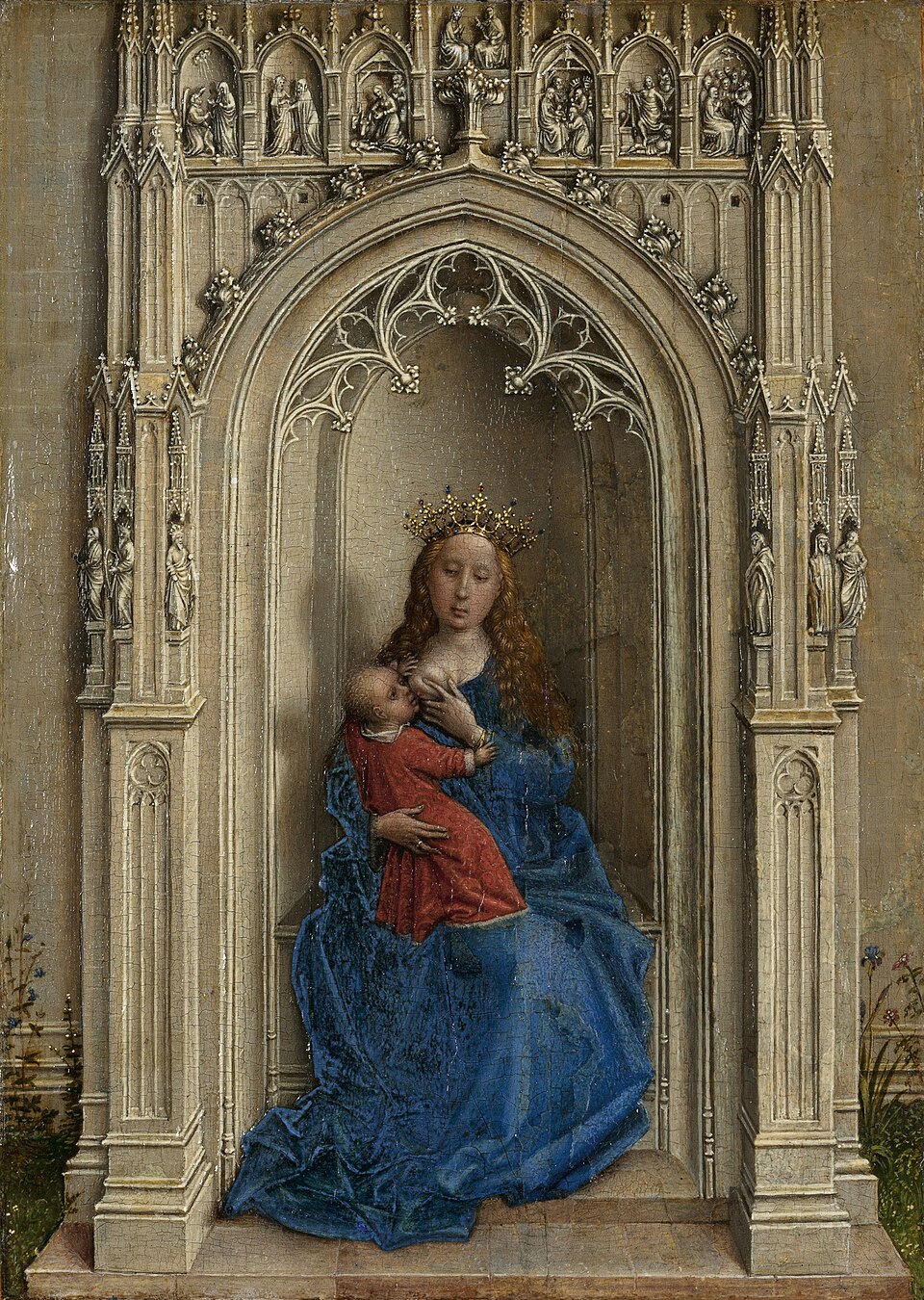
A mother nursing her child, framed by a tiny stone chapel crowded with carved prophets. Barely 16 cm tall, this is the smallest surviving work by Rogier van der Weyden, and probably his earliest.
The story behind the painting
The Virgin and Child Enthroned, also called the Thyssen Madonna, is an oil on oak panel dated about 1433 and usually given to Rogier van der Weyden. It is generally accepted as his earliest surviving work, made just after his apprenticeship with Robert Campin, whose studio he left on 1 August 1432. It may be the left wing of a dismantled diptych; Erwin Panofsky proposed the Saint George and the Dragon in Washington as its partner. Not everyone agrees on the hand: Lorne Campbell gives it to Rogier's workshop, and John Ward credits it to Campin himself, about 1435.
What to look for
At about 15.8 by 11.4 cm, it rewards close looking. Mary nurses the Child, who unusually wears a red garment instead of swaddling. Her loose blond hair falls over her shoulders; she wears a crown as Queen of Heaven and a ring as the Bride of Christ. Light falls from the right, throwing shadows of both heads on the left wall of the niche. Above the arch are six reliefs from the life of the Virgin, topped by her Coronation, and statues of prophets line the sides, David among them. Notice even the four small holes above each arch, likely for scaffolding.
Meaning and intent
The chapel is deliberately too small for the Virgin, stressing her presence while standing for the Church and the doctrine of Redemption. An iris beside it recalls her sorrow at the Passion, a columbine her Sorrows. The prophets are painted as grey stone, separating the divine, frozen in time, from the flesh and blood of mother and child. The panel also shows a young painter's struggles: Mary's head is a little too large, her lap seems to lack volume as if she had one leg, and the buttress foreshortening does not agree with the space, problems Rogier solved in later work.
Legacy
Shirley Blum suggests that pairing this static Madonna with a saint in a real landscape made the saint a living witness to the eternal presence of the Virgin and Child, a simple solution she finds only in early works. Its closeness to Campin's Virgin and Child before a Firescreen in London, in the full breasts, pressing fingers, face and hair, is the heart of the attribution debate. The panel is one of three by Rogier with Madonna and Child enclosed in a niche, and today it is in the Museo Thyssen-Bornemisza in Madrid.
Schon gewusst?
- Usually considered Rogier van der Weyden's earliest surviving work, about 1433.
- His smallest known painting, about 16 by 11 cm.
- Possibly one wing of a diptych with a Saint George.
- In the Museo Thyssen-Bornemisza, Madrid.
Über den Künstler
Rogier van der Weyden (1390s-1464)
religiöse Kunst · Maria · Jesuskind · Flämische Primitive · Museo Thyssen-Bornemisza · Sammlung Thyssen-Bornemisza · Stillen · Maria lactans
Mehr von Rogier van der Weyden
 Kreuzabnahme - Rogier van der Weyden (1440s)
 Porträt einer Dame - Rogier van der Weyden (1460)
 Das Jüngste Gericht - Rogier van der Weyden (1443)
 Lukas-Madonna - Rogier van der Weyden (1490)
 Columba-Altar - Rogier van der Weyden (1450s)
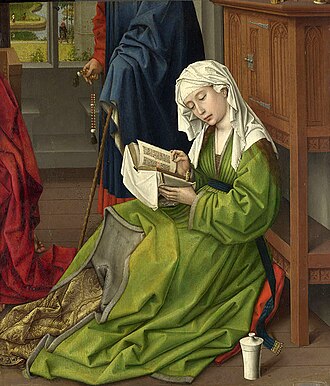 Die lesende Magdalena - Rogier van der Weyden (1435)
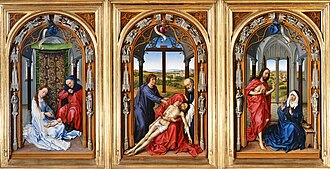 Der Miraflores-Altar - Rogier van der Weyden (1443)
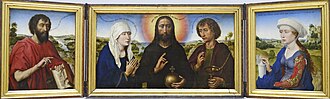 Braque Triptychon - Rogier van der Weyden (1452)
Werke verwandter Künstler
 Arnolfini-Porträt - Jan van Eyck (1434)
 Genter Altar - Jan van Eyck (1432)
 Die Verkündigung - Hans Memling (1480s)
 Szenen der Passion Christi - Hans Memling (1470)
 Der Garten der Lüste - Hieronymus Bosch
 Das Narrenschiff - Hieronymus Bosch (1500s)
 Die Jäger im Schnee - Pieter Bruegel the Elder (1565)
 Die niederländischen Sprichwörter - Pieter Bruegel the Elder (1551)