水差しを持つ女
Johannes Vermeer · 1660
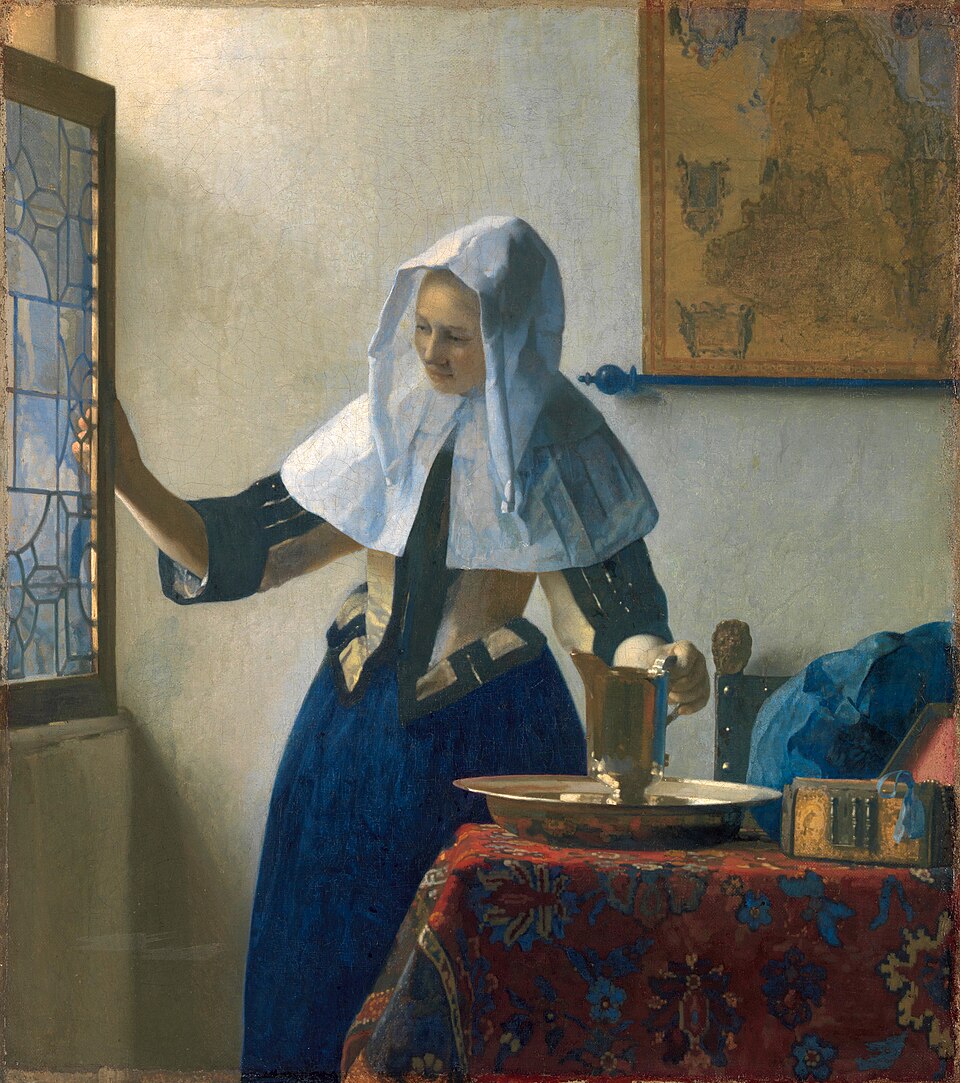
A young woman opens a window with one hand and rests the other on a silver jug. In this quiet room, Vermeer let light alone decide what we see first.
The story behind the painting
Woman with a Water Jug, in Dutch Vrouw met waterkan, also known as Young Woman with a Water Pitcher, was finished by Johannes Vermeer between 1660 and 1662; Wikidata gives 1660. It is an oil on canvas of 45.7 by 40.6 cm, painted in the Baroque style. It belongs to a closely related group of pictures made in the early to mid 1660s, a time when the artist was no longer relying on linear perspective and geometric order, and light was his only source of emphasis.
What to look for
A young woman stands at the centre. With her right hand she opens a window; with her left she holds a water jug resting on a larger platter. These and other objects sit on a table covered with a mostly red rug of Asian origin. Behind the table is a chair with a blue cloth lying on it. She wears a dark blue dress with a black and gold bodice and a white cloth over her head, and she looks out of the window. A map hangs on the wall behind her. Look closely at the jug and the basin.
Meaning and intent
The work suggests that Vermeer understood that light is made of colours, and that colours affect one another. The blue drapery is reflected as dark blue on the side of the metal pitcher, and the red rug changes the golden tone on the underside of the basin. These small reflections tie the room together, so that cloth, metal and skin seem to share the same air. Nothing dramatic happens: a window opens, a hand rests on a jug. Yet that light, falling softly from the window, is what gives the moment its stillness and its weight.
Legacy
Henry Gurdon Marquand bought the painting in 1887 at a gallery in Paris. When he brought it to the United States, it became the first Vermeer in America. Marquand later donated it, along with other works from his collection, to the Metropolitan Museum of Art in New York, where it is on display today. Vermeer is believed to have painted Woman with a Lute shortly after this work, using the same framing of the figure within rectangular forms, so the two paintings can now be seen as close companions in the same museum.
豆知識
- Finished between 1660 and 1662; Wikidata gives 1660.
- Light is the only source of emphasis in the composition.
- Reflections show the blue cloth on the jug and the red rug on the basin.
- The first Vermeer brought to America, by Henry Gurdon Marquand in 1887.
画家について
Johannes Vermeer (1632-1675)
女性 · 肖像 · 風俗美術 · メトロポリタン美術館 · オランダ黄金時代の絵画 · 窓 · ピッチャー · 地図
同じ画家の作品: Johannes Vermeer
 真珠の耳飾りの少女 - Johannes Vermeer (1665)
 牛乳を注ぐ女 - Johannes Vermeer (c. 1658)
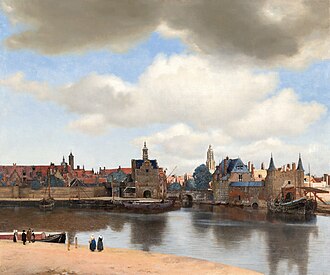 デルフト眺望 - Johannes Vermeer (1660s)
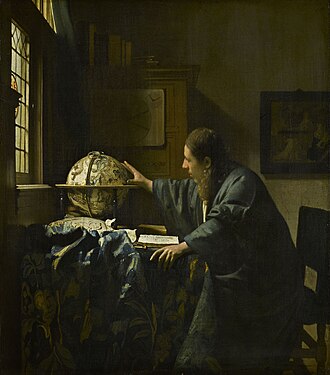 天文学者 - Johannes Vermeer (1664)
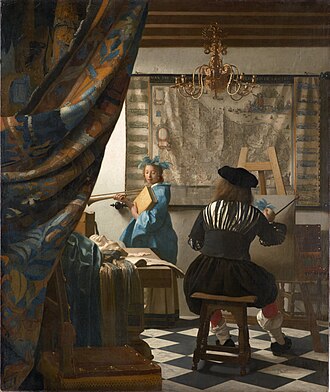 絵画芸術 - Johannes Vermeer (1660s)
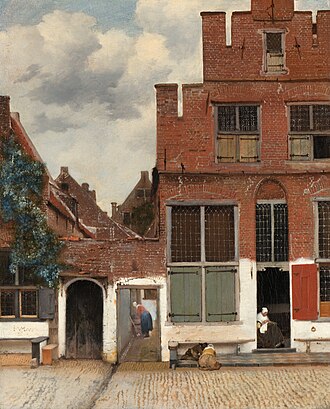 小路 - Johannes Vermeer (1658)
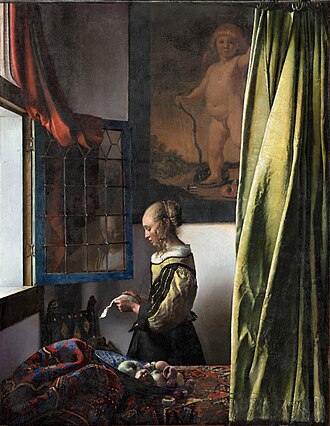 窓辺で手紙を読む女 - Johannes Vermeer (1650s)
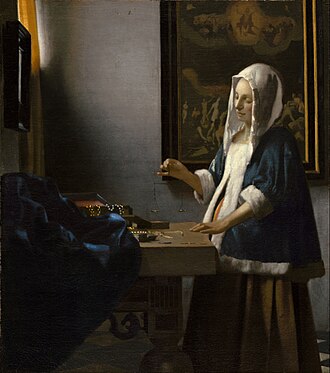 天秤を持つ女 - Johannes Vermeer (1665)
関連する画家の作品
 夜警 - Rembrandt van Rijn (1642)
 自画像 - Rembrandt van Rijn (1659)
 聖ニコラウスのお祭り - Jan Steen (1660s)
 牡蠣を食べる少女 - Jan Steen (1658)
 陽気な酒飲み - Frans Hals (1620s)
 微笑む騎士 - Frans Hals (1624)
 ウェイク・ベイ・ドゥールステーデの風車 - Jacob van Ruisdael (1670)
 The Jewish Cemetery - Jacob van Ruisdael (1650s)
 デルフトの家の中庭 - Pieter de Hooch (1658)
 リンゴの皮を剥く女性 - Pieter de Hooch (1663)