取り持ち女
Johannes Vermeer · 1656
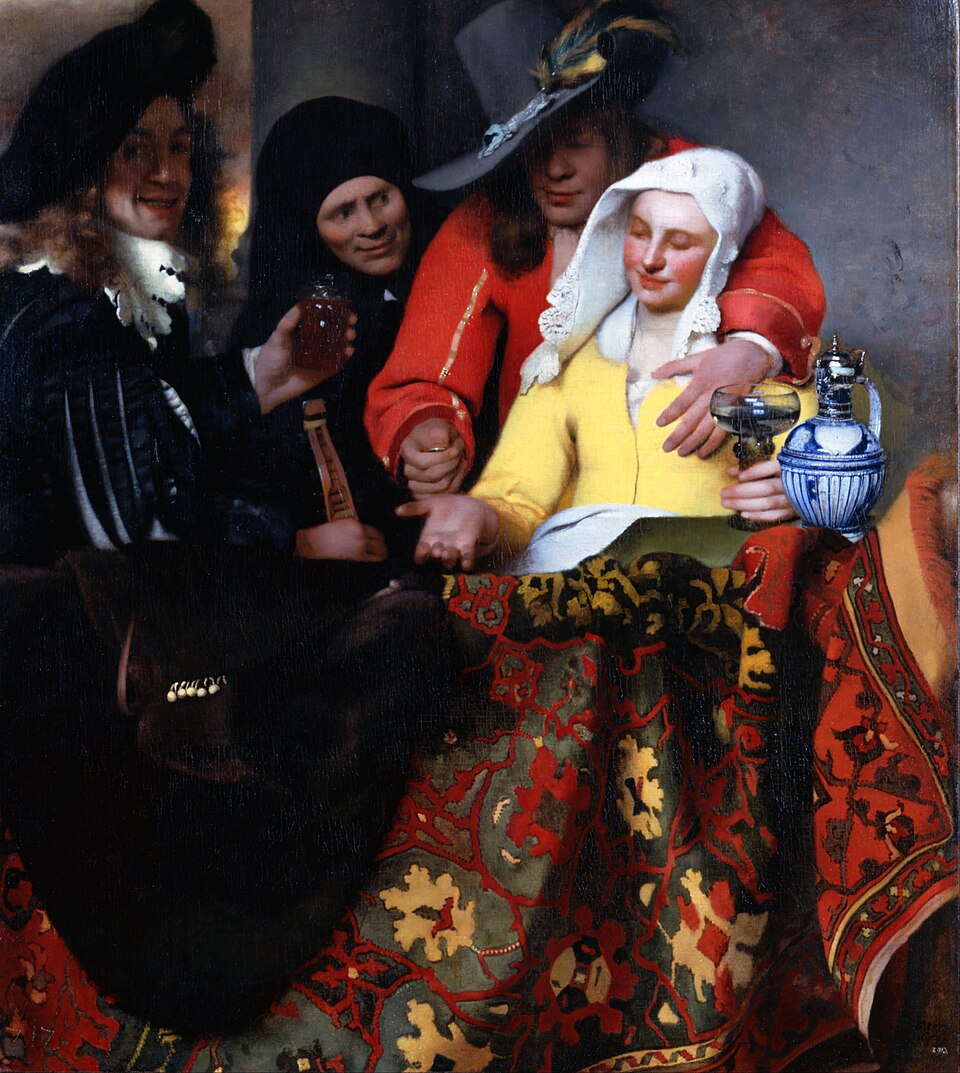
A soldier drops a coin into a young woman's open hand while a woman in black leers beside them, and a man in a black beret, perhaps Vermeer himself, joins the company. Vermeer, aged 24, painted his first scene of everyday life, and it is anything but quiet.
The story behind the painting
Vermeer painted The Procuress in 1656, when he was 24. It is his first genre painting, a scene of contemporary life, and it marks a break from his earlier biblical and mythological pictures. It shows mercenary love, perhaps in a brothel. It is one of only three paintings he signed and dated, with The Astronomer and The Geographer. When it was sold at auction in Amsterdam in 1696, it was called A merry company in a room. Vermeer seems to have known earlier works on the subject by Gerard ter Borch, and The Procuress by Dirck van Baburen, which hung in the home of his mother-in-law Maria Thins.
What to look for
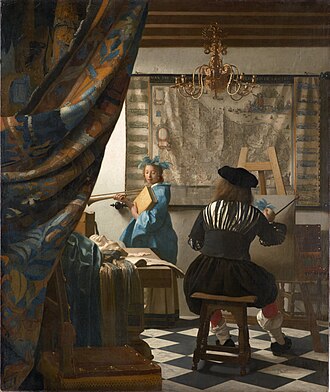
A kilim thrown over a banister, probably made in Uşak, covers a third of the canvas with medallions and leaves. On it stands a Westerwald stoneware jug and a blue wine jug. The man in a red jacket, a soldier, fondles the young woman's breast and drops a coin into her outstretched hand. The woman in black, in something like a nun's costume, may be the procuress herself. At left, a man in a black beret and slashed sleeves, holding what is probably a cittern, has been identified as Vermeer's self-portrait, resembling the painter in his The Art of Painting. The dark coat with five buttons was added later.
Meaning and intent
Critics disagree. Some found the picture untypical of Vermeer because it lacks his usual light. In 1950 Pieter Swillens wrote that, if it was by Vermeer at all, it showed the artist seeking and groping for a way to express himself. Ten years earlier, Eduard Trautscholdt had written that here the young painter's temperament fully emerges for the first time. Benjamin Binstock reads this dark and gloomy picture as a psychological portrait of Vermeer's adopted family rather than a moral lesson, with his wife Catherina as the procuress and her brother Willem as the soldier.
Legacy
The painting was in the Waldstein collection at Dux, now Duchcov, and was bought in 1741 for Augustus III of Poland, Elector of Saxony. It hangs in the Gemäldegalerie Alte Meister in Dresden. In 1968 Hermann Kühn analysed its pigments: ultramarine in the blue jug and lead-tin yellow in the woman's jacket, as usual for Vermeer, but also smalt in the green tablecloth and background, less usual for him. It should not be confused with a fake once attributed to Vermeer; analysis in 2011 found Bakelite in its paint, proving it a modern forgery, most probably by Han van Meegeren.
豆知識
- Painted in 1656, Vermeer's first genre painting.
- One of only three works Vermeer signed and dated.
- The man at left may be a self-portrait.
- Bought in 1741 for the Elector of Saxony.
画家について
Johannes Vermeer (1632-1675)
風俗美術 · オランダ黄金時代の絵画 · ドレスデン美術館
同じ画家の作品: Johannes Vermeer
 真珠の耳飾りの少女 - Johannes Vermeer (1665)
 牛乳を注ぐ女 - Johannes Vermeer (c. 1658)
 デルフト眺望 - Johannes Vermeer (1660s)
 天文学者 - Johannes Vermeer (1664)
 絵画芸術 - Johannes Vermeer (1660s)
 小路 - Johannes Vermeer (1658)
 窓辺で手紙を読む女 - Johannes Vermeer (1650s)
 天秤を持つ女 - Johannes Vermeer (1665)
関連する画家の作品
 夜警 - Rembrandt van Rijn (1642)
 自画像 - Rembrandt van Rijn (1659)
 聖ニコラウスのお祭り - Jan Steen (1660s)
 牡蠣を食べる少女 - Jan Steen (1658)
 陽気な酒飲み - Frans Hals (1620s)
 微笑む騎士 - Frans Hals (1624)
 ウェイク・ベイ・ドゥールステーデの風車 - Jacob van Ruisdael (1670)
 The Jewish Cemetery - Jacob van Ruisdael (1650s)
 デルフトの家の中庭 - Pieter de Hooch (1658)
 リンゴの皮を剥く女性 - Pieter de Hooch (1663)