1639年の聖ゲオルギウス市民警備隊士官の宴会
フランス・ハルス · 1639
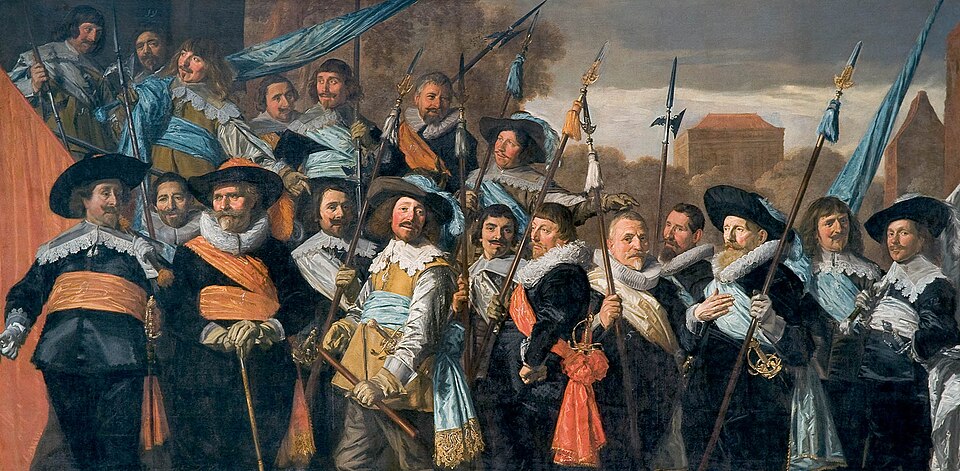
Nineteen men across more than four metres of canvas, three flags in orange, white and blue, and in the back row, perhaps, the painter himself looking out. This was Frans Hals's last and largest portrait of Haarlem's St George guard.
The story behind the painting
Hals painted this group for the St George, or St Joris, civic guard of Haarlem, the same company for which he had made his first such portrait, the banquet of 1616. The officers were chosen by the city council for three years, and this group had just ended its tenure and celebrated with a portrait. By then Hals had been a soldier of the guard for 25 years, and 23 years had passed since that first commission, a highly unusual span between commissions for any artist of his time. It became his last and largest guard portrait.
What to look for
Every man wears a sash in the colour of his brigade, and all three brigades are present, their ensigns carrying orange, white and blue flags. Third from the lower left, with an orange sash and an orange feather in his hat, stands Colonel Johan Claesz Loo with the commander's staff. The other ranks can be read by their weapons: captains with tasselled partisans, lieutenants with spontoons, sergeants with halberds. Then look at the back row, upper left: the second face is identified as Frans Hals himself. The building behind the men is not the guard's own hall but looks like Gemeenlandshuis Zwanenburg.
Meaning and intent
Hals was never made an officer, yet he appears among them, as does his fellow portraitist Hendrik Gerritsz Pot. Historians have asked whether the face is really Hals or an absent officer, since the men paid for their places and some skipped a painting. The back row is almost an artists' lineup: Lieutenant Cornelis Coning was an engraver, Ensign Jacob Druyvesteyn was the son of a painter, and Sergeant van der Schalcken was the father of a painter some say made the original landscape. In front sits Quirijn Jansz Damast, a designer of fine linen whose work appears in the tablecloth of Hals's 1616 banquet.
Legacy
In 1706, according to the guard's archives, Colonel Pieter Schatter paid the painter Dirk Maas to touch up the picture, which explains the borrowed building; the source also dates the overpainting to 1702, a small inconsistency. Why Schatter did it is unknown, perhaps to honour the Peace of Münster and the architect Pieter Post. The painting once hung in the St Jorisdoelen, later an inn where the guard portraits were tourist attractions, and by 1819 it was in Haarlem City Hall. Today it is one of the main attractions of the Frans Hals Museum.
豆知識
- Hals's last and largest civic guard portrait, over 4 metres wide.
- Nineteen men from all three brigades of the St George guard.
- The back row includes what is identified as a self-portrait of Hals.
- The background landscape was partly overpainted by Dirk Maas.
画家について
フランス・ハルス (1591-1666)
同じ画家の作品: フランス・ハルス
 陽気な酒飲み - Frans Hals (1620s)
 微笑む騎士 - Frans Hals (1624)
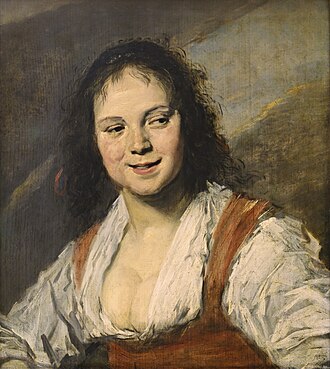 ジプシー女 - Frans Hals (1628)
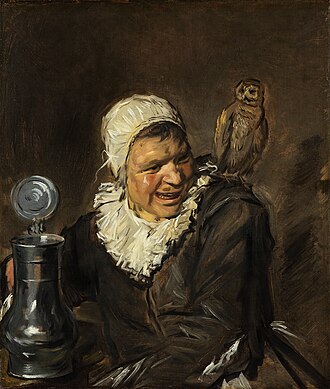 マッレ・バッベ - Frans Hals (1640s)
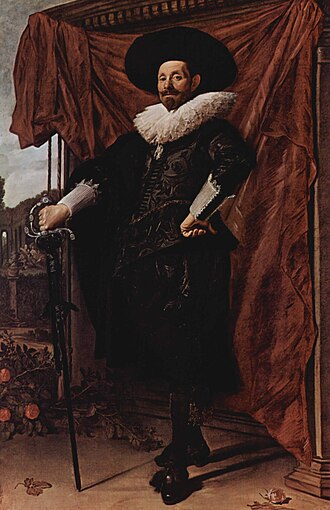 剣を持ってポーズをとるウィレム・ファン・ヘイトゥイセン - Frans Hals (1625)
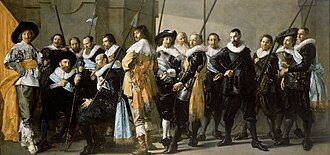 Militia Company of District XI under the Command of Captain Reynier Reael - Frans Hals (1630s)
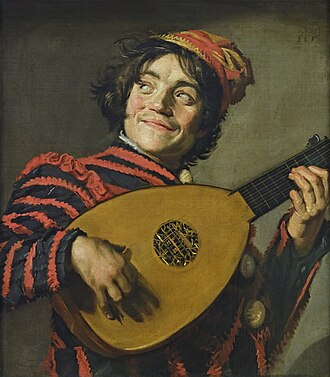 リュートを弾く道化師 - Frans Hals (1623)
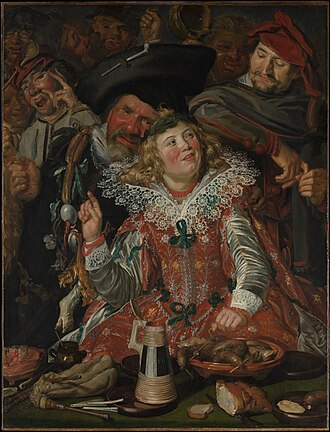 ざんげ節に浮かれ騒ぐ人々 - Frans Hals (1610s)
関連する画家の作品
 夜警 - Rembrandt van Rijn (1642)
 自画像 - Rembrandt van Rijn (1659)
 真珠の耳飾りの少女 - Johannes Vermeer (1665)
 牛乳を注ぐ女 - Johannes Vermeer (c. 1658)
 聖ニコラウスのお祭り - Jan Steen (1660s)
 牡蠣を食べる少女 - Jan Steen (1658)
 ウェイク・ベイ・ドゥールステーデの風車 - Jacob van Ruisdael (1670)
 The Jewish Cemetery - Jacob van Ruisdael (1650s)
 デルフトの家の中庭 - Pieter de Hooch (1658)
 リンゴの皮を剥く女性 - Pieter de Hooch (1663)