The Immaculate Conception
フランシスコ・デ・スルバラン · 1661
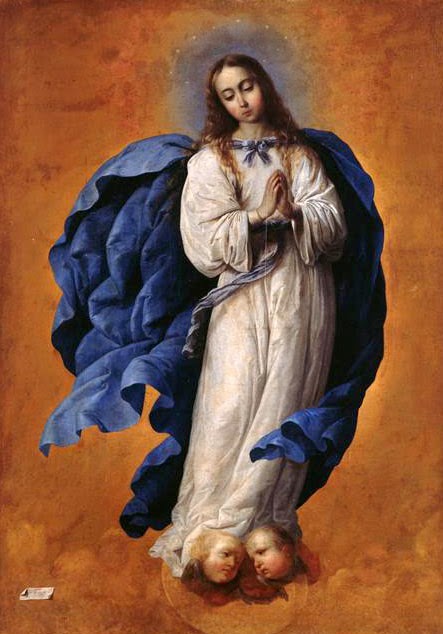
No towers, no fountains, no symbols: only Mary, absorbed in prayer, floating in golden light, her blue mantle tossed by an unseen wind. Zurbarán signed and dated this canvas in 1661, one of his last two versions of the theme, and it hangs in a French parish church.
The story behind the painting
Over some thirty years Zurbarán painted thirteen versions of the Immaculate Conception, changing his style and adding new ideas while staying within the rules of the Counter-Reformation. This canvas and the one in Budapest are his last two. Both date from 1661, the year Pope Alexander VII approved the doctrine and authorised its cult, which Spain celebrated after years of enforced silence, though it was not yet a dogma. The model for Mary in both may have been María Manuela, the painter's daughter with his third wife, Leonor de Tordera. It is signed and dated on a small card, lower left: Franco dezur baran.f/1661. It is number 285 in Odile Delenda's catalogue.
What to look for
The traditional litany symbols are missing, and the usual stars of the halo are reduced to tiny white dots. Zurbarán shows only the Virgin, deeply absorbed, bathed in golden light and floating in the sky against a sunlit ground. Her face is admired for its sweetness, the fine drawing of her half-closed eyes and her long wavy blond hair. The halo around her head stands out against a blue-grey sky edged with yellowish clouds, copper at the rims; beyond it the clouds turn pink and in places become golden cherubs. Her joined hands are very delicate. The white tunic falls in soft vertical folds, while the deep blue mantle forms heavy folds as if blown by the wind.
Meaning and intent
By stripping away the symbols, Zurbarán leaves nothing between the viewer and Mary's quiet absorption. The source calls the windblown mantle a piece of painting of exceptional quality, its movement typical of the Spanish Baroque. The work is praised for its beautiful colour and luminosity. Painted in the very year the long-awaited papal approval arrived, and possibly using his own young daughter as the model, this late canvas feels like the end of a long conversation the painter had held with this subject for three decades.
Legacy
In 1837 the painting was in the gallery of Aniceto Bravo in Seville. It later reached the sacristy of the parish church of Saint-Gervais-Saint-Protais in Langon, in France's Nouvelle-Aquitaine region. From 1966 to 1970 it was deposited at the Musée des Beaux-Arts in Bordeaux, where Robert Garrigou restored it in 1966, and it was returned to Langon in 1970. It was restored again in 2000 by Marie Paule Barra in Angoulême. Tiziana Frati lists it as number 490, next to the Budapest version at 489.
豆知識
- Signed and dated 1661, 140 by 103 cm.
- One of Zurbarán's last two Immaculate Conceptions, with the Budapest canvas.
- The model may have been his daughter María Manuela.
- Kept in the parish church of Saint-Gervais-Saint-Protais, Langon.
画家について
フランシスコ・デ・スルバラン (1598-1664)
同じ画家の作品: フランシスコ・デ・スルバラン
 Saint Francis in Meditation - Francisco de Zurbarán (1639)
 The Immaculate Conception - Francisco de Zurbarán (1661)
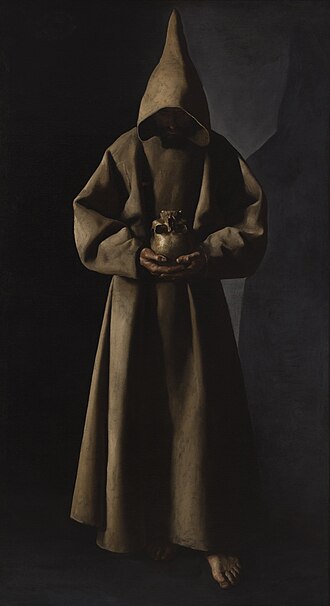 Saint Francis - Francisco de Zurbarán (1635)
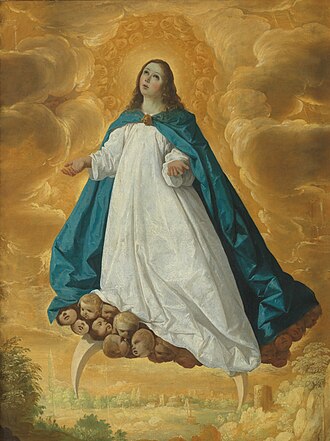 The Immaculate Conception - Francisco de Zurbarán (1635)
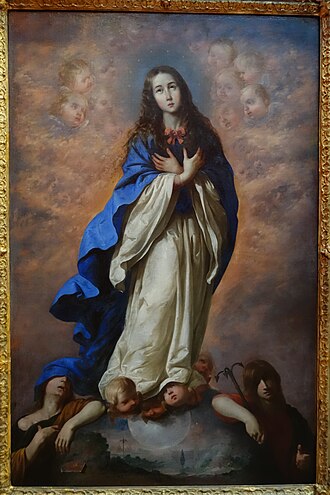 The Immaculate Conception - Francisco de Zurbarán (1658)
 The Immaculate Conception - Francisco de Zurbarán (1630)
 Saint Lawrence - Francisco de Zurbarán (1630s)
 The Immaculate Conception - Francisco de Zurbarán (1645)
関連する画家の作品
 エマオの晩餐 - Caravaggio (1601)
 聖マタイの召命 - Caravaggio (1609)
 ラス・メニーナス - Diego Velázquez (1656)
 ブレダの開城 - Diego Velázquez (1635)
 チャールズ1世の三面肖像画 - Anthony van Dyck (1635)
 馬上のチャールズ1世とサン・アントワーヌの領主の肖像 - Anthony van Dyck (1636)
 キリスト昇架 - Peter Paul Rubens (1609)
 レウキッポスの娘たちの略奪 - Peter Paul Rubens (1618)
 夜警 - Rembrandt van Rijn (1642)
 自画像 - Rembrandt van Rijn (1659)
 陽気な酒飲み - Frans Hals (1620s)
 微笑む騎士 - Frans Hals (1624)