The Immaculate Conception
フランシスコ・デ・スルバラン · 1630
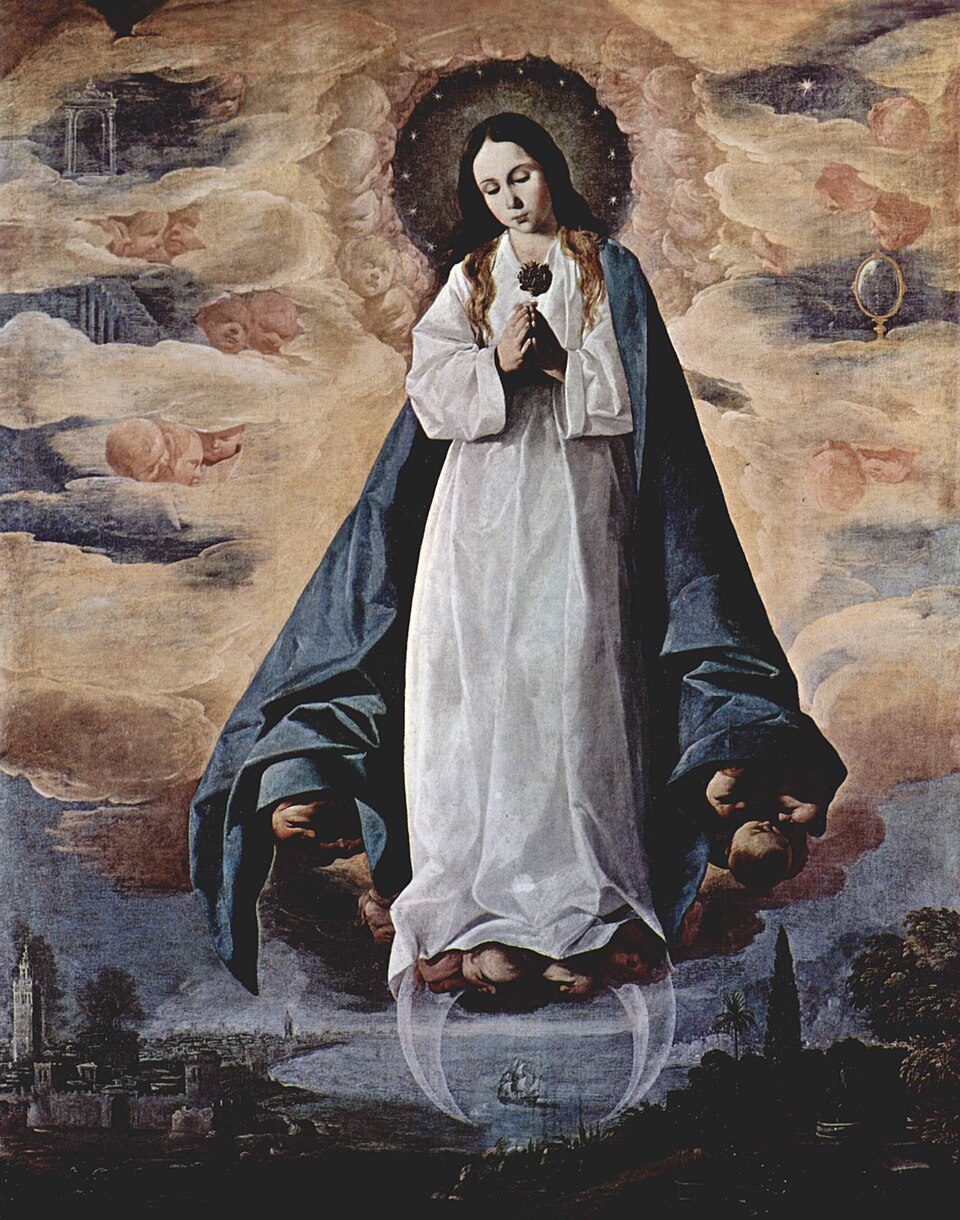
The Virgin floats in white above a landscape full of hidden symbols, and among them rises the bell tower of Seville's cathedral. Zurbarán may have painted it for Seville's city council, or a few years later.
The story behind the painting
On 8 June 1630 the city council of Seville recorded that Zurbarán would take charge of a painting of the Immaculate Conception for its lower chapter hall. Because the Giralda, Seville's famous tower, appears in this canvas, it has been linked to that commission. The order came only days after Alonso Cano demanded that Zurbarán sit an exam of professional competence, which could explain the care shown here. But the historian Jeannine Baticle doubts this is the 1630 painting, since its style seems later. The Spanish Wikipedia article dates it around 1635, while Wikidata gives 1630. It is number 87 in Odile Delenda's catalogue.
What to look for
The canvas, about 174 by 138 cm, has a large heavenly zone and a smaller earthly one. Mary resembles the figure in Zurbarán's first Immaculate Conception of 1629, but here, for the first time in his work, she wears a white dress, arranged geometrically on both sides of her body. Three groups of small angel heads appear: two under the ends of her mantle and one beneath her tunic, inside the moon. Below lies a city, sea and flower landscape. Around her in the sky float the Mirror of Justice, the Morning Star, Jacob's Ladder and the Gate of Heaven.
Meaning and intent
The image of the Immaculate Conception grew during the sixteenth century from a verse of the Book of Revelation and symbols from the Litany of Loreto. A 1618 treatise by Luis del Alcázar advised that the horns of the moon point down, and Francisco Pacheco devised a transparent crescent moon. Pacheco placed Mary's symbols among clouds, but Zurbarán sets them in a real landscape. On the left stand signs of strength and beauty, the City of God, the Tower of Ivory and the Tower of David, shown as the Giralda. On the right are the Enclosed Garden, the Sealed Fountain and the Well of Living Water, and in the centre a double bay recalls Mary as Refuge of sailors.
Legacy
The painting's early history is uncertain, and the source marks several steps with question marks: Seville city council in 1630, the collection of Jovellanos in Madrid, then Juan José Arias de Saavedra between 1808 and 1811. It later belonged to his great granddaughter María Cristina Perlado y Verdugo in Jadraque, who gave it in 1952 to the parish school of Nuestra Señora del Carmen there. It was restored in Madrid in 1965 to 1966 and is now on deposit in the Museo Diocesano de Arte Antiguo in Sigüenza. It is also catalogued by Tiziana Frati as number 66.
豆知識
- Possibly the painting Seville's city council ordered from Zurbarán in 1630.
- Dated around 1635 by Wikipedia; Wikidata gives 1630.
- The first time Zurbarán painted Mary in a white dress.
- On deposit in the Museo Diocesano de Arte Antiguo, Sigüenza.
画家について
フランシスコ・デ・スルバラン (1598-1664)
同じ画家の作品: フランシスコ・デ・スルバラン
 Saint Francis in Meditation - Francisco de Zurbarán (1639)
 The Immaculate Conception - Francisco de Zurbarán (1661)
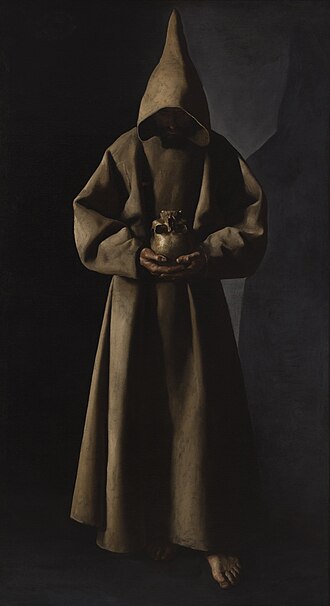 Saint Francis - Francisco de Zurbarán (1635)
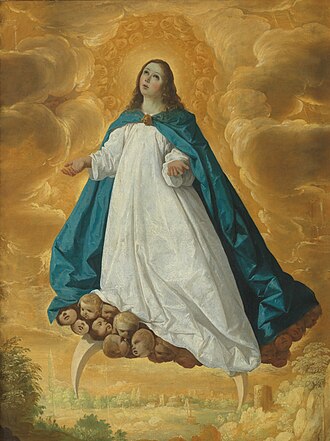 The Immaculate Conception - Francisco de Zurbarán (1635)
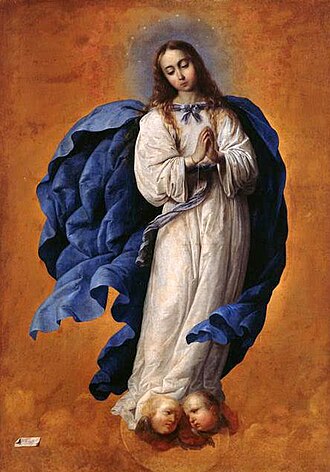 The Immaculate Conception - Francisco de Zurbarán (1661)
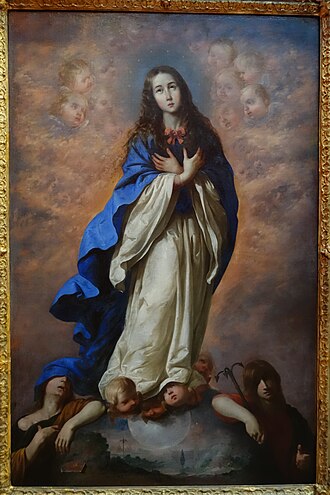 The Immaculate Conception - Francisco de Zurbarán (1658)
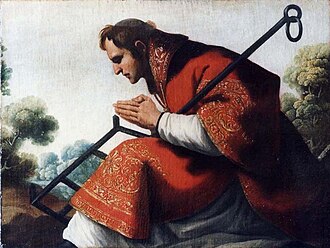 Saint Lawrence - Francisco de Zurbarán (1630s)
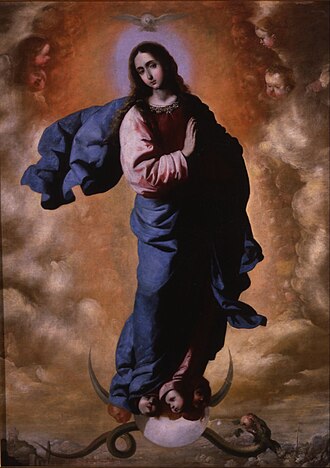 The Immaculate Conception - Francisco de Zurbarán (1645)
関連する画家の作品
 エマオの晩餐 - Caravaggio (1601)
 聖マタイの召命 - Caravaggio (1609)
 ラス・メニーナス - Diego Velázquez (1656)
 ブレダの開城 - Diego Velázquez (1635)
 チャールズ1世の三面肖像画 - Anthony van Dyck (1635)
 馬上のチャールズ1世とサン・アントワーヌの領主の肖像 - Anthony van Dyck (1636)
 キリスト昇架 - Peter Paul Rubens (1609)
 レウキッポスの娘たちの略奪 - Peter Paul Rubens (1618)
 夜警 - Rembrandt van Rijn (1642)
 自画像 - Rembrandt van Rijn (1659)
 陽気な酒飲み - Frans Hals (1620s)
 微笑む騎士 - Frans Hals (1624)