首当てをつけた自画像
Rembrandt van Rijn · 1629
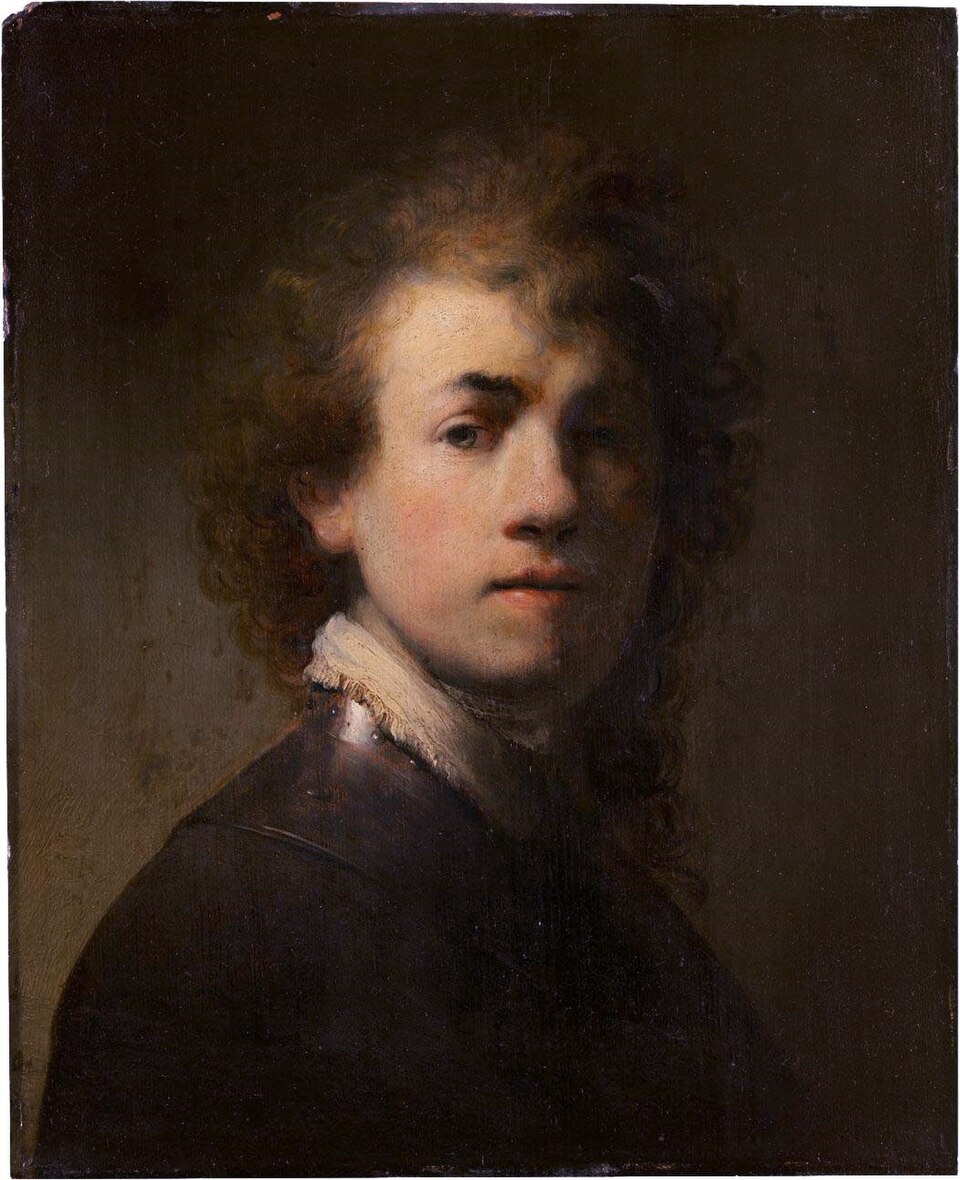
A young Rembrandt turns to look at us, light catching on an iron gorget at his throat. For most of the twentieth century this small oak panel in Nuremberg was dismissed as a copy. Around the year 2000 it was recognised as the original.
The story behind the painting
Rembrandt painted this small portrait on an oak panel around 1629, when he was still a young man. Before it he had already slipped his own face into biblical and history scenes as a minor figure, and painted several self-portraits. A drawing dated 1628 or 1629, kept in the British Museum since 1799, is cited as a study for some of these early self-portraits, this one included. The panel belongs to the city of Nuremberg and is on permanent loan to the Germanisches Nationalmuseum. Tree-ring study by Peter Klein found that its wood comes from the same tree as the Laughing Man in the Rijksmuseum.
What to look for
Rembrandt shows himself bust-length, turned three quarters to the right, his head turning back to meet our eyes. His skin is slightly pink, brown curls fall onto his forehead, and on the left side a single long lovelock hangs down to his shoulder. Over a dark doublet he wears an iron gorget and a white scarf. The background is a grey-brown wall that seems to be made of brick. Light comes from the left, glints on the metal, brightens one side of his face and leaves his left eye in shadow. Look closely at the mouth, slightly open, and the untidy curls.
Meaning and intent
The gorget and the lovelock belonged to young aristocrats and officers. The lovelock was a fashion of the 1620s and 1630s in England, France and Germany, rare in the Dutch Republic, where painters gave it almost only to foreign nobles. Rembrandt was never a member of the civic guard, so the gorget can be read as vanity or as patriotism. He did own one, listed in the 1656 inventory of his goods, but it is very doubtful he wore it outside painting. The picture is therefore less a strict self-portrait than a tronie with the artist's features. The shining metal may also have been a way to throw more light onto his face.
Legacy
Until 1998 this panel was considered a copy of a version in the Mauritshuis in The Hague. Debate among art historians around 2000 reversed that view: Nuremberg holds the original, and the Mauritshuis panel is a workshop copy, with other copies also made in the studio. In the copy, the head is raised, the mouth closed and the curls tidied, giving a more gentlemanly air. Old reports disagree about the signature. Rudolf Bergau saw faint traces of a monogram, a 1909 catalogue mentioned only an R, and in 1969 the Rembrandt Research Project found none. Remains of the RHL monogram were only found by research at the end of the century.
豆知識
- Oil on oak panel, about 38 by 31 cm, painted around 1629.
- Owned by the city of Nuremberg, on loan to the Germanisches Nationalmuseum.
- Long seen as a copy, it was identified as the original around 2000.
- The panel's wood comes from the same tree as Rembrandt's Laughing Man.
画家について
Rembrandt van Rijn (1606-1669)
自画像 · レンブラント・ファン・レイン · ゲルマン国立博物館
同じ画家の作品: Rembrandt van Rijn
 夜警 - Rembrandt van Rijn (1642)
 自画像 - Rembrandt van Rijn (1659)
 テュルプ博士の解剖学講義 - Rembrandt van Rijn (1632)
 ユダヤの花嫁 - Rembrandt van Rijn (1660s)
 ガラリアの海の嵐 - Rembrandt van Rijn (1633)
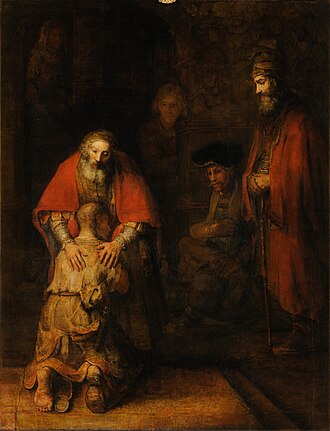 放蕩息子の帰還 - Rembrandt van Rijn (1668)
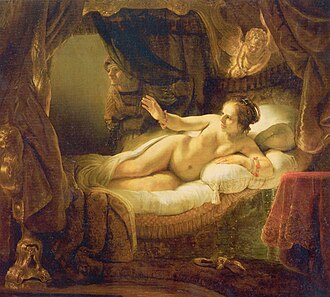 ダナエ - Rembrandt van Rijn (1636)
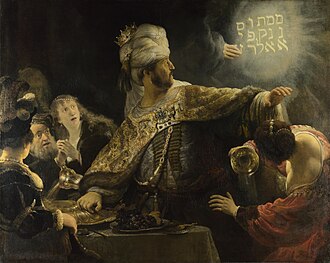 ベルシャザルの酒宴 - Rembrandt van Rijn (1636)
関連する画家の作品
 真珠の耳飾りの少女 - Johannes Vermeer (1665)
 牛乳を注ぐ女 - Johannes Vermeer (c. 1658)
 聖ニコラウスのお祭り - Jan Steen (1660s)
 牡蠣を食べる少女 - Jan Steen (1658)
 陽気な酒飲み - Frans Hals (1620s)
 微笑む騎士 - Frans Hals (1624)
 ウェイク・ベイ・ドゥールステーデの風車 - Jacob van Ruisdael (1670)
 The Jewish Cemetery - Jacob van Ruisdael (1650s)
 デルフトの家の中庭 - Pieter de Hooch (1658)
 リンゴの皮を剥く女性 - Pieter de Hooch (1663)