Portrait of Catrina Hoogsaet
Rembrandt van Rijn · 1657
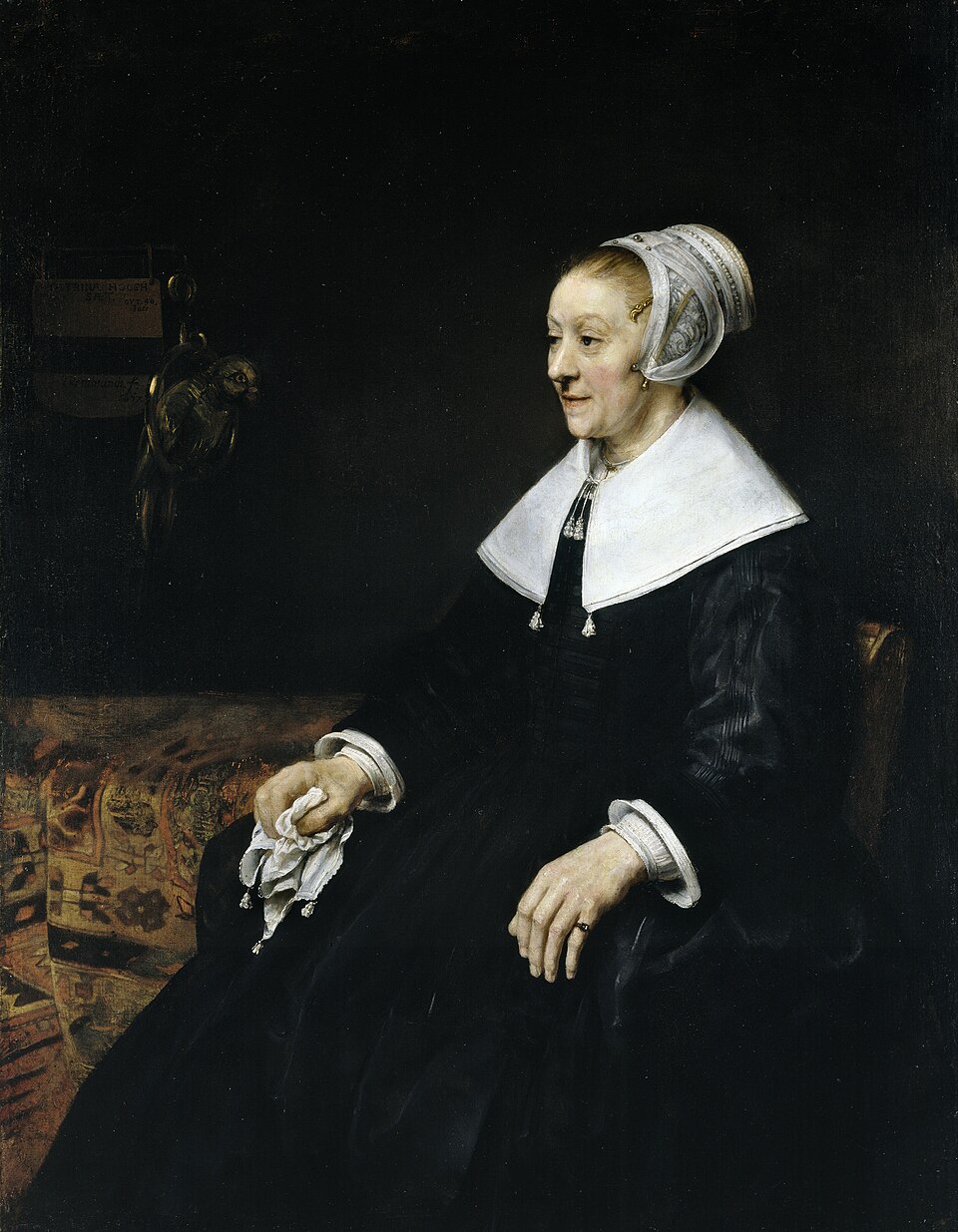
A Mennonite woman of fifty sits in sober black, but her eyes are on her parrot. Rembrandt painted Catharina Hooghsaet in 1657, the same year she wrote a will that left the portrait to her brother and the bird to a friend.
The story behind the painting
Catharina Hooghsaet lived from 1607 to 1685. When Rembrandt painted her in 1657 she was fifty and, according to a biography written in 2014, living apart from her husband. That same year she drew up her will. She named several nieces and nephews and left sums to the poor of both the Mennonite and the Reformed communities. The Rembrandt portrait was left to her brother, and the parrot to Giertje Crommelingh. Her family name is spelled several ways, Hoogsaet, Hooghsaet or Hoogzaad, and traces back to a farm called Hoochsaet in Nieuwe Niedorp.
What to look for
The canvas is about 123.5 by 95 cm. Catharina sits in an armchair, both arms stretched along it, turned to the left and looking that way, a handkerchief in her right hand. She wears the black gown of a citizen's wife with a plain flat white collar and a white cap over her smoothly combed hair. Beside her a table carries a Turkish carpet with a red pattern, and above it a parrot sits in a metal ring hanging from a bracket on the wall. On two labels on that bracket Rembrandt wrote her name, her age of fifty and the date 1657.
Meaning and intent
A pet is unusual in a portrait, and here it changes everything. Catharina looks at her parrot with a satisfied expression, and Horst Gerson remarked that her lively contact with the bird would make an interesting subject for a book about Rembrandt and animals. Her dress is the sober black of the Mennonites, yet its silky sheen, her pearl pin, hairpin, ring and gold cap support quietly show her wealth. Modest faith and comfortable means meet in one figure, softened by a private affection.
Legacy
The portrait was in the collection of Lord Penrhyn at Penrhyn Castle and was shown in London exhibitions in the 19th and early 20th centuries. It was lent to the Rijksmuseum in 2006 and again for exhibitions of Rembrandt's late works in London and Amsterdam in 2014 and 2015. In 2015 it was sold to a buyer abroad. The UK judged it a national treasure and placed a temporary export bar, and the buyer withdrew the export application so it could stay in Britain for the time being. It was then displayed at the National Museum Cardiff.
豆知識
- Painted by Rembrandt in 1657, when the sitter was fifty.
- Her will left the portrait to her brother and the parrot to a friend.
- Signed on two labels on the parrot's wall bracket.
- Ruled a UK national treasure in 2015.
画家について
Rembrandt van Rijn (1606-1669)
肖像 · ナショナル・トラスト
同じ画家の作品: Rembrandt van Rijn
 夜警 - Rembrandt van Rijn (1642)
 自画像 - Rembrandt van Rijn (1659)
 テュルプ博士の解剖学講義 - Rembrandt van Rijn (1632)
 ユダヤの花嫁 - Rembrandt van Rijn (1660s)
 ガラリアの海の嵐 - Rembrandt van Rijn (1633)
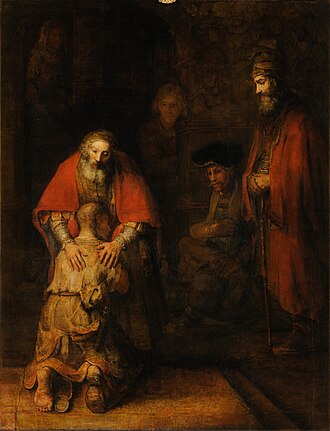 放蕩息子の帰還 - Rembrandt van Rijn (1668)
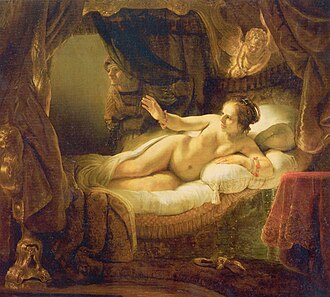 ダナエ - Rembrandt van Rijn (1636)
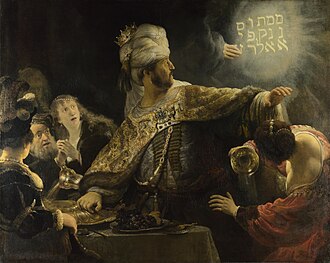 ベルシャザルの酒宴 - Rembrandt van Rijn (1636)
関連する画家の作品
 真珠の耳飾りの少女 - Johannes Vermeer (1665)
 牛乳を注ぐ女 - Johannes Vermeer (c. 1658)
 聖ニコラウスのお祭り - Jan Steen (1660s)
 牡蠣を食べる少女 - Jan Steen (1658)
 陽気な酒飲み - Frans Hals (1620s)
 微笑む騎士 - Frans Hals (1624)
 ウェイク・ベイ・ドゥールステーデの風車 - Jacob van Ruisdael (1670)
 The Jewish Cemetery - Jacob van Ruisdael (1650s)
 デルフトの家の中庭 - Pieter de Hooch (1658)
 リンゴの皮を剥く女性 - Pieter de Hooch (1663)