少女
Johannes Vermeer · 1665
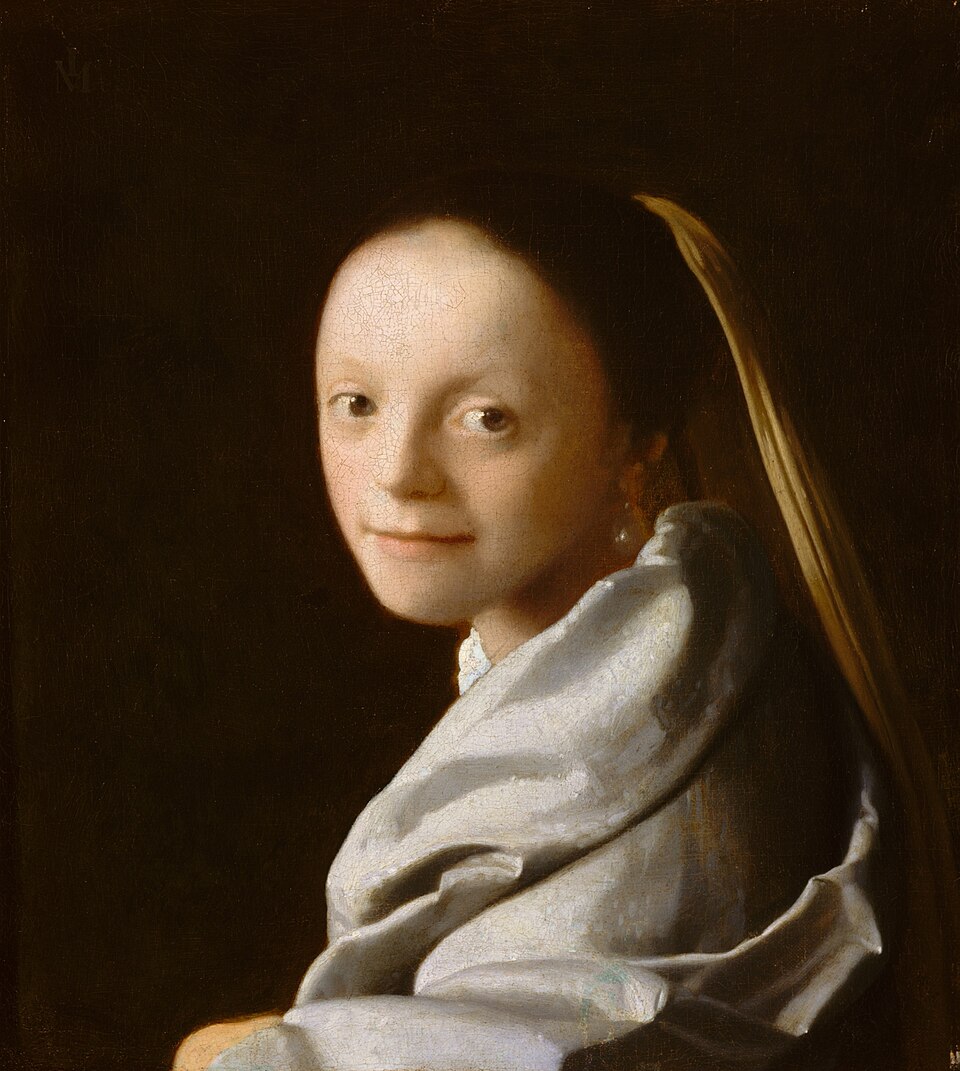
Out of a deep black background a young girl turns toward us, a pearl at her ear and a scarf over her shoulders. She is not a conventional beauty, and that is exactly why Vermeer's picture feels so tender.
The story behind the painting
Vermeer painted this work, also called Study of a Young Woman or Girl with a Veil, between 1665 and 1667, around the same time as the far better known Girl with a Pearl Earring. The two are nearly the same size and close in tone and composition, so the picture is sometimes seen as a variant or a companion of the famous girl. Both sitters wear pearl earrings and draped scarves before a plain black ground. It has been suggested, though widely contested, that an optical device such as a camera obscura or a mirror helped in making both.
What to look for
Look at the face: wide-set and flat, with a small nose and thin lips on a relatively large head. Vermeer did not idealise her. The deep black background is unusual for him, since he usually gave his figures rich interiors. Here the girl is isolated, and the darkness seems to heighten her vulnerability and her wish to trust the viewer. Notice how her expression invites questions about what she thinks and feels, a curiosity that runs through many of Vermeer's paintings. The pearl and the soft scarf catch the light against that darkness.
Meaning and intent
Because she lacks idealised beauty, many believe the painting was a commission, though the model may have been Vermeer's own daughter. He probably worked from a live model, yet, as with Girl with a Pearl Earring, he made not a portrait but a tronie, a Dutch word for a face or expression. Such pictures were valued for unusual costumes, intriguing faces, a hint of personality and a show of skill. In 1994 Edward Snow wrote that the painting turns the desire for beauty and perfection into a loving acceptance of what is flawed.
Legacy
The painting may have belonged to Pieter Claesz van Ruijven of Delft before 1674 and then to his family, and it is thought to have been in the Dissius sale of 1696. In 1816 it was sold in Rotterdam for a sum that was tiny even then. Prince Auguste d'Arenberg owned it by 1829, and it stayed with his family in Brussels and Schloss Meppen until the early 1950s. Charles and Jayne Wrightsman bought it in 1959, or 1955 according to another source, and in 1979 gave it to the Metropolitan Museum of Art in memory of curator Theodore Rousseau Jr.
豆知識
- Painted between 1665 and 1667.
- Close in size and composition to Girl with a Pearl Earring.
- A tronie, a study of a face, rather than a formal portrait.
- Given to the Metropolitan Museum of Art in 1979.
画家について
Johannes Vermeer (1632-1675)
女性 · 肖像 · オランダ黄金時代の絵画 · メトロポリタン美術館 · 肖像
同じ画家の作品: Johannes Vermeer
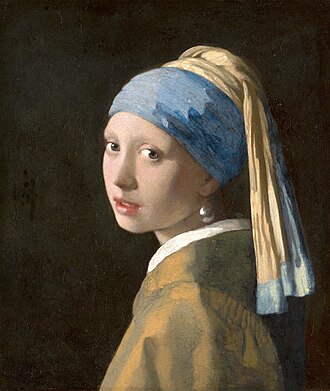 真珠の耳飾りの少女 - Johannes Vermeer (1665)
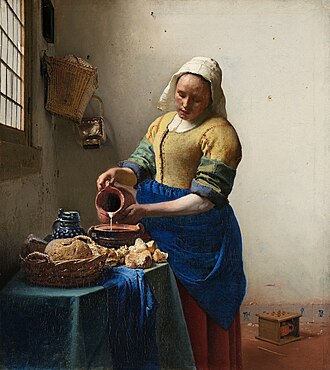 牛乳を注ぐ女 - Johannes Vermeer (c. 1658)
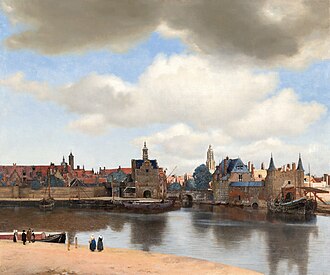 デルフト眺望 - Johannes Vermeer (1660s)
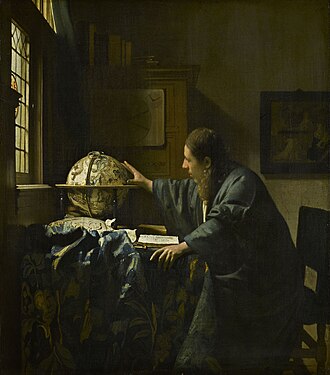 天文学者 - Johannes Vermeer (1664)
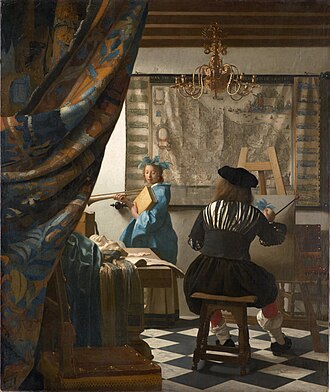 絵画芸術 - Johannes Vermeer (1660s)
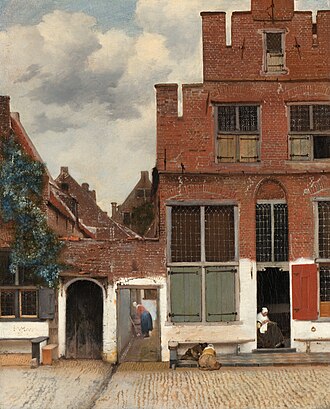 小路 - Johannes Vermeer (1658)
.jpg) 窓辺で手紙を読む女 - Johannes Vermeer (1650s)
窓辺で手紙を読む女 - Johannes Vermeer (1650s)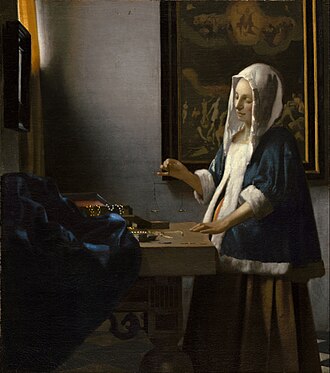 天秤を持つ女 - Johannes Vermeer (1665)
 夜警
夜警 自画像
自画像