ファン・ベレステイン家の一員と思われる男性の肖像
Rembrandt van Rijn · 1632
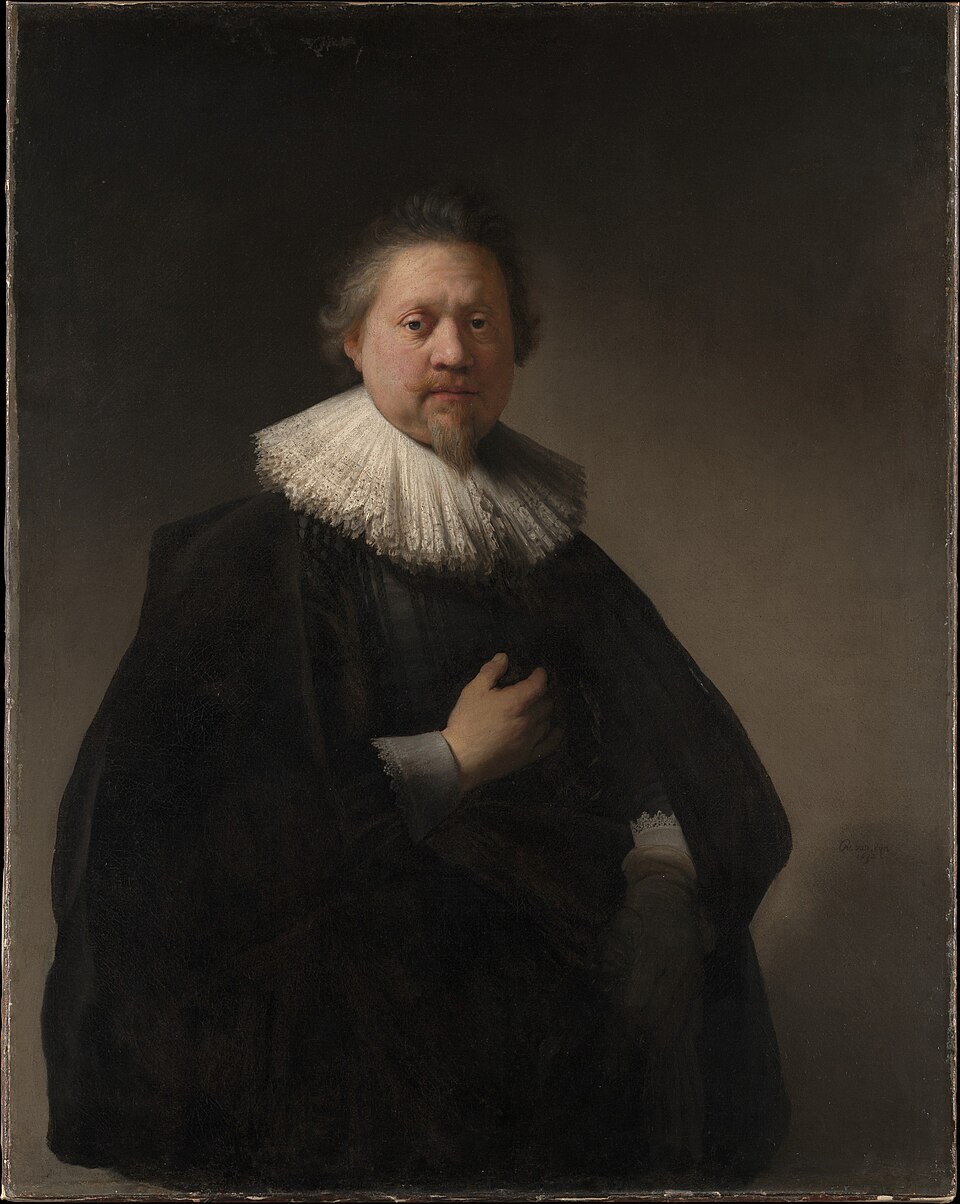
A grey-haired man of about fifty lays his hand on his chest and looks straight ahead. Rembrandt signed him in 1632 as one half of a married pair, but even the family name in the title is only a guess.
The story behind the painting
Rembrandt painted this oil on canvas in 1632 as a pendant to a Portrait of a Woman, probably a Member of the Van Beresteyn Family, probably as a wedding pair. Only a few pairs of pendant portraits by Rembrandt survive. The scholar Hofstede de Groot documented it in 1914, noting it was in the Beresteyn family collection at Chateau Maurik in Vucht in 1884. The provenance goes no further back than the Havemeyer purchase from Maurik. The pair came to the Metropolitan Museum of Art in New York through the bequest of Mrs. H. O. Havemeyer in 1929.
What to look for
Hofstede de Groot described him in detail: three-quarter length, life size, about fifty, standing slightly turned to the right and looking straight before him. He is bare-headed, with grey hair combed up high and a pointed beard. His right hand lies on his breast; his gloved left hand, holding the other glove, peeps out of the cloak. He wears a striped grey and black silk coat under a black cloak, narrow cuffs and a close-fitting pleated collar trimmed with lace, then a new fashion replacing the older millstone collars. Bright light falls from the upper left onto a dark grey background.
Meaning and intent
A wedding pendant is a portrait made to be seen beside another, husband and wife facing each other across a wall. Here Rembrandt gives the man a quiet, composed dignity: the hand on the heart, the glove held rather than worn, the fashionable lace collar. Yet the sources stress how little we know. Nothing is known about the sitter's identity, and as Hofstede de Groot wrote, he may as easily have belonged to a family related through a female line as to the Beresteyn family itself. The title's "probably" is doing honest work.
Legacy
The picture is signed on the right, level with the elbow, "RH L van Ryn 1632", and measures about 111.8 by 88.9 cm. Hofstede de Groot noted that it had suffered from heavy pressure when it was transferred to a new canvas. It appeared in most twentieth-century Rembrandt catalogues alongside its companion. The woman's portrait has recently been disputed as Rembrandt's own work, though it is still linked to his workshop and time and still considered the pendant. The man remains firmly Rembrandt's, an anonymous husband who has outlasted the certainty of his own name.
豆知識
- Signed by Rembrandt and dated 1632.
- Painted as a pendant to a portrait of a woman, probably a wedding pair.
- The sitter's identity is unknown; the Van Beresteyn link is uncertain.
- In the Metropolitan Museum of Art since the Havemeyer bequest of 1929.
画家について
Rembrandt van Rijn (1606-1669)
肖像 · 男性 · メトロポリタン美術館 · 肖像
同じ画家の作品: Rembrandt van Rijn
 夜警 - Rembrandt van Rijn (1642)
 自画像 - Rembrandt van Rijn (1659)
 テュルプ博士の解剖学講義 - Rembrandt van Rijn (1632)
 ユダヤの花嫁 - Rembrandt van Rijn (1660s)
 ガラリアの海の嵐 - Rembrandt van Rijn (1633)
 放蕩息子の帰還 - Rembrandt van Rijn (1668)
 ダナエ - Rembrandt van Rijn (1636)
 ベルシャザルの酒宴 - Rembrandt van Rijn (1636)
関連する画家の作品
 真珠の耳飾りの少女 - Johannes Vermeer (1665)
 牛乳を注ぐ女 - Johannes Vermeer (c. 1658)
 聖ニコラウスのお祭り - Jan Steen (1660s)
 牡蠣を食べる少女 - Jan Steen (1658)
 陽気な酒飲み - Frans Hals (1620s)
 微笑む騎士 - Frans Hals (1624)
 ウェイク・ベイ・ドゥールステーデの風車 - Jacob van Ruisdael (1670)
 The Jewish Cemetery - Jacob van Ruisdael (1650s)
 デルフトの家の中庭 - Pieter de Hooch (1658)
 リンゴの皮を剥く女性 - Pieter de Hooch (1663)