中断された音楽の稽古
Johannes Vermeer · 1660
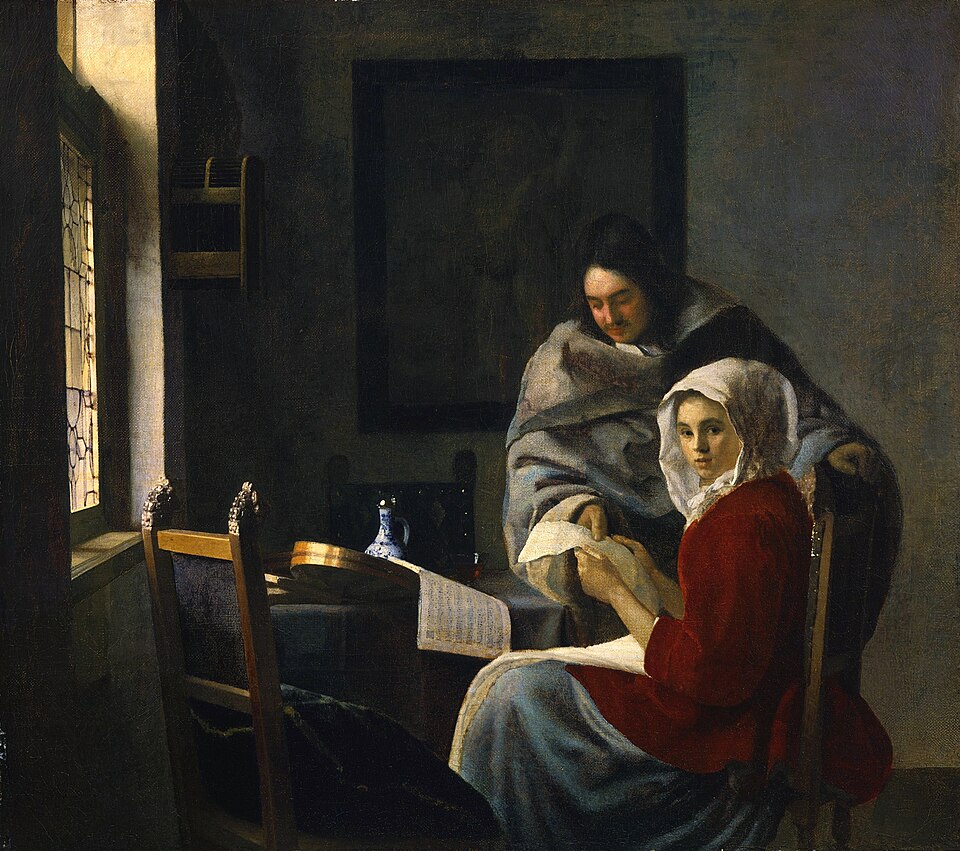
A young woman looks up from her songbook, as if someone has just called her name, while a well-dressed man leans over her shoulder. Vermeer turned a quiet music lesson into a moment of courtship that still feels caught in mid-breath.
The story behind the painting
Vermeer painted this small canvas in oil, probably between 1658 and 1659 according to Wikipedia, while Wikidata gives the year 1660, so the exact date remains uncertain. It shows a woman at her music with a gentleman beside her, a scene of 17th century courtship in a room that most likely belonged to a family of the haute bourgeoisie. Music and love often went hand in hand at the time: playing together was one of the few ways young men and women could spend time with each other. Some experts once doubted that the picture was by Vermeer at all, and the precise fall of light from the window was taken as proof that it is an original.
What to look for
Light enters from a multi-paned window on the left, the same window design Vermeer used in nine other works, among them The Music Lesson and Lady Writing a Letter with her Maid. On the table, behind the songbook, stands a wine glass, full and untouched, often read as a sign of a slow-moving relationship. Nearby sits a vase of porcelain and silver, probably used to serve wine. Look at the Spanish-style chairs: the lion head carving, brass studs and lozenge pattern are among the few details that survived heavy restoration. On the back wall hangs a hazy painting of Cupid, uncovered in a restoration of 1907 after being hidden under a wall and a hanging violin.
Meaning and intent
The wine glass ties the scene to joy and seduction, since drinking wine was linked with love in this period, and earlier Dutch pictures of feasts with drinking, gaming and music had slowly narrowed to intimate scenes of two or three people. The man's fashionable clothes mark him as upper class, and both figures were likely educated in music, each probably owning songbooks. The Cupid on the wall has invited many readings: a warning about the dangers of love, a raised hand meaning one should have only one lover, a blank card showing love as a game, or simply that love is in the air. Because that inner painting is damaged, Vermeer's exact intent may never be known.
Legacy
Since 1901 the painting has belonged to the Frick Collection in New York. Its title travelled far beyond the museum. Susanna Kaysen took it for her book Girl, Interrupted, in which the painting itself is a theme. The singer-songwriter Aimee Mann also refers to the work in her song At the Frick Museum, from the album Queens of the Summer Hotel, describing a narrator who meets a Vermeer of a girl with a startled glance. More than three centuries after it was painted, that interrupted look still makes viewers stop, as if they too had walked into the room.
豆知識
- Probably painted 1658-1659 (Wikipedia); Wikidata gives 1660.
- Oil on canvas, about 39.4 x 44.5 cm.
- The Cupid painting on the back wall was uncovered in a 1907 restoration.
- In the Frick Collection, New York, since 1901.
画家について
Johannes Vermeer (1632-1675)
風俗美術 · オランダ黄金時代の絵画 · フリック・コレクション
同じ画家の作品: Johannes Vermeer
 真珠の耳飾りの少女 - Johannes Vermeer (1665)
 牛乳を注ぐ女 - Johannes Vermeer (c. 1658)
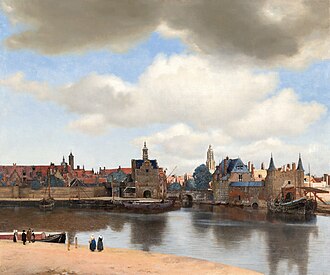 デルフト眺望 - Johannes Vermeer (1660s)
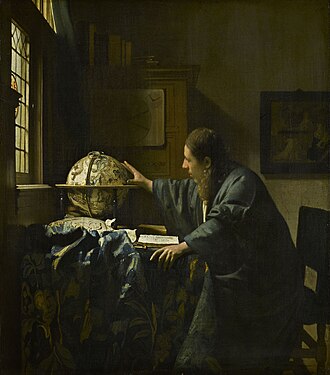 天文学者 - Johannes Vermeer (1664)
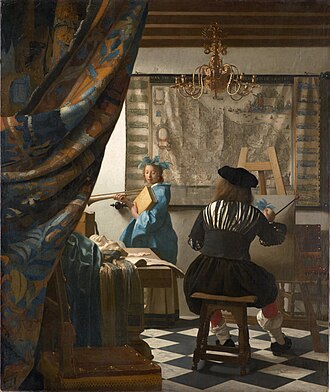 絵画芸術 - Johannes Vermeer (1660s)
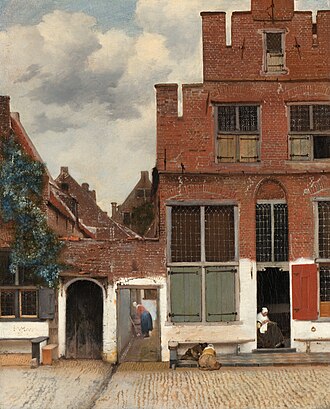 小路 - Johannes Vermeer (1658)
.jpg) 窓辺で手紙を読む女 - Johannes Vermeer (1650s)
窓辺で手紙を読む女 - Johannes Vermeer (1650s)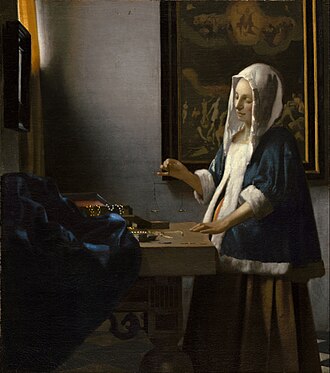 天秤を持つ女 - Johannes Vermeer (1665)
 夜警
夜警 自画像
自画像