David with the Head of Goliath before Saul
Rembrandt van Rijn · 1627
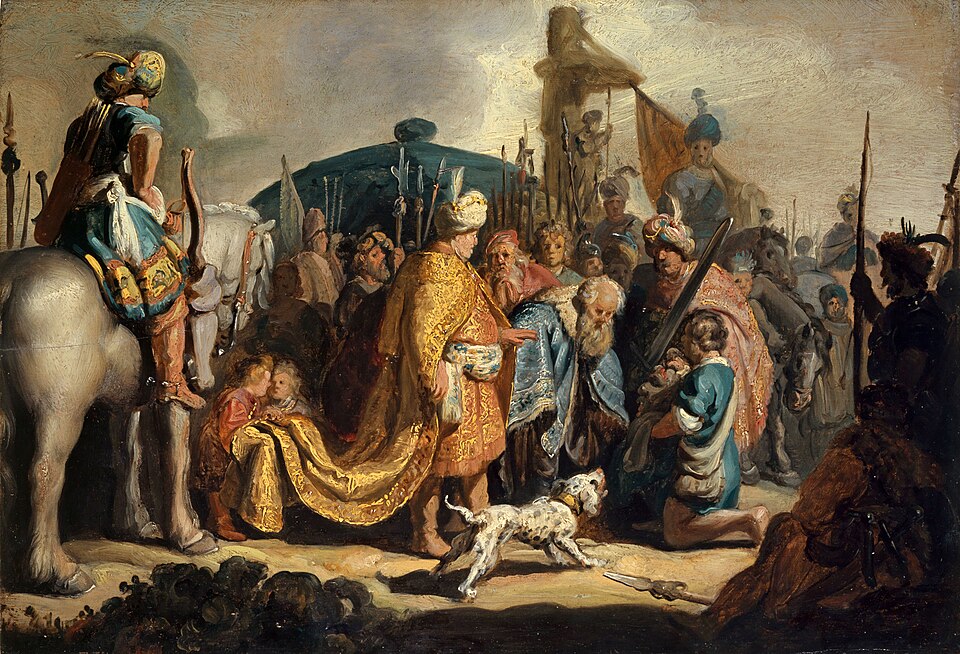
On a small oak panel, a crowd of turbans, spears and horses gathers around one moment: the shepherd boy David kneels before King Saul with the giant's head in his arms. The young Rembrandt dashed it off in rough strokes and signed it RH 1627.
The story behind the painting
The scene comes from the First Book of Samuel. After killing Goliath with his sling, David is brought before Saul by the commander Abner with the head in his hand, and Saul asks whose son he is. This handover is painted far less often than David's triumphant return in the next chapter. The panel was probably an oil sketch for a larger work that may never have been made. Rembrandt painted it in Leiden, where he shared a studio with Jan Lievens, after training with Jacob van Swanenburgh and, briefly, with Pieter Lastman in Amsterdam.
What to look for
Saul stands in profile in rich yellow brocade, his train held by two pages, a white turban with a feather on his head. David kneels in grey-blue with his shepherd's bag, holding a grey cloth on which Goliath's head is barely recognisable. Behind him Abner holds the giant's huge sword, and an old bearded man, probably the prophet Samuel, bends between them. A rider on a grey horse at left may be Saul's son Jonathan. More than fifteen other figures crowd in, a spotted dog barks in the foreground, and one face beside Saul strongly resembles Rembrandt's self-portraits of the late 1620s.
Meaning and intent
Light falls from the upper right like a spotlight, picking out the main figures in colour while the others stay in shadow, a play of light and dark Rembrandt may have learned from Swanenburgh, known for his scenes of hell. Placing Samuel in the scene contradicts the biblical account, which says he did not see Saul again after the killing of Agag, although the Bible mentions another meeting elsewhere. In its rough, sketch-like handling the panel stands completely alone in Rembrandt's early work.
Legacy
The oak panel is a single board about 5 mm thick, measured by Wikipedia at 27.4 by 39.7 cm, while Wikidata gives 27.5 by 39.5 cm; it was probably cut down before Rembrandt painted on it. X-rays reveal an earlier picture underneath, the shoulder of a young man in a turban, turned ninety degrees. The paint layer is very well preserved. Wikidata lists the Jacques Goudstikker collection among its past homes and the Kunstmuseum Basel as its present one.
豆知識
- Signed and dated RH 1627 in a small cartouche.
- Probably an oil sketch for a larger, perhaps never painted work.
- X-rays show an earlier portrait of a young man beneath.
- Now in the Kunstmuseum Basel, according to Wikidata.
画家について
Rembrandt van Rijn (1606-1669)
宗教美術 · ダビデ · バーゼル市立美術館 · Jacques Goudstikker collection
同じ画家の作品: Rembrandt van Rijn
 夜警 - Rembrandt van Rijn (1642)
 自画像 - Rembrandt van Rijn (1659)
 テュルプ博士の解剖学講義 - Rembrandt van Rijn (1632)
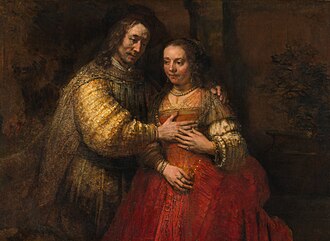 ユダヤの花嫁 - Rembrandt van Rijn (1660s)
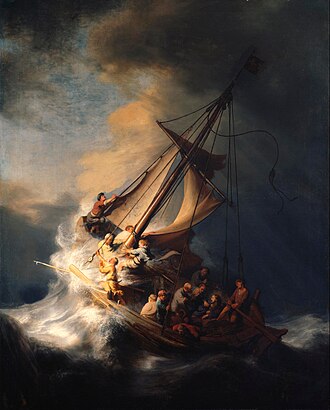 ガラリアの海の嵐 - Rembrandt van Rijn (1633)
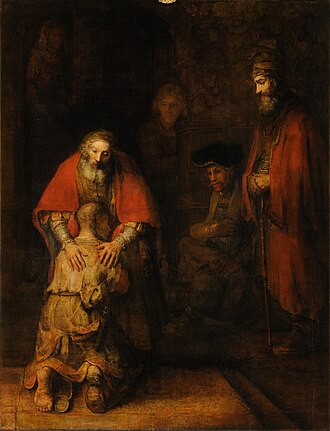 放蕩息子の帰還 - Rembrandt van Rijn (1668)
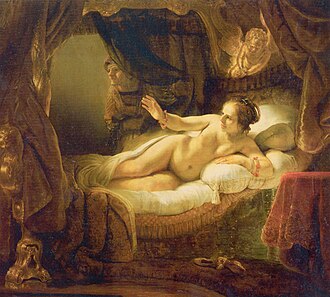 ダナエ - Rembrandt van Rijn (1636)
 ベルシャザルの酒宴 - Rembrandt van Rijn (1636)
 真珠の耳飾りの少女
 牛乳を注ぐ女