Boy with Flute
フランス・ハルス · 1623
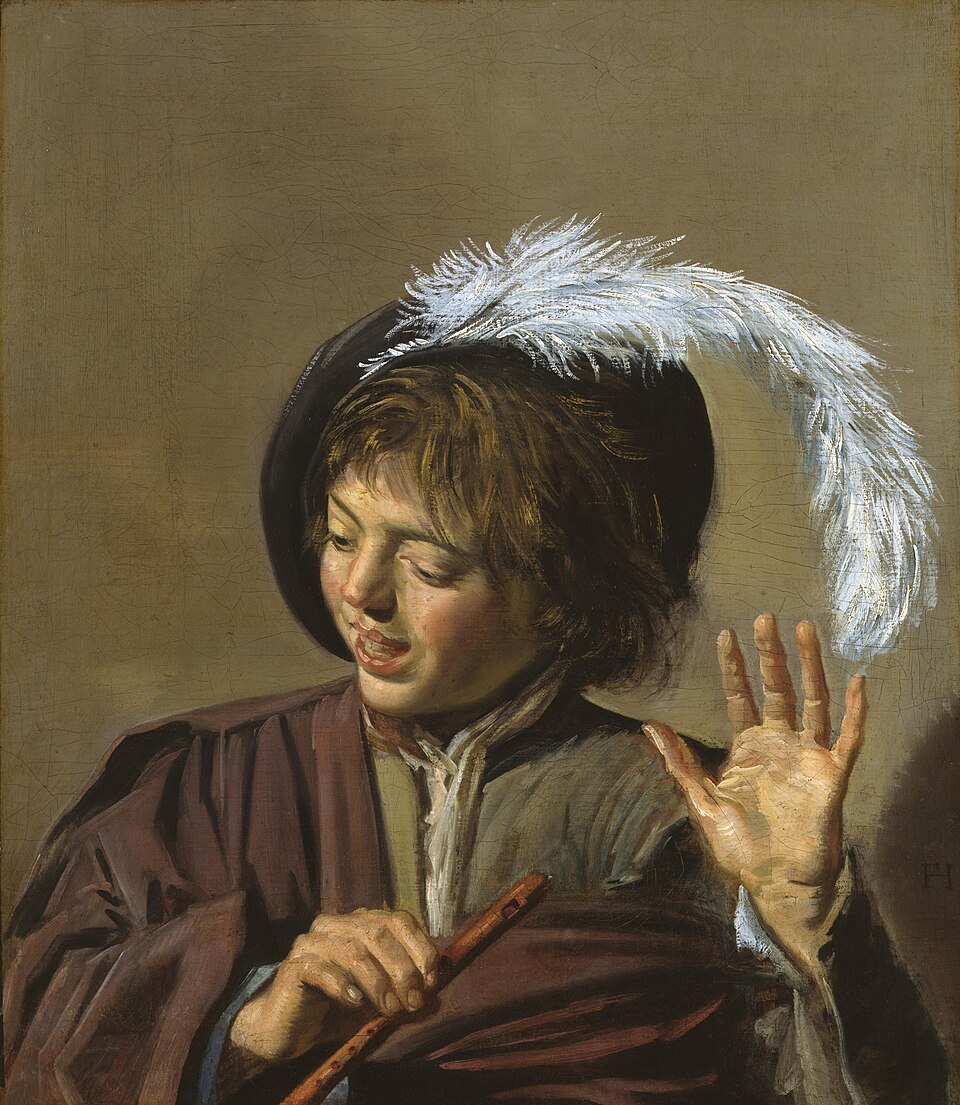
A boy in a plumed beret holds a recorder, mouth open, eyes lowered, one hand raised as if listening to the last notes fade. Frans Hals painted him with quick, lively strokes, and later hands cut and patched the canvas.
The story behind the painting
Frans Hals painted Boy with a Flute, also called Singing Boy with a Flute, in oil on canvas. The German Wikipedia article dates it to around 1627, while Wikidata gives 1623. The sitter's identity is unknown; one suggestion is that he was one of the painter's children, who were known to be musical. In the 1620s Hals repeatedly drew on the Utrecht Caravaggisti, painters such as Hendrick ter Brugghen and Dirck van Baburen, and his picture is closely related to ter Brugghen's Boy Playing a Recorder of 1621. Hals shows the pause, ter Brugghen the playing.
What to look for
The boy is set in a triangle against an almost plain light grey ground. His head turns towards his right shoulder, eyes lowered. His wavy hair, red cheeks and full red lips give him youthful energy, and his open mouth shows his teeth: some say he has just finished playing, others that he is laughing. His fingers cover the upper holes of a brown recorder, and his left hand is raised, palm open. The costume is theatrical, not everyday dress for Haarlem boys, with a reddish cloak and a beret carrying a lush white and blue feather. The monogram FH sits beside the raised hand.
Meaning and intent
The work can be read as an allegory of hearing and as a vanitas image, a reminder that pleasures pass. The open hand and inward gaze give the sense that the boy is listening to the echo of fading music. Writers have praised its spontaneity: Katja Kleinert noted Hals's loose paint, set with short, spirited strokes, and Théophile Thoré, who rediscovered Hals, said he painted like a fencer. Seymour Slive admired the natural cheerfulness and ease of the musician. Light picks out the face and follows the sweep of the feather.
Legacy
The picture has been in the Gemäldegalerie in Berlin since 1874. In 1959 to 1960 the restorer Hans Böhm found that a later hand had added a strip of canvas at the bottom showing an open songbook, though the boy looks past it. X-rays showed the strip had been cut from the top and attached below. The original size was probably about 70 by 57 cm, giving more space around the figure; today it measures 62 by 55.2 cm, while Wikidata gives 68.8 by 55.2 cm. Claus Grimm criticised the restoration for losing part of the upper arm.
豆知識
- Dated around 1627 on Wikipedia, 1623 on Wikidata.
- Read as an allegory of hearing and a vanitas image.
- Altered by a later painter, restored in 1959 to 1960.
- In the Gemäldegalerie Berlin since 1874.
画家について
フランス・ハルス (1591-1666)
同じ画家の作品: フランス・ハルス
 陽気な酒飲み - Frans Hals (1620s)
 微笑む騎士 - Frans Hals (1624)
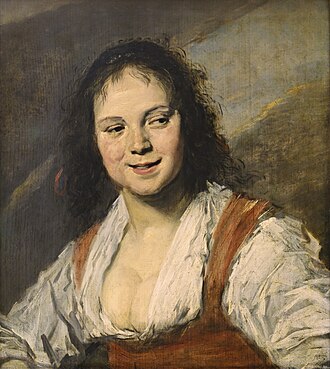 ジプシー女 - Frans Hals (1628)
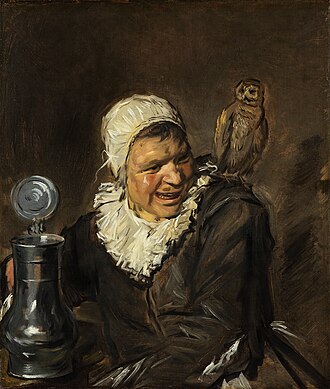 マッレ・バッベ - Frans Hals (1640s)
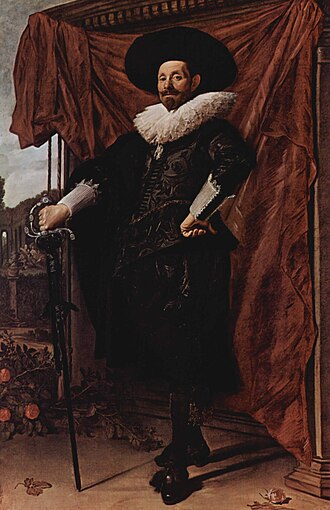 剣を持ってポーズをとるウィレム・ファン・ヘイトゥイセン - Frans Hals (1625)
 Militia Company of District XI under the Command of Captain Reynier Reael - Frans Hals (1630s)
 リュートを弾く道化師 - Frans Hals (1623)
 ざんげ節に浮かれ騒ぐ人々 - Frans Hals (1610s)
関連する画家の作品
 夜警 - Rembrandt van Rijn (1642)
 自画像 - Rembrandt van Rijn (1659)
 真珠の耳飾りの少女 - Johannes Vermeer (1665)
 牛乳を注ぐ女 - Johannes Vermeer (c. 1658)
 聖ニコラウスのお祭り - Jan Steen (1660s)
 牡蠣を食べる少女 - Jan Steen (1658)
 ウェイク・ベイ・ドゥールステーデの風車 - Jacob van Ruisdael (1670)
 The Jewish Cemetery - Jacob van Ruisdael (1650s)
 デルフトの家の中庭 - Pieter de Hooch (1658)
 リンゴの皮を剥く女性 - Pieter de Hooch (1663)