眠る女
Johannes Vermeer · 1657
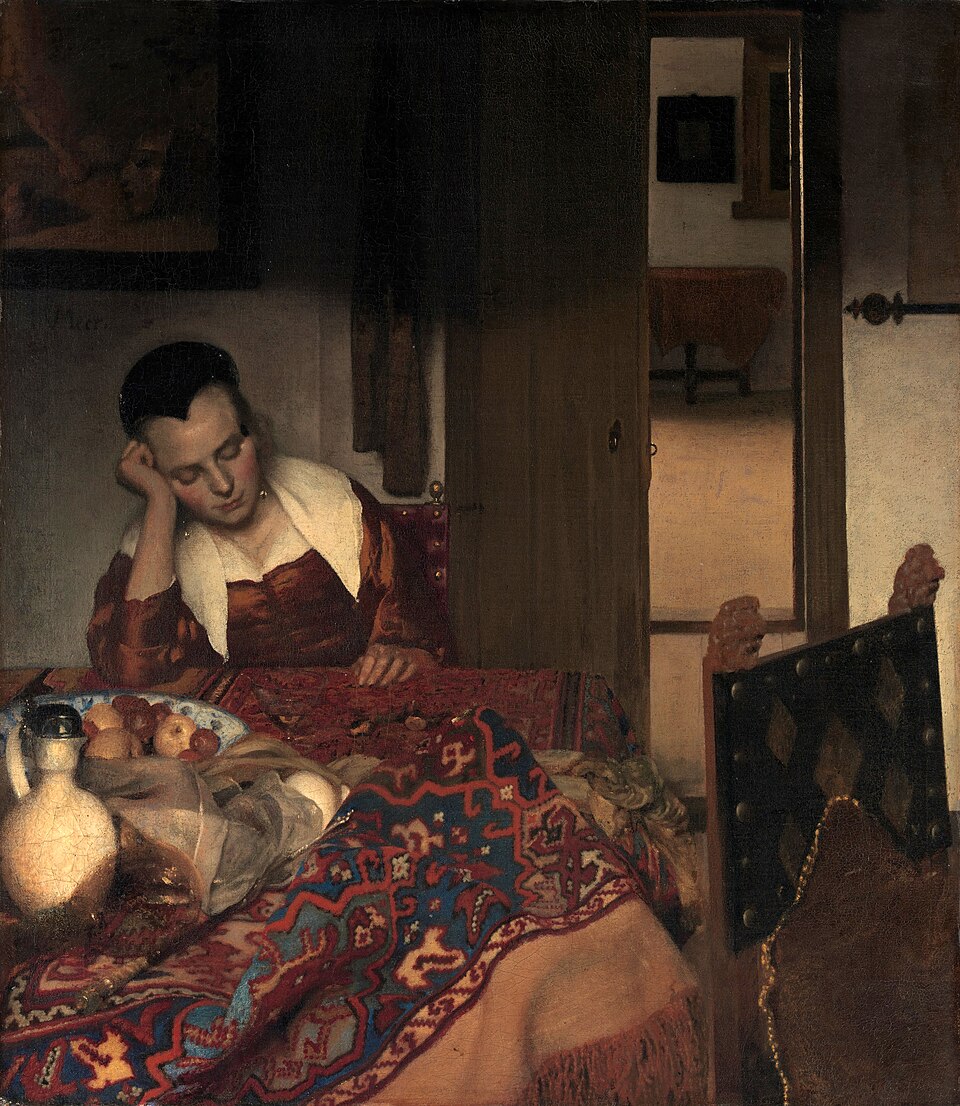
A young woman has dozed off at a table, head resting on her hand, in a quiet Delft interior. Vermeer once painted a man and a dog in the doorway behind her, then took them away, leaving only hints of someone who has just left.
The story behind the painting
A Girl Asleep, also called A Woman Asleep, A Woman Asleep at Table and A Maid Asleep, was painted by Johannes Vermeer around 1657. It was very likely owned by his patron Pieter van Ruijven of Delft, who also owned The Milkmaid. Technical examination has shown that Vermeer first painted a man standing in the second room, with a dog looking at him. He later painted both out, and changed the story of the picture in doing so.
What to look for
In place of the man and the dog, a mirror now hangs on the far wall of the back room, and a chair is left at an angle with a pillow on it. On the table are a wine pitcher, a glass lying on its side and perhaps a knife and fork, and a Chinese bowl of fruit. A jug sits open-mouthed under a gauzy cloth. Through the half-open door we glimpse another room, while the young woman sleeps with her head propped on her hand. The canvas measures about 87.6 by 76.5 cm.
Meaning and intent
According to the curator Walter Liedtke, the dog would have alluded to the casual relationships of suitors in the street. Its removal makes the scene quieter, but the clues remain: the mirror suggests how quickly the pleasures of the senses pass, the tilted chair may hint at idleness and at company that has just left, and the fruit bowl was a symbol of temptation. To a viewer of Vermeer's time, the knife and open jug would have suggested more than conversation. Like The Milkmaid, the picture treats a maid with more sympathy than the older tradition did.
Legacy
The painting was sold in Amsterdam on 16 May 1696 with the estate of Jacob Dissius, the husband of Van Ruijven's daughter. Its history is then unknown until it belonged to John Waterloo Wilson in Paris after 1873. In 1881 the Galerie Sedelmeyer bought it and sold it to Rodolphe Kann. In 1908 it passed through Duveen Brothers to Benjamin Altman, who left it to the Metropolitan Museum of Art in New York in 1913. Under the terms of his bequest it may not be lent elsewhere.
豆知識
- Painted by Vermeer around 1657.
- X-rays show a man and a dog that Vermeer later painted out.
- Bequeathed by Benjamin Altman to the Metropolitan Museum of Art in 1913.
- By the terms of the bequest it cannot be lent.
画家について
Johannes Vermeer (1632-1675)
女性 · 風俗美術 · オランダ黄金時代の絵画 · メトロポリタン美術館 · テーブル · 椅子 · 果物 · Charles Sedelmeyer collection · 扉
同じ画家の作品: Johannes Vermeer
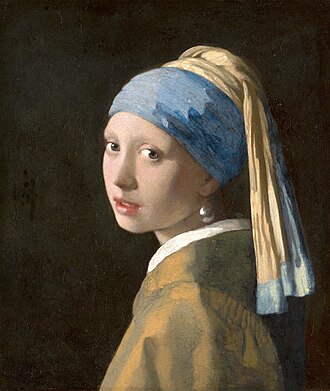 真珠の耳飾りの少女 - Johannes Vermeer (1665)
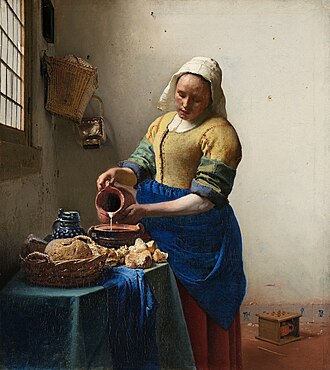 牛乳を注ぐ女 - Johannes Vermeer (c. 1658)
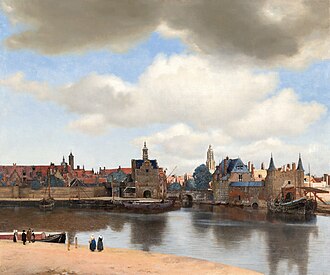 デルフト眺望 - Johannes Vermeer (1660s)
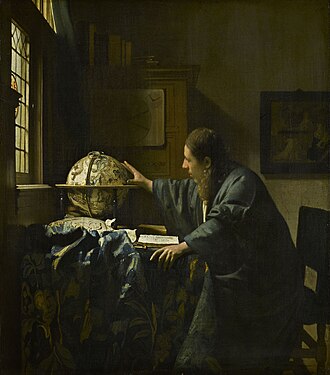 天文学者 - Johannes Vermeer (1664)
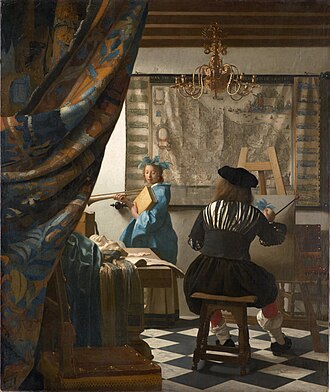 絵画芸術 - Johannes Vermeer (1660s)
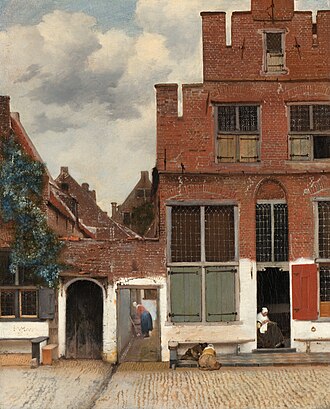 小路 - Johannes Vermeer (1658)
.jpg) 窓辺で手紙を読む女 - Johannes Vermeer (1650s)
窓辺で手紙を読む女 - Johannes Vermeer (1650s)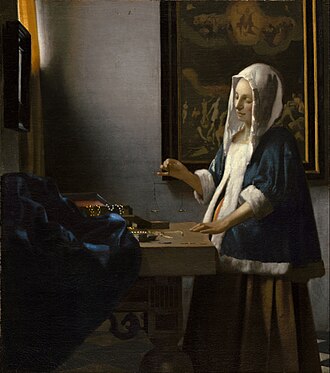 天秤を持つ女 - Johannes Vermeer (1665)
 夜警
夜警 自画像
自画像