Italian Baroque painting
Italian Baroque painting is where the Baroque story begins: in Rome around 1600, with Caravaggio's spotlit realism and Annibale Carracci's glowing frescoes.
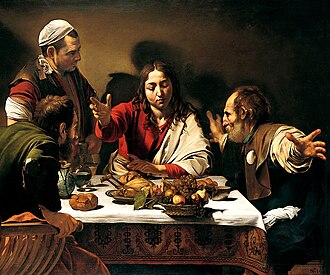 Supper at Emmaus - Caravaggio (1601)
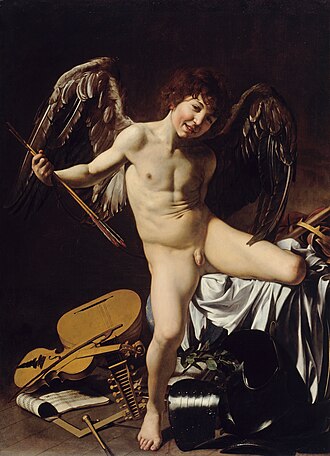 Amor Vincit Omnia - Caravaggio (1600s)
%2C%201595%20circa%2C%20534.jpg) Self-Portrait as Bacchus - Caravaggio (1595)
Self-Portrait as Bacchus - Caravaggio (1595).jpg) Death of the Virgin - Caravaggio (1600s)
Death of the Virgin - Caravaggio (1600s)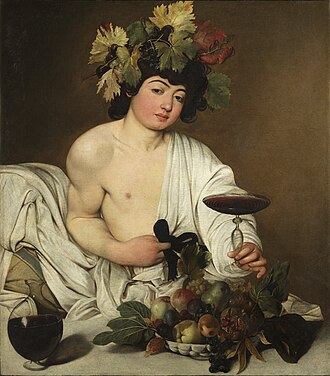 Bacchus - Caravaggio (1593)
.jpg) La buona ventura - Caravaggio (1594)
La buona ventura - Caravaggio (1594).jpg) Davide con la testa di Golia - Caravaggio (1605)
Davide con la testa di Golia - Caravaggio (1605).jpg) Boy with a Basket of Fruit - Caravaggio (1590s)
Boy with a Basket of Fruit - Caravaggio (1590s).jpg) Crucifixion of Saint Peter - Caravaggio (1600)
Crucifixion of Saint Peter - Caravaggio (1600)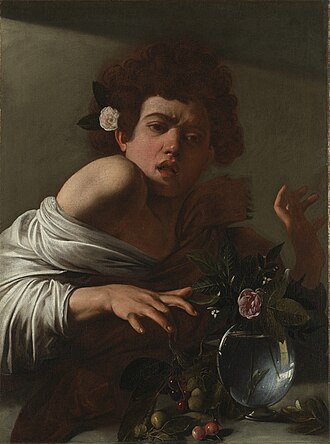 Boy Bitten by a Lizard - Caravaggio (1590s)
.jpg) The Entombment of Christ - Caravaggio (1602)
The Entombment of Christ - Caravaggio (1602)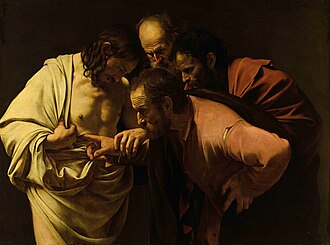 The Incredulity of Saint Thomas - Caravaggio (1600s)
.jpg) Saint Jerome - Caravaggio (1606)
Saint Jerome - Caravaggio (1606)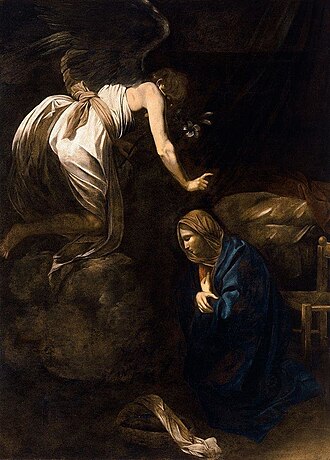 Annunciation - Caravaggio
.jpg) Saint Francis of Assisi in Ecstasy - Caravaggio (1590s)
Saint Francis of Assisi in Ecstasy - Caravaggio (1590s).jpg) Sleeping Cupid - Caravaggio (1608)
Sleeping Cupid - Caravaggio (1608).jpg) Basket of Fruit - Caravaggio
Basket of Fruit - Caravaggio%20-%20Boy%20Peeling%20Fruit%20-%20RCIN%20402612%20-%20Royal%20Collection.jpg) Boy Peeling Fruit - Caravaggio (1590s)
Boy Peeling Fruit - Caravaggio (1590s).jpg) Madonna and Child with Saint Anne - Caravaggio (1605)
Madonna and Child with Saint Anne - Caravaggio (1605)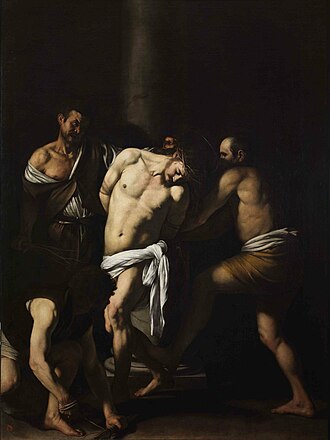 The Flagellation of Christ - Caravaggio (1607)
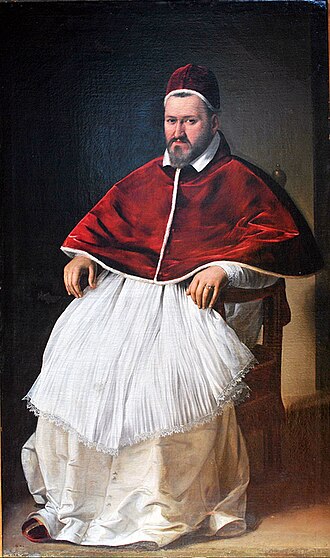 Portrait of Pope Paul V - Caravaggio (1600s)
Curioso di sapere cos'è Italian Baroque painting?
Italian Baroque painting is where the Baroque story begins: in Rome around 1600, with Caravaggio's spotlit realism and Annibale Carracci's glowing frescoes. From there, Italian artists carried the style across Europe, filling churches and palaces with drama, colour and sky-high ceiling paintings.
What is Italian Baroque painting, in simple words?
It is the Italian part of Baroque art, made from the end of the 16th century to the middle of the 18th century. The movement began in Italy, and Italy stayed its stronghold even as tastes shifted toward classicism and the Rococo. Italian painters favoured strong drama, bold light and shadow, rich colour and, later, huge illusionistic ceiling frescoes. Many Italian artists also took the Baroque style to other parts of Europe.
Why did it start in Italy?
The background is the Counter Reformation. At the Council of Trent (1545-63), the Catholic Church discussed reform and briefly addressed religious art. Church writers such as the Flemish theologian Molanus then asked that paintings and sculptures in churches show their subjects clearly and powerfully, with decorum and without the stylish airs of Mannerism. Italian painters in Rome responded with a new, direct and dramatic way of painting.
Who started it?
Two painters led the way: Caravaggio (1571-1610), born and trained in Milan, and Annibale Carracci (1560-1609) from Bologna. Caravaggio brought raw realism and dramatic lighting. Carracci, who with his brothers Agostino and Ludovico ran an influential academy for training painters, combined lessons from Correggio, Titian and Veronese into a natural, convincing style with pure, saturated colours. In the 1590s he went to Rome to decorate the gallery of the Palazzo Farnese.
What was so shocking about Caravaggio?
Caravaggio painted religious and classical figures in the clothes of his own day, as ordinary living men and women. He even showed the seedier side of life, such as dirty feet. At the time, the usual habit was to idealise holy or classical figures and give them a dignified look. He also used tenebrism, setting partly lit figures against dark backgrounds for dramatic effect. His followers were known as the Caravaggisti.
How can I recognise an Italian Baroque painting?
Look for strong contrasts of light and dark, figures that feel real and present, and saturated colour. In churches and palaces, look up: monumental ceiling frescoes, many from the later 17th century, open the ceiling into a painted sky full of figures. Some, like Gaulli's nave fresco in the church of the Gesù and Andrea Pozzo's vault in Sant'Ignazio, both in Rome, are dramatically illusionistic.
Who were the other important painters?
Among the Caravaggisti were Orazio Gentileschi, Artemisia Gentileschi, Mattia Preti, Carlo Saraceni and Bartolomeo Manfredi. Guercino and Giovanni Lanfranco were influential early on, while Guido Reni and Domenichino took a more classical path. Pietro da Cortona was the leading painter of the Roman High Baroque (1623-1667). Later came Luca Giordano of Naples and, in Venice, Sebastiano Ricci, Piazzetta and Giambattista Tiepolo, called the greatest Baroque exponent there.
Did all Italian Baroque painters agree on style?
No, and they argued about it. In the 1630s, Pietro da Cortona debated the painter Andrea Sacchi at the Accademia di San Luca in Rome. Cortona argued for an "epic" approach with many figures, while Sacchi made the case for "tragedy" with fewer figures to carry the message. Both trends flourished side by side, and even classical painters like Carlo Maratta borrowed Baroque colour.
Which famous works should I see first?
Caravaggio's The Calling of St. Matthew and The Conversion of St. Paul are good starting points. Annibale Carracci's ceiling in the Palazzo Farnese in Rome was highly influential. Pietro da Cortona's vault fresco in the Palazzo Barberini (finished 1639) shows the High Baroque at full power. For sculpture, Bernini's Apollo and Daphne and his Ecstasy of Saint Teresa capture dramatic moments in marble.
Where can I see these works today?
Many are still in the buildings they were made for. In Rome, you can see Gaulli's fresco in the church of the Gesù, Pozzo's vault in Sant'Ignazio, Bernini's Apollo and Daphne in the Villa Borghese and his Ecstasy of Saint Teresa in Santa Maria della Vittoria. Tiepolo's frescoes are in the Palazzo Labia and Scuola Grande dei Carmini in Venice, the Villa Valmarana at Vicenza, the Würzburg Residence and the Royal Palace of Madrid.
Why does Italian Baroque painting still matter?
It was the engine of the whole Baroque movement. Caravaggio was one of the most original and influential painters of his time, and his use of light and shadow was copied by a whole circle of followers. Carracci's Farnese ceiling shaped painting throughout the 17th century. Cities like Genoa drew artists even from abroad, including Velázquez and Van Dyck, who came to gain Baroque experience before moving on.