The Entombment of Christ
Caravaggio · 1602
.jpg)
A dead man, heavy as any labourer, is lowered toward a bare stone slab while the people who loved him bend under his weight and their grief. Caravaggio made this altarpiece to be seen every day above the Mass.
The story behind the painting
The Entombment of Christ was painted for the second chapel on the right in Santa Maria in Vallicella, the Chiesa Nuova built for the Oratory of Saint Philip Neri. The chapel, dedicated to the Pieta, had been founded by Pietro Vittrice, a close follower of Filippo Neri. After his death in 1600 a legacy paid for the chapel, which was built in 1602, and on 1 September 1604 a document described the painting as new and paid for by his nephew and heir, Girolamo Vittrice. Girolamo was linked to Caravaggio through marriage: his wife was the sister of the painter's friend Prospero Orsi. Wikipedia dates the work to 1603-1604, probably planned and begun in 1602-1603, while Wikidata gives 1602.
What to look for
The composition falls in a diagonal cascade, from the raised arms of Mary of Clopas in the gloom down to the limp body of Christ and the hard edge of the stone. John, young and in a red cloak, holds the body on his knee and arm, and in doing so opens the wound in Christ's side. Nicodemus, given the face of Michelangelo, grips the knees with his feet set at the very edge of the slab. Mary Magdalene dries her tears with a white handkerchief, her face in shadow. Behind John, the Virgin appears not eternally young, as tradition preferred, but as an old woman in a nun's robes, one hand hovering as if to touch her son.
Meaning and intent
The source reads the picture as a descent of feeling, from the open anguish of Mary of Clopas, through quieter sorrow, to death as the final silence. Christ's body is not the thin, bony figure of custom but muscled and thick-limbed, like a working man. His fallen arm and clean shroud touch the stone while Mary of Clopas gestures toward heaven, a pairing the source links to the message of God come to earth. Because Mass was celebrated at this altar, the priest would raise the consecrated host in front of this very body, so that the words of the rite and the image answered one another daily.
Legacy
Caravaggio drew on Michelangelo's Pieta in Saint Peter's and his Florentine Pieta, and on Raphael's Borghese Deposition, setting his own naturalism against High Renaissance idealism. Early writers including Giulio Mancini, Giovanni Baglione, Francesco Scanelli and Gian Pietro Bellori admired and wrote about it. The painting itself travelled: it was taken to Paris in 1797 for the Musee Napoleon, came back to Rome and was installed in the Vatican in 1816. A copy now hangs in the original chapel, and the original is in the Vatican Pinacoteca. Artists as different as Rubens, Fragonard, Gericault and Cezanne made copies of it.
Lo sapevi?
- Painted for the Chiesa Nuova (Santa Maria in Vallicella) in Rome; the original is now in the Vatican Pinacoteca.
- Wikidata gives 1602; Wikipedia dates it 1603-1604.
- Taken to Paris in 1797, installed in the Vatican in 1816.
- Copied by Rubens, Fragonard, Gericault and Cezanne.
L'artista
Caravaggio (1571-1610)
religious art · man · Mary · Italian Baroque painting · Jesus Christ · Mary Magdalene
Altre opere di Caravaggio
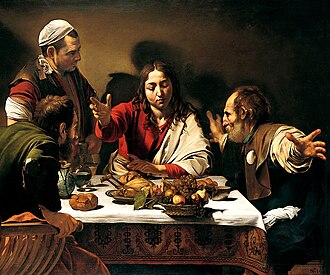 Supper at Emmaus - Caravaggio (1601)
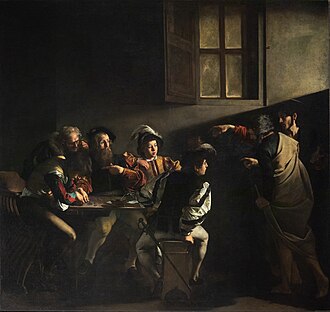 La vocazione di San Matteo - Caravaggio (1609)
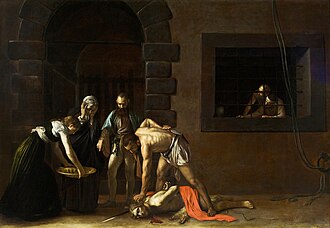 Decapitazione di San Giovanni Battista - Caravaggio (1608)
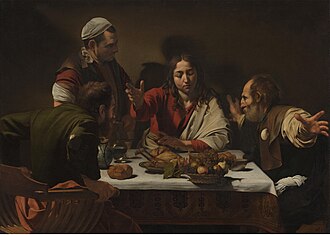 Supper at Emmaus - Caravaggio (1601)
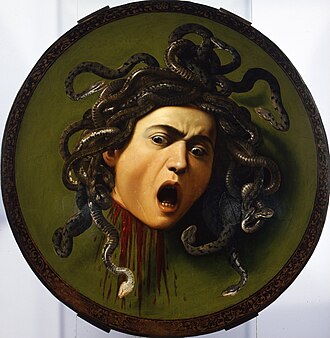 Testa di Medusa - Caravaggio (1597)
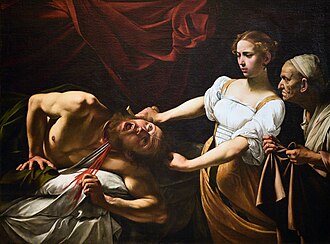 Giuditta che decapita Oloferne - Caravaggio (1598)
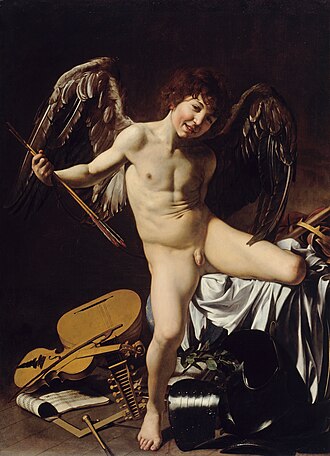 Amor Vincit Omnia - Caravaggio (1600s)
%2C%201595%20circa%2C%20534.jpg) Self-Portrait as Bacchus - Caravaggio (1595)
Self-Portrait as Bacchus - Caravaggio (1595)
Dipinti di artisti collegati
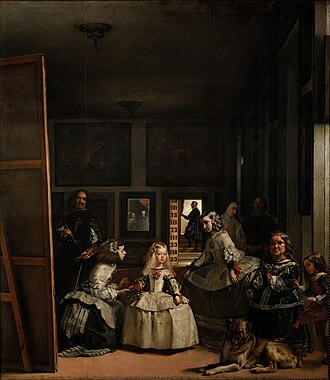 Las Meninas - Diego Velázquez (1656)
 The Surrender of Brea - Diego Velázquez (1635)
 The Night Watch - Rembrandt van Rijn (1642)
 Self-Portrait - Rembrandt van Rijn (1659)
 Girl with a Pearl Earring - Johannes Vermeer (1665)
 The Milkmaid - Johannes Vermeer (c. 1658)