The Martyrdom of Saint Sebastian
El Greco · 1577
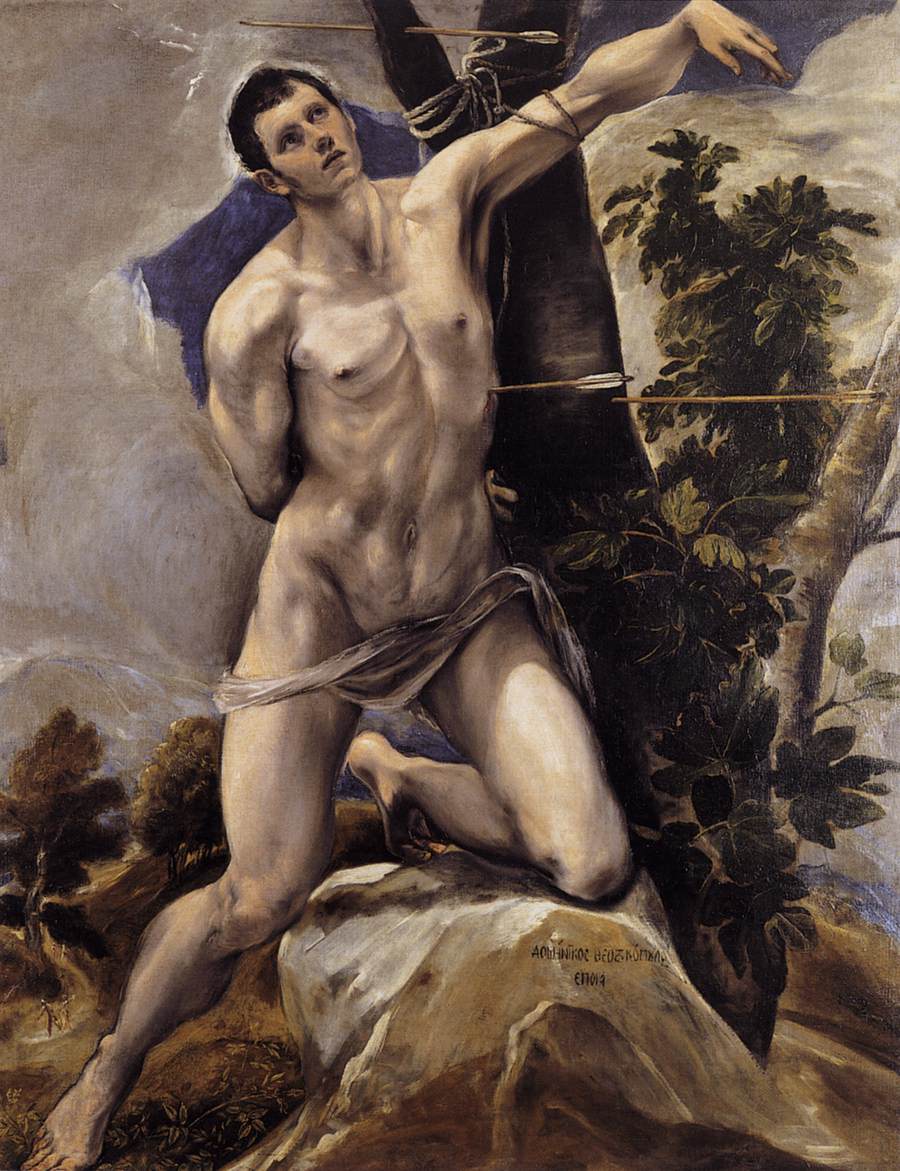
Most painters showed Saint Sebastian standing. El Greco made him kneel, tied by one raised arm to a tree, his weight resting on the rock where the painter signed his name. Scholars still argue about whose art inspired that pose.
The story behind the painting
Much of this painting's early history is conjecture. Scholars date it, from its style and the documents, to El Greco's first decade in Spain, roughly 1576 to 1579; Wikidata gives 1577. Many assume it was painted for Diego de Castilla, dean of Toledo Cathedral, who obtained El Greco's first major Spanish commission. Jesus San Martin Payo proposed another story from a sixteenth century manuscript: that it belonged to Juan Alonso de Cordoba, right arm of Bishop Juan Ramirez Zapata de Cardenas, who died in 1577. If so, it would predate The Disrobing of Christ, usually considered El Greco's first known Spanish work.
What to look for
The figure is graceful and naturalistic, painted in a late Renaissance style that shows El Greco's Italian training. The eyes look up toward heaven, in communion with God or in acceptance of death. The nude body, perhaps slightly elongated, is solid and fleshy, with none of the extreme contrasts the painter would later be known for. Behind him, a stormy landscape is sketched with loose, gestural strokes. An arrow pierces his side. Unlike the standing figure of El Greco's Sebastian in the Prado, this one kneels, bound by a rope around a raised arm, his weight on a large rock. The canvas measures 191 by 152 cm, according to Wikidata.
Meaning and intent
Sebastian was a victim of Diocletian's persecution of Christians. According to legend he was tied to a tree and shot with arrows, healed by a miracle, and then clubbed to death. Arrows had been linked since antiquity with divine punishment by pestilence, so in the fifteenth and sixteenth centuries he was invoked for plague victims. His martyrdom also gave Counter-Reformation artists one of the rare chances to paint the nude in religious art. El Greco's Sebastian seems resigned to his fate, or perhaps even to welcome it.
Legacy
The unusual pose has fuelled long debate. Andrew Casper calls it a quotation of a figure by Michelangelo, though scholars disagree on which one. Michael Scholz-Hansel links it to Michelangelo and the Laocoön. Harold Wethey compared it to Michelangelo's Genius of Victory, and George A. Rodetis to the Punishment of Haman on the Sistine ceiling, while also suggesting Titian's Averoldi Altarpiece, whose Sebastian hangs from bonds and is signed on a stone, as an equally likely model. The painting is now on display in Palencia Cathedral, in the sacristy of the chapel of San Jeronimo.
Lo sapevi?
- Dated about 1576 to 1579 by scholars; Wikidata says 1577.
- Shows Sebastian kneeling, unlike the usual standing pose.
- Signed on the rock that bears the saint's weight.
- On display in Palencia Cathedral.
L'artista
El Greco (1541-1614)
religious art · Mannerism · arrow
Altre opere di El Greco
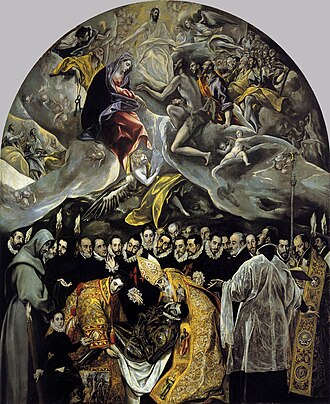 The Burial of the Count of Orgaz - El Greco (1586)
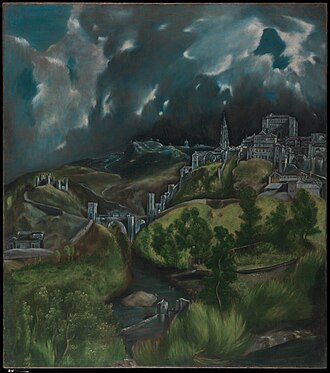 View of Toledo - El Greco (1596)
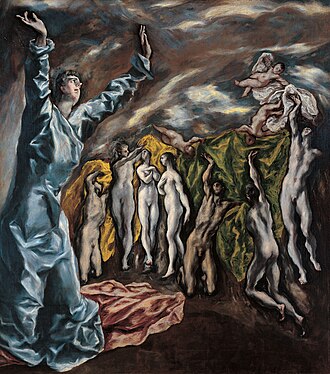 Opening of the Fifth Seal - El Greco (1610)
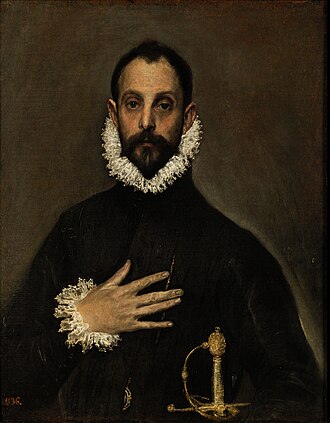 The Nobleman with his Hand on his Chest - El Greco (1580)
%20-%20Laoco%C3%B6n%20-%20Google%20Art%20Project.jpg) Laocoön - El Greco (1610s)
Laocoön - El Greco (1610s)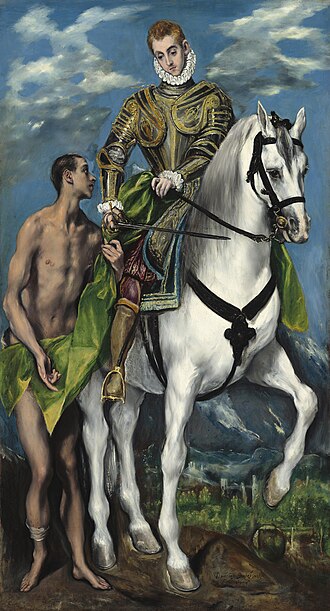 Saint Martin and the Beggar - El Greco (1597)
.jpg) Adoration of the Shepherds - El Greco (1612)
Adoration of the Shepherds - El Greco (1612) The Concert of the Angels - El Greco (1600s)
Dipinti di artisti collegati
.jpg) Venus of Urbino - Titian (1538)
Venus of Urbino - Titian (1538)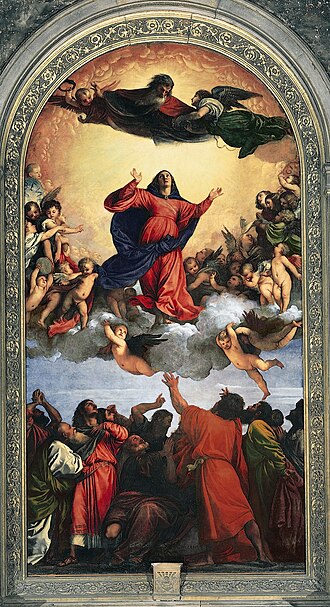 Assumption of the Virgin - Titian (1510s)
 Supper at Emmaus - Caravaggio (1601)
 La vocazione di San Matteo - Caravaggio (1609)
 The Ambassadors - Hans Holbein the Younger (1533)
 The Body of the Dead Christ in the Tomb - Hans Holbein the Younger (1520s)