The Disrobing of Christ
El Greco · 1570s
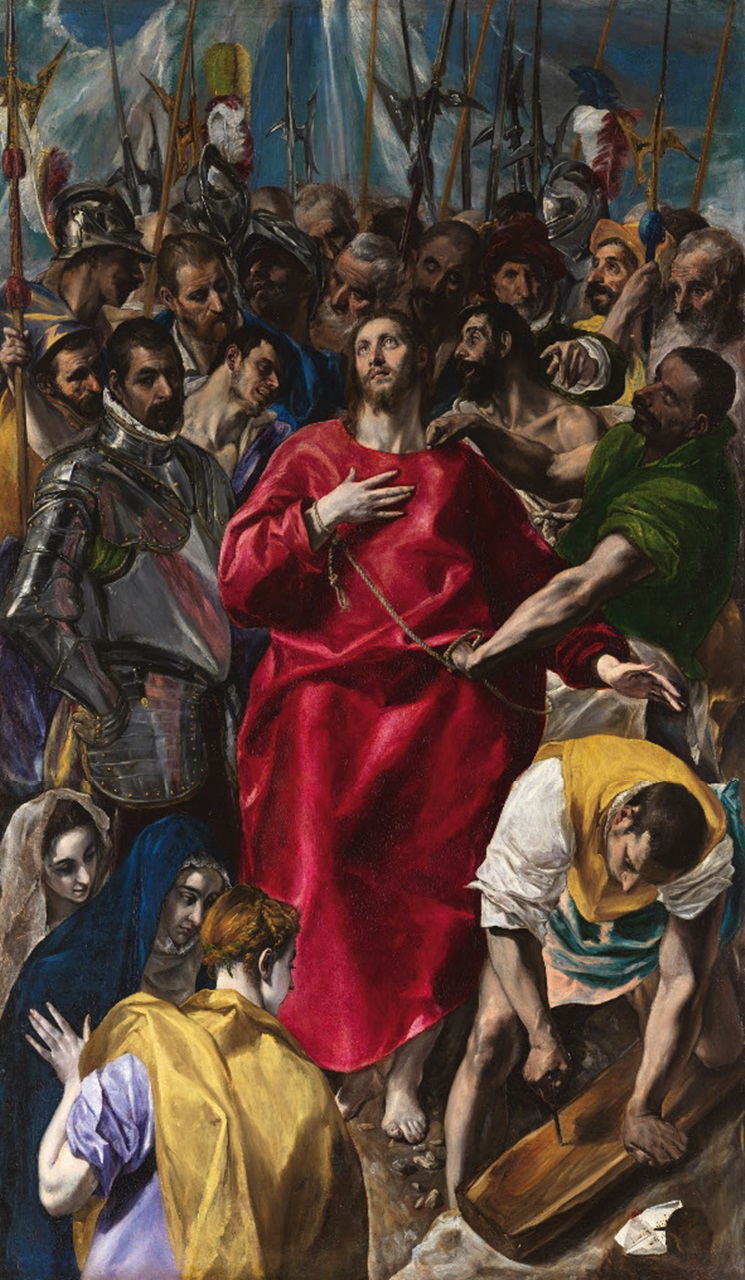
Christ stands calm in a blazing red robe while a crowd of helmets and lances presses around him and a man grips the rope at his wrist. El Greco's first great Spanish commission won him fame, and a long quarrel with the cathedral that ordered it.
The story behind the painting
El Greco began El Expolio in the summer of 1577 and finished it in the spring of 1579 for the high altar of the sacristy of Toledo Cathedral, where it still normally hangs. A document of 2 July 1577 about this painting is the earliest record of his presence in Spain. He owed the commission to his friendship from Rome with Luis de Castilla, son of the cathedral's dean Diego de Castilla, who also arranged his other major commission of those years, for Santo Domingo el Antiguo. After cleaning at the Prado, it was shown in Madrid in late 2013 and returned to Toledo in 2014.
What to look for
Christ looks up to Heaven with serene calm, set apart from the violence around him. A figure in black points at him accusingly, two others argue over his garments, and a man in green holds him with a rope, about to tear off his robe. At the lower right a man in yellow bends over the cross, boring a hole for the nail for his feet. The red robe is the focal point, with yellow and blue in the foreground secondary to it. At lower left the three Marys watch in distress. The crowd is stacked like a wall, heads above heads, which Harold Wethey links to late Byzantine painting.
Meaning and intent
El Greco built the picture vertically and compactly to show Christ oppressed by his tormentors, his tall, tranquil figure dominating the centre. Wethey called it a masterpiece of extraordinary originality, its power resting above all on the bold use of colour. It recalls the grand images of Christ in Byzantine art, and by then the disrobing was a rare subject in the West. The crowding may show knowledge of Northern painters such as Bosch, and the man bending over the cross may come from Raphael's Miraculous Draught of Fishes, the last time specific borrowings can be traced in El Greco's art.
Legacy
The cathedral authorities objected to the three Marys, who are not mentioned at this moment in the Gospels, and to tormentors placed higher than Christ's head. El Greco probably took the Marys and the rope from the Meditations attributed to Saint Bonaventure. The dispute over payment went to arbitration, and he was told to remove the figures, which he never did. Sources disagree on the amounts involved. Despite the complaints, the painting was hugely successful: more than 17 versions are known, including works in Lyon, Oslo, Munich and Upton House. His gilded altar frame is lost, but his small sculpted Miracle of Saint Ildefonso survives on it.
Lo sapevi?
- Painted 1577-1579 for the sacristy of Toledo Cathedral.
- A 1577 document on it is the earliest record of El Greco in Spain.
- The cathedral objected to the three Marys; El Greco never removed them.
- More than 17 versions of the composition are known.
L'artista
El Greco (1541-1614)
religious art · man · Jesus Christ
Altre opere di El Greco
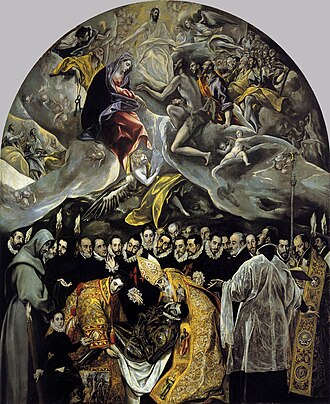 The Burial of the Count of Orgaz - El Greco (1586)
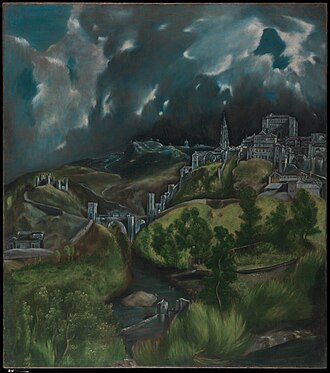 View of Toledo - El Greco (1596)
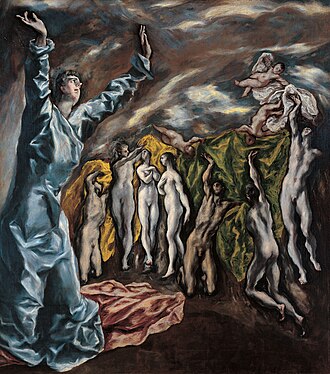 Opening of the Fifth Seal - El Greco (1610)
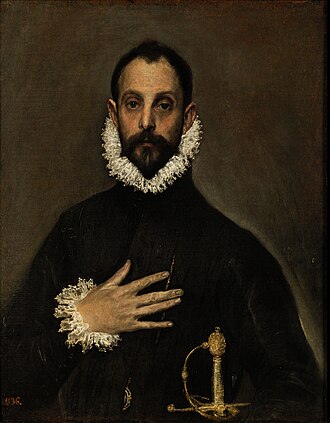 The Nobleman with his Hand on his Chest - El Greco (1580)
%20-%20Laoco%C3%B6n%20-%20Google%20Art%20Project.jpg) Laocoön - El Greco (1610s)
Laocoön - El Greco (1610s)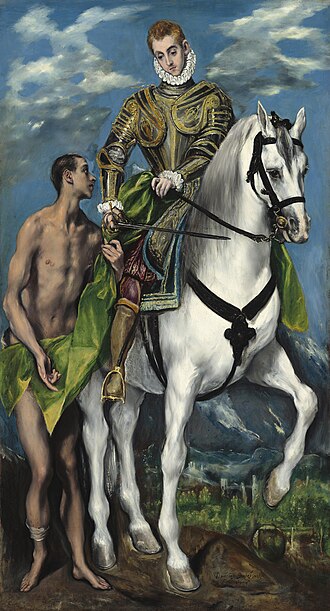 Saint Martin and the Beggar - El Greco (1597)
.jpg) Adoration of the Shepherds - El Greco (1612)
Adoration of the Shepherds - El Greco (1612)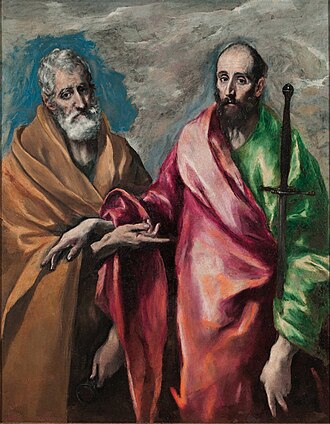 Saint Peter and Saint Paul - El Greco (1595)
Dipinti di artisti collegati
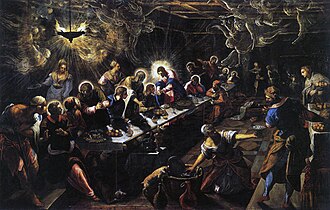 Last Supper - Jacopo Tintoretto (1563)
 Miracle of the Slave - Jacopo Tintoretto (1540s)
.jpg) Venus of Urbino - Titian (1538)
Venus of Urbino - Titian (1538) Assumption of the Virgin - Titian (1510s)
 Supper at Emmaus - Caravaggio (1601)
 La vocazione di San Matteo - Caravaggio (1609)
 The Ambassadors - Hans Holbein the Younger (1533)
 The Body of the Dead Christ in the Tomb - Hans Holbein the Younger (1520s)