The Ambassadors
Hans Holbein the Younger · 1533
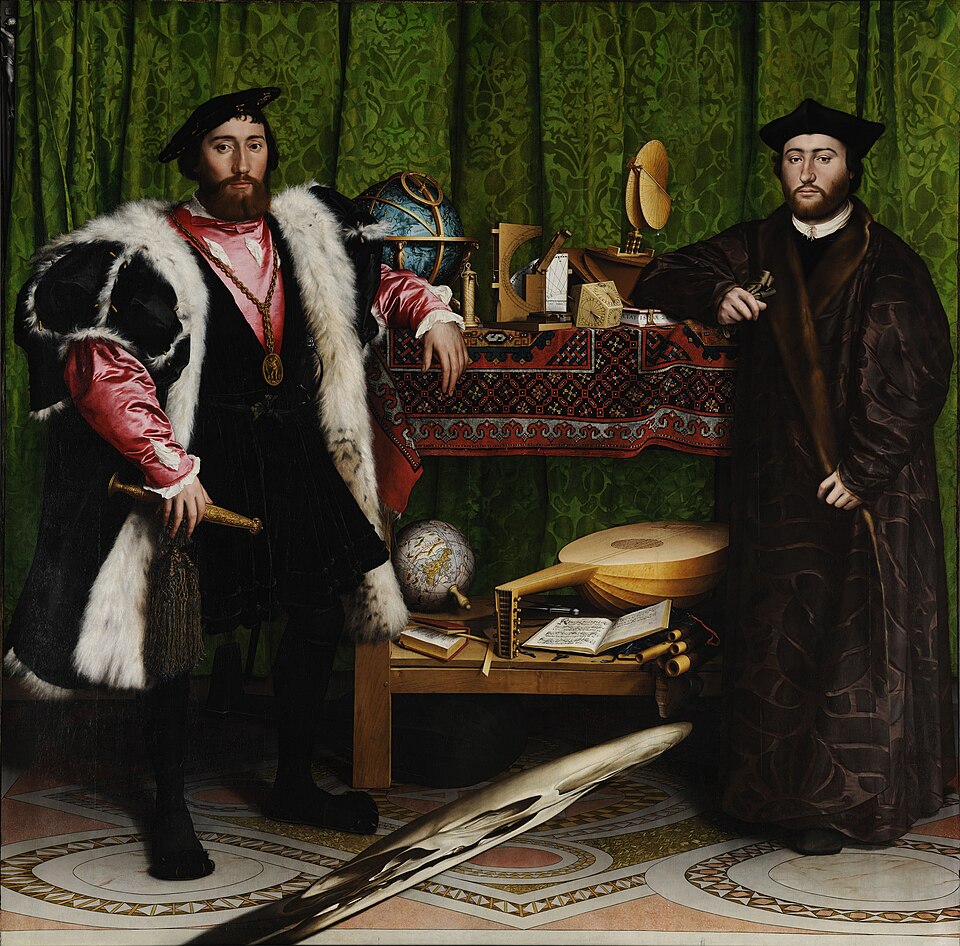
A masterpiece of Renaissance art, The Ambassadors by Hans Holbein the Younger is a painting that continues to fascinate art lovers with its intricate details, symbolism, and mysterious anamorphic skull.
The story behind the painting
Painted in 1533, The Ambassadors is a double portrait of Jean de Dinteville, a French ambassador, and Georges de Selve, a Catholic bishop. The painting was created during the Tudor period, the same year Elizabeth I was born. It is believed that Anne Boleyn, the Queen of England, might have commissioned it as a gift for Jean de Dinteville. Holbein, a German-born artist, was active in Switzerland and England, and his work was influenced by the Northern Renaissance style. He was known for his precision and attention to detail, which is evident in the intricate rendering of the objects in the painting.
What to look for
The painting features a meticulously rendered still life of expensive scientific objects, including two globes, a shepherd's dial, a quadrant, a torquetum, and a polyhedral sundial. The floor mosaic is based on a design from Westminster Abbey, and the carpet on the upper shelf is an example of a 'Holbein carpet.' The figure on the left is in secular attire, while the figure on the right is dressed in clerical clothes. Look closely for the anamorphic skull in the foreground, which appears distorted unless viewed from a certain angle. The painting also features a lute with a broken string, a symbol of discord, next to a hymnal composed by Martin Luther.
Meaning and intent
The painting is rich in symbolism, with the objects and figures representing various themes. The two men, Jean de Dinteville and Georges de Selve, are depicted with a range of scientific and musical instruments, reflecting their interests and status. The anamorphic skull is a reminder of mortality, while the lute with a broken string may symbolize discord between scholars and the clergy. The painting has been interpreted as a representation of the conflicts between secular and religious authorities, as well as a celebration of the intellectual and cultural pursuits of the Renaissance.
Legacy
The Ambassadors has been part of the National Gallery's collection since 1890 and is considered one of the greatest portrait paintings of the Renaissance. It has undergone extensive restoration, including a major restoration in 1997, which aimed to preserve the painting and restore its original appearance. Today, the painting remains a popular attraction at the National Gallery, continuing to inspire art lovers with its beauty, symbolism, and historical significance.
Lo sapevi?
- The Ambassadors is also known as Jean de Dinteville and Georges de Selve.
- The painting was extensively restored in 1997, leading to criticism that the skull's dimensions had been changed.
- The anamorphic skull in the painting is one of the most famous examples of anamorphosis in art.
- The painting features a 'Holbein carpet,' an Anatolian carpet often depicted in the artist's paintings.
Wikipedia · Wikipedia - Hans Holbein the Younger · Wikidata
portrait · man · National Gallery
Dipinti di artisti collegati
%20-%20Google%20Art%20Project.jpg) The Hunters in the Snow - Pieter Bruegel the Elder (1565)
The Hunters in the Snow - Pieter Bruegel the Elder (1565)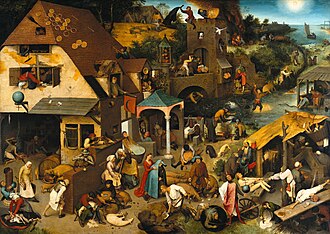 Netherlandish Proverbs - Pieter Bruegel the Elder (1551)
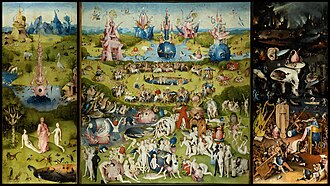 The Garden of Earthly Delights - Hieronymus Bosch
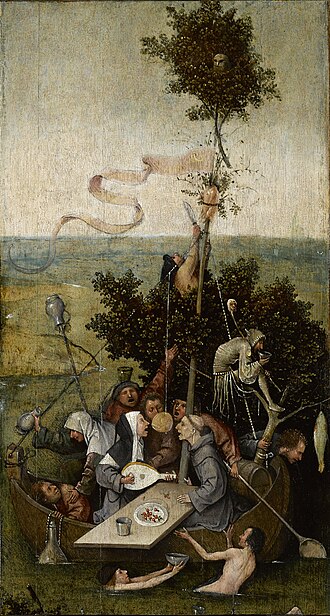 Ship of Fools - Hieronymus Bosch (1500s)