The Feast in the House of Levi
Paolo Veronese · 1573
.jpg)
It was meant to be the Last Supper, but it was full of jesters, dogs and drunken soldiers, and the Inquisition summoned the painter. Veronese did not repaint it. He simply changed its name.
The story behind the painting
In 1573 Paolo Veronese painted a huge canvas for the refectory of the Dominican friary of Santi Giovanni e Paolo in Venice. It was to be a Last Supper, replacing a painting of the same subject by Titian that had been destroyed by fire in 1571. About three months after he finished, the Venetian Holy Inquisition summoned him to explain elements thought unfit for the Last Supper. He was asked why it contained buffoons, drunken Germans, dwarfs and other such scurrilities, and charges of irreverence were raised, with even the grave offence of heresy mentioned. The transcripts of that trial survive.
What to look for
Christ sits at the centre of a banquet framed by great pillars and three arches that recall a triptych and Roman triumphal arches. Two staircases at the sides lead the eye toward him, and with no buildings behind him the space looks heavenly. Around him swarm figures in colourful poses: a man with a nosebleed, servants, drunken Germans. Veronese avoided a single vanishing point, letting diagonals meet at different places, probably because of the vast surface and the many angles from which it would be seen. Wikipedia gives its size as 555 by 1,309 cm, while Wikidata records 560 by 1,039 cm; either way it is one of the largest canvases of the sixteenth century.
Meaning and intent
Veronese defended himself simply: the canvas was large and he had to fill the space, and he had placed the offending figures at a different level, away from Christ and the apostles. The Tribunal was not moved. It said he had exposed Catholicism to Protestant criticism and ordered him to change the painting within three months. Instead he changed the title, adding an inscription that tied it to Luke chapter 5, where Levi gives a great feast and Christ eats with publicans and sinners. Sinners were now part of the story, and no more was said. One theory holds the trial was more about the Tribunal's own politics than the painting.
Legacy
The case shows the pressure that the Council of Trent and the Counter-Reformation put on religious art, whose late, vague rules were then sharpened by clerical interpreters. It also shows why the artist, not the patron, was judged: in the Renaissance, as Leon Battista Alberti's treatise of 1435 suggests, the composition was usually left to the painter. Veronese's answer, keeping his crowded, splendid fantasy of a Venetian patrician feast and changing only its name, has made the work famous far beyond its subject. Today it fills a wall of the Gallerie dell'Accademia in Venice.
Lo sapevi?
- Painted in 1573 to replace a Titian Last Supper lost to fire.
- Veronese was questioned by the Venetian Inquisition.
- He renamed it after Luke 5 instead of repainting it.
- Now in the Gallerie dell'Accademia, Venice.
L'artista
Paolo Veronese (1528-1588)
religious art · man · Jesus Christ · Mannerism · Gallerie dell'Accademia
Altre opere di Paolo Veronese
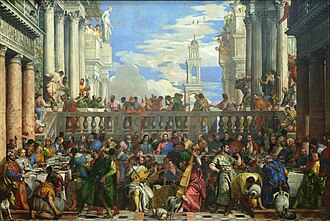 The Wedding at Cana - Paolo Veronese (1560s)
.jpg) Venus and Adonis - Paolo Veronese (1580)
Venus and Adonis - Paolo Veronese (1580)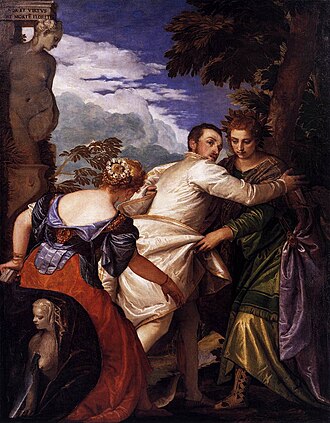 Allegory of Virtue and Vice - Paolo Veronese (1565)
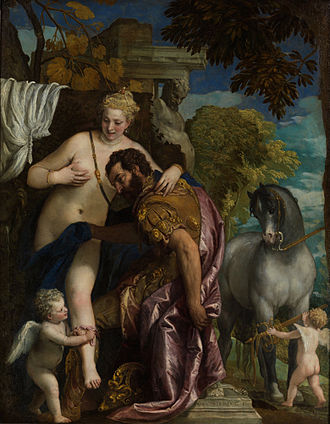 Venus and Mars - Paolo Veronese (1570s)
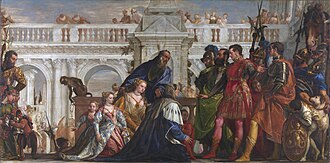 The Family of Darius Before Alexander - Paolo Veronese (1565)
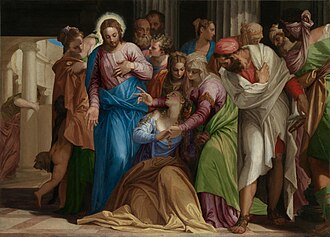 The Conversion of Mary Magdalene - Paolo Veronese (1548)
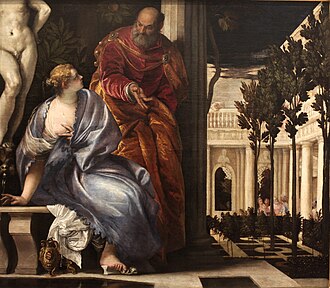 Bathsheba at Her Bath - Paolo Veronese (1575)
%20grande.jpg) Christ Among the Doctors - Paolo Veronese (1560)
Christ Among the Doctors - Paolo Veronese (1560)
Dipinti di artisti collegati
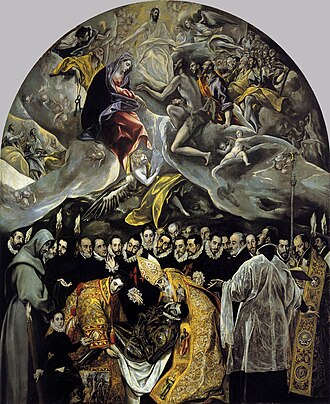 The Burial of the Count of Orgaz - El Greco (1586)
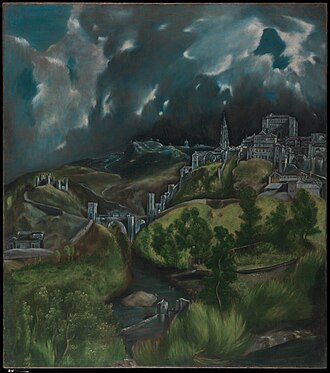 View of Toledo - El Greco (1596)
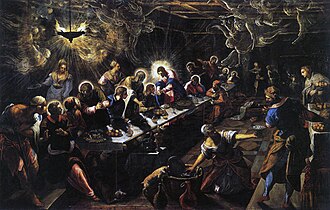 Last Supper - Jacopo Tintoretto (1563)
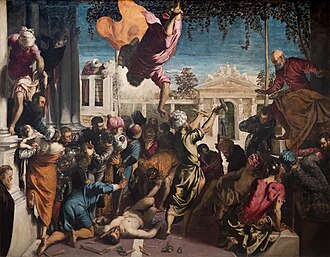 Miracle of the Slave - Jacopo Tintoretto (1540s)
.jpg) Venus of Urbino - Titian (1538)
Venus of Urbino - Titian (1538)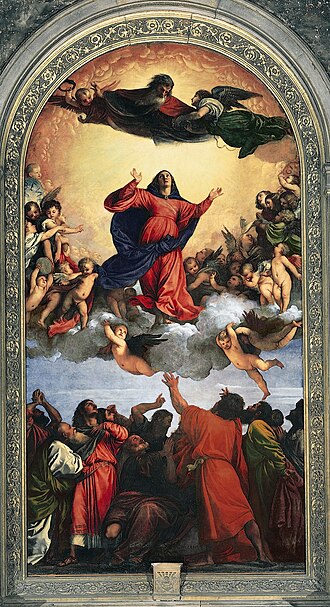 Assumption of the Virgin - Titian (1510s)
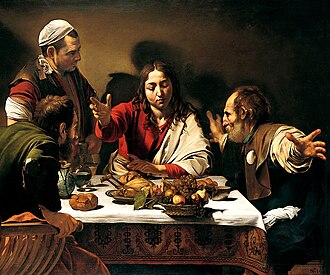 Supper at Emmaus - Caravaggio (1601)
 La vocazione di San Matteo - Caravaggio (1609)
 The Ambassadors - Hans Holbein the Younger (1533)
 The Body of the Dead Christ in the Tomb - Hans Holbein the Younger (1520s)