Romulus
Jean-Auguste-Dominique Ingres · 1812
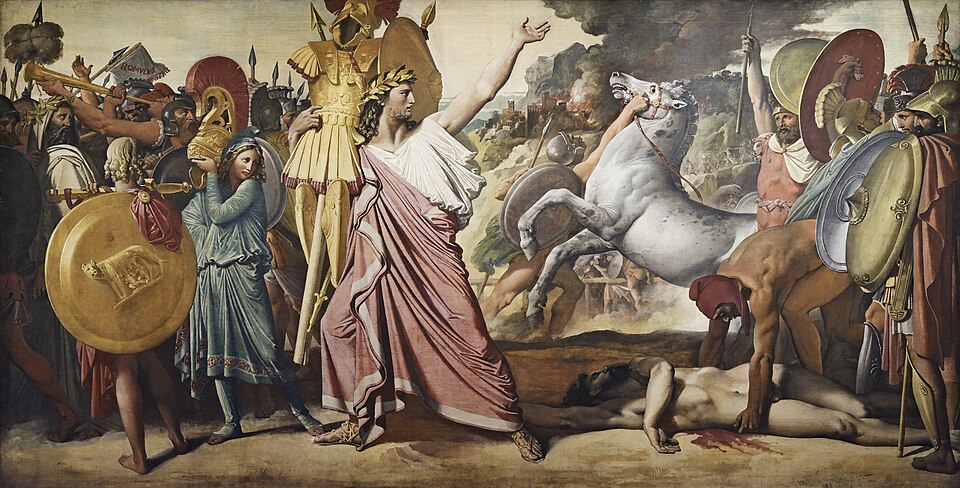
Romulus strides forward in triumph over the fallen king Acron, across a canvas more than five metres wide. Ingres painted it for Napoleon's palace in Rome, borrowing the stillness of an ancient frieze.
The story behind the painting
Ingres took the subject from Plutarch's Life of Romulus. After the Romans abducted the Sabine women to remedy a shortage of women in their newly founded city, Acron, king of the neighbouring Caeninenses, declared war. He and his men were defeated and their city sacked. In 1811 General de Miollis commissioned the painting, together with The Dream of Ossian, for Napoleon's residence in Rome, the Palazzo Monte Cavallo, now the Quirinale. It was meant to decorate the empress's second salon, and Ingres completed it in 1812.
What to look for
At 276 by 530 cm it is one of Ingres' largest paintings, laid out like a long frieze in the manner of the ancient world. The horse is a clear homage to the marble horses of the Parthenon frieze, and Ingres used tempera to give the matte surface of Roman frescoes. Look at the shield: it carries the she-wolf with the infant twins Romulus and Remus. The slain Acron closely matches the dead Sabine in David's The Intervention of the Sabine Women, and the pose of Romulus may echo a Roman relief after the Greek sculptor Phidias. The action is held still, giving the scene a cool, almost icy feel.
Meaning and intent
The painting is a statement of Neoclassical faith in subject, style and scale. Ingres had studied for four years with Jacques-Louis David, and here he answers his master directly: the same shield, minus its inscription, and a victorious Romulus close to the warrior at the far left of David's Sabines. Yet the frozen action points somewhere new, a quality the Wikipedia article links to the Gothic style emerging in the early 19th century. Victory here is shown not as fury but as solemn, measured order.
Legacy
In 1815 the Romulus was taken out of the Quirinale and moved to the Lateran Palace. In 1857 Pope Pius IX gave it to Napoleon III, who presented it to the École des Beaux-Arts in Paris, where it hung in the Amphithéâtre d'Honneur. In 1969 it was deposited at the Louvre. In January 2017 it returned to the École des Beaux-Arts for restoration and was reinstalled in May 2017 in the newly restored amphitheatre, the room where it had hung for more than a century before its years at the Louvre.
Lo sapevi?
- Commissioned in 1811 for Napoleon's residence in Rome.
- Completed in 1812; about 276 by 530 cm.
- Ingres used tempera to imitate ancient frescoes.
- Back at the École des Beaux-Arts since 2017.
L'artista
Jean-Auguste-Dominique Ingres (1780-1867)
mythological painting · Neoclassicism · history painting · horse · corpse
Altre opere di Jean-Auguste-Dominique Ingres
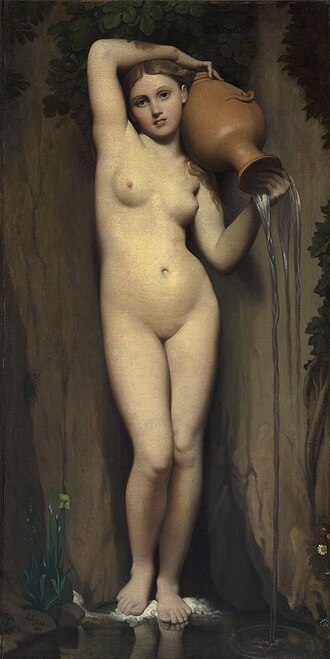 The Source - Jean-Auguste-Dominique Ingres (1856)
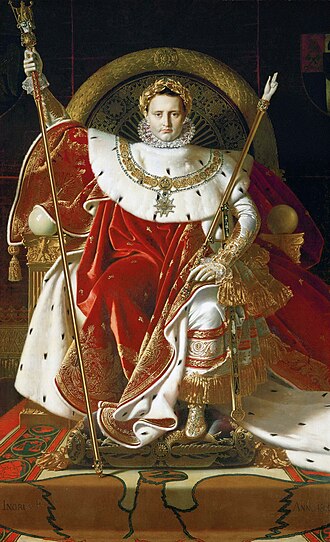 Napoleon I on his Imperial Throne - Jean-Auguste-Dominique Ingres (1806)
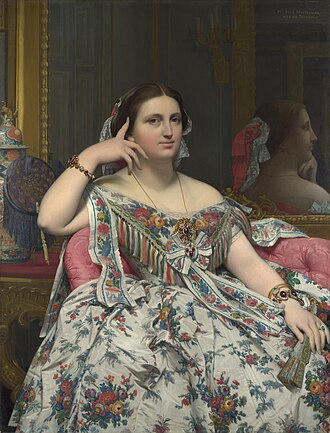 Madame Moitessier - Jean-Auguste-Dominique Ingres (1856)
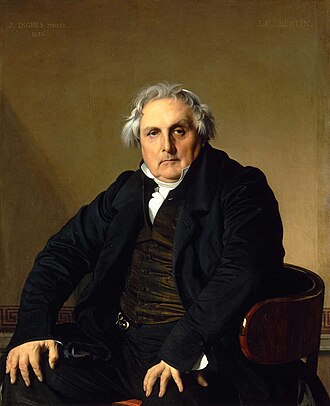 Portrait of Monsieur Bertin - Jean-Auguste-Dominique Ingres (1832)
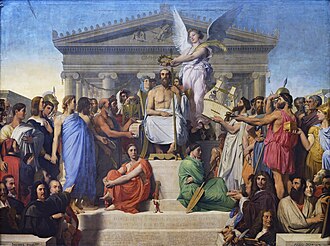 The Apotheosis of Homer - Jean-Auguste-Dominique Ingres (1827)
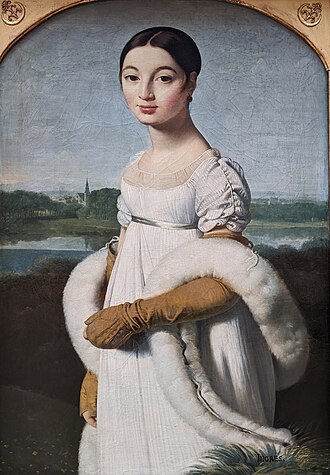 Mademoiselle Caroline Rivière - Jean-Auguste-Dominique Ingres (1806)
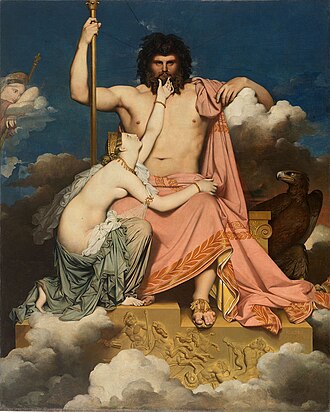 Jupiter and Thetis - Jean-Auguste-Dominique Ingres (1811)
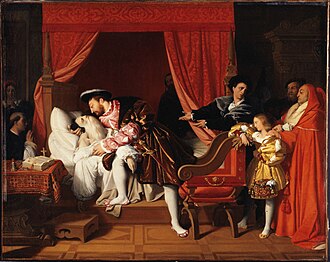 The Death of Leonardo da Vinci - Jean-Auguste-Dominique Ingres (1818)
Dipinti di artisti collegati
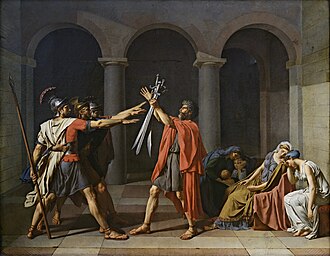 The Oath of the Horatii - Jacques-Louis David (1784)
.jpg) The Intervention of the Sabine Women - Jacques-Louis David (1799)
The Intervention of the Sabine Women - Jacques-Louis David (1799)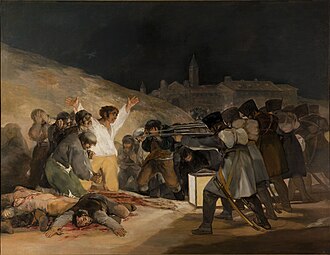 The Third of May 1808 - Francisco Goya (1814)
.jpg) La maja nuda - Francisco Goya (1800)
La maja nuda - Francisco Goya (1800)