The Death of Socrates
Jacques-Louis David · 1787
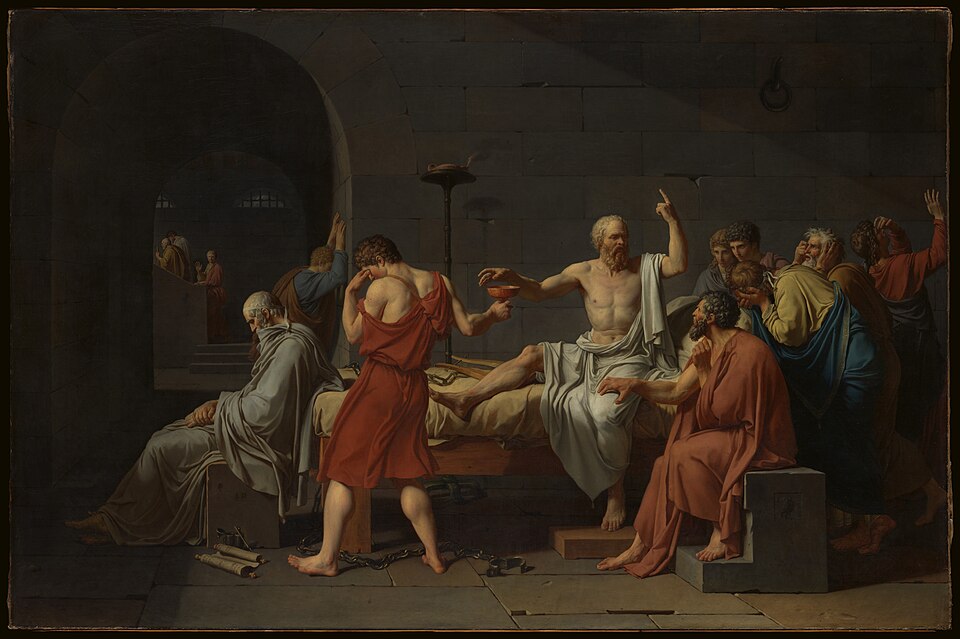
Condemned to die, Socrates reaches for the cup of hemlock without looking at it, still teaching. Around him his friends break down. David's calm, luminous scene was hailed in 1787 as a masterpiece.
The story behind the painting
David received a private commission in 1786 from Charles-Michel Trudaine de la Sablière, then about 20, who was intrigued by a drama Diderot had considered but never finished. David had made a first treatment as early as 1782. He consulted the Hellenist Father Jean Adry, who advised showing Plato immobile, Crito more emotional and Apollodorus visibly moved, and seems to have followed his friend André Chénier on Socrates's pose, reaching for the cup while still teaching.
What to look for
Socrates sits upright in a white robe, one hand over the cup, the other raised. The young man handing the cup looks away, face in his hand. Crito clutches his teacher's knee. Plato, shown old though he was young then and not actually present, sits slumped at the foot of the bed. Xanthippe glances back from the stairs. Reds grow stronger toward the centre, ending in the robe of the cup bearer, while Socrates and Plato wear bluish white. David signed his full name under Crito and his initials under Plato.
Meaning and intent
Socrates was a popular Enlightenment example of truth held with rational self-control. He is calm because he sees death as another state of being, not an end. David idealised him and simplified Plato's account. The signatures may be meaningful: the initials thank Plato as the source, while the full name under Crito suggests the figure David identified with, clinging to Socrates's values. Even before his death, his gesture shows him still teaching.
Legacy
At the Salon of 1787 it was acclaimed. Joshua Reynolds called it the greatest work since the Sistine Chapel and Raphael's Stanze, and Thomas Jefferson thought it the best work there. Critics felt it beat Pierre Peyron's rival version. It was shown again in 1791. After Trudaine was executed in 1794 it passed through inheritances, and in 1931 it went to the Metropolitan Museum of Art. Count Potocki said Peyron's picture proved how far beneath David one could be.
Lo sapevi?
- Painted in 1787 on a private commission.
- Based on Plato's Phaedo.
- Praised by Joshua Reynolds and Thomas Jefferson.
- In the Metropolitan Museum of Art since 1931.
L'artista
Jacques-Louis David (1748-1825)
Metropolitan Museum of Art · history painting · bed · robe · stairs
Altre opere di Jacques-Louis David
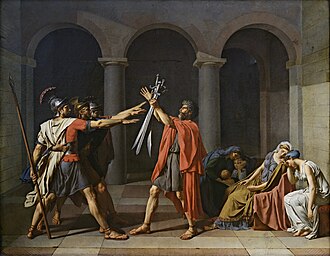 The Oath of the Horatii - Jacques-Louis David (1784)
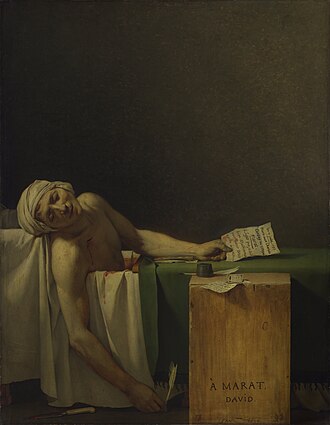 The Death of Marat - Jacques-Louis David (1793)
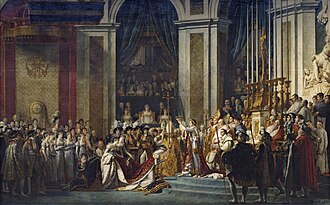 The Coronation of Gabo Napoleon - Jacques-Louis David (1807)
.jpg) The Intervention of the Sabine Women - Jacques-Louis David (1799)
The Intervention of the Sabine Women - Jacques-Louis David (1799)%20-%20National%20Gallery%20of%20Art%20(Samuel%20H.%20Kress%20Foundation).jpg) The Emperor Napoleon in His Study at the Tuileries - Jacques-Louis David (1812)
The Emperor Napoleon in His Study at the Tuileries - Jacques-Louis David (1812)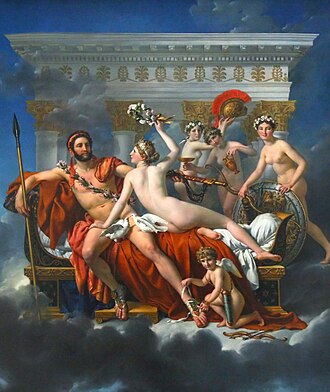 Mars Being Disarmed by Venus - Jacques-Louis David (1824)
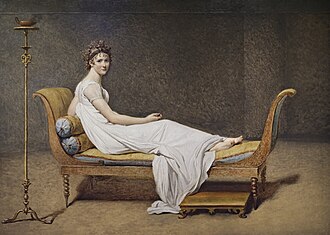 Portrait of Madame Récamier - Jacques-Louis David (1800)
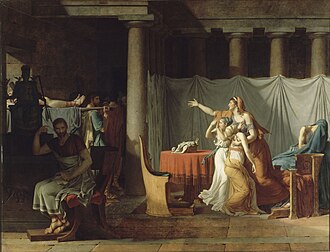 The Lictors Bring to Brutus the Bodies of His Sons - Jacques-Louis David (1789)
Dipinti di artisti collegati
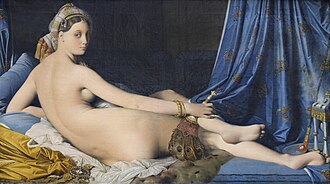 Grande Odalisque - Jean-Auguste-Dominique Ingres (1814)
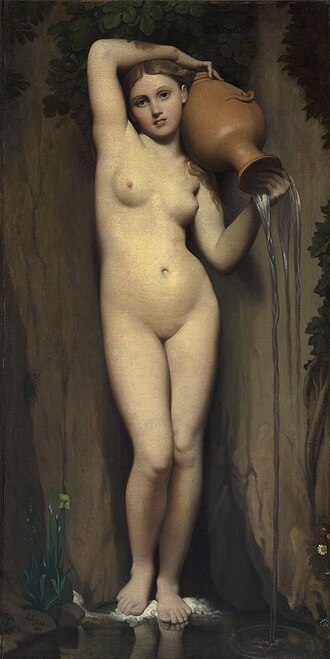 The Source - Jean-Auguste-Dominique Ingres (1856)
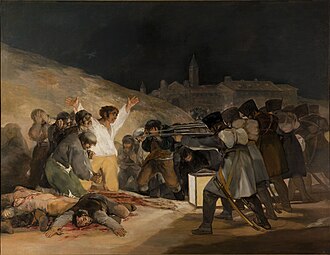 The Third of May 1808 - Francisco Goya (1814)
.jpg) La maja nuda - Francisco Goya (1800)
La maja nuda - Francisco Goya (1800)