Grande Odalisque
Jean-Auguste-Dominique Ingres · 1814
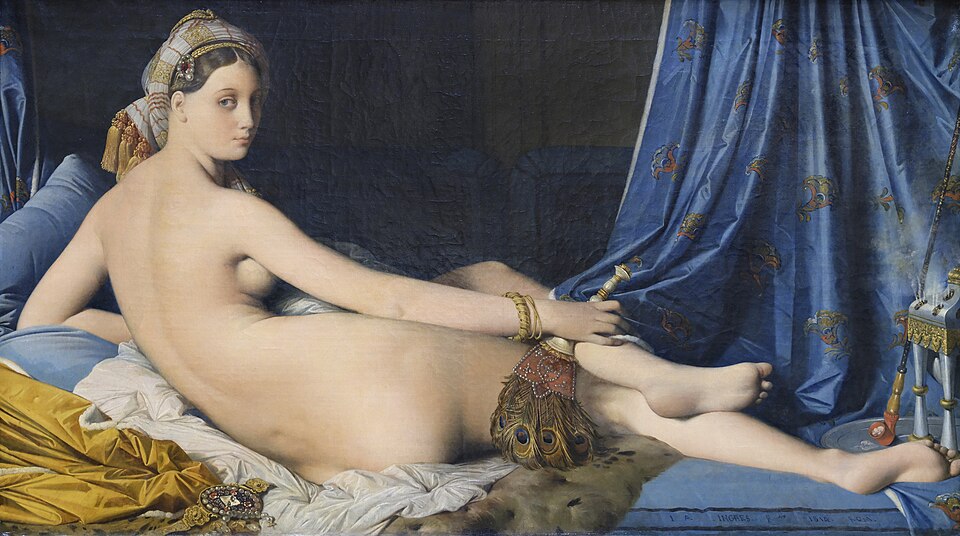
A woman reclines with her back to us and looks over her shoulder, her body impossibly long. Critics mocked Ingres for it in 1819; today the Grande Odalisque is one of the most quoted nudes in art.
The story behind the painting
Grande Odalisque was commissioned by Napoleon's sister, Queen Caroline Murat of Naples, and finished in 1814. Ingres looked to Giorgione's Dresden Venus and Titian's Venus of Urbino for his reclining nude, but the pose of a figure looking back over her shoulder comes directly from Jacques-Louis David's Portrait of Madame Récamier of 1800. An odalisque is a concubine. His contemporaries saw the work as Ingres breaking with Neoclassicism and turning toward an exotic Romanticism.
What to look for
The canvas, about 91 by 162 cm, shows the concubine in a languid pose seen from behind. Look at the small head, the elongated limbs and the cool colours, which recall Mannerists such as Parmigianino, whose Madonna with the Long Neck is famous for its distortions. Ingres favoured long lines to convey curves and sensuality, and abundant, even light that softens volume. A modern study found the spine's curve and the turn of the pelvis impossible for a real body, and the left arm shorter than the right.
Meaning and intent
When the painting was shown at the Salon of 1819, one critic wrote that it had neither bones nor muscle, neither blood nor life. The figure was said to have two or three vertebrae too many; the study mentioned found it longer by five, and that the distortions were deliberate, not errors. One interpretation reads the long pelvis as a symbol of the concubine's role, while her gaze has been described both as reflecting a complex psychological make-up and as betraying no feeling. Ingres was criticised for his work until the mid-1820s.
Legacy
The Louvre bought the painting in 1899. Artists have answered it ever since: Jules Flandrin copied it in 1903, Martial Raysse turned it into pop art in 1964, and Herman Braun-Vega placed it among Peruvian children in 1985. In 1989 the Guerrilla Girls gave her a gorilla mask and asked whether women have to be naked to get into the Met. Museum; the poster ran on New York buses until the lease was cancelled. The Manic Street Preachers mention her in a 2009 song.
Lo sapevi?
- Commissioned by Caroline Murat, Queen of Naples, finished in 1814.
- Criticised at the Salon of 1819 for its lack of anatomical realism.
- A study found the figure longer by five vertebrae, on purpose.
- Bought by the Louvre in 1899.
L'artista
Jean-Auguste-Dominique Ingres (1780-1867)
Department of Paintings of the Louvre · nude · bed · drapery · cushion · hand fan · naked woman · turban
Altre opere di Jean-Auguste-Dominique Ingres
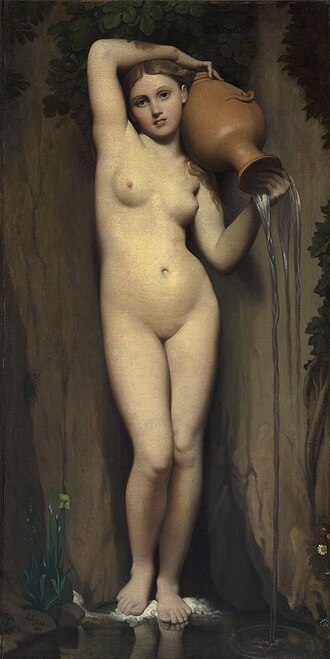 The Source - Jean-Auguste-Dominique Ingres (1856)
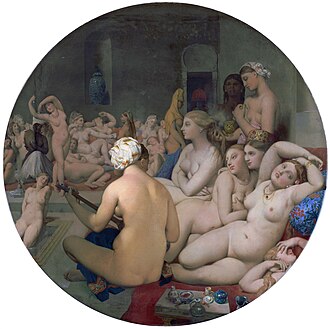 The Turkish Bath - Jean-Auguste-Dominique Ingres (1862)
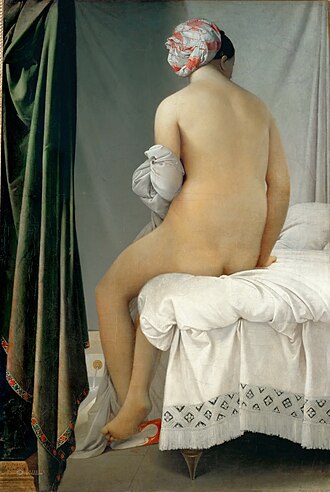 The Valpinçon Bather - Jean-Auguste-Dominique Ingres (1808)
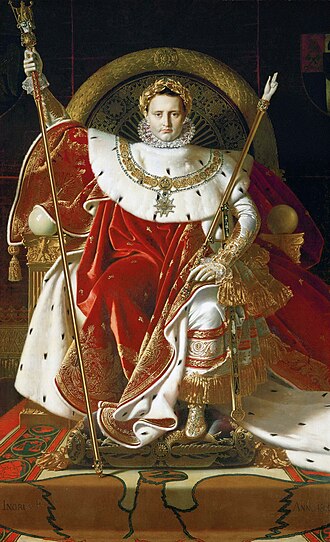 Napoleon I on his Imperial Throne - Jean-Auguste-Dominique Ingres (1806)
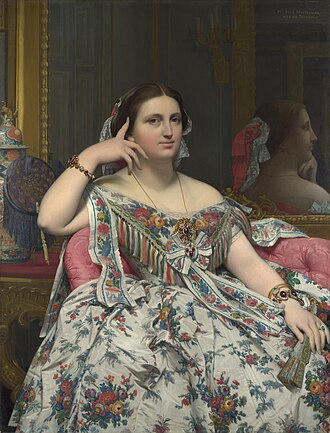 Madame Moitessier - Jean-Auguste-Dominique Ingres (1856)
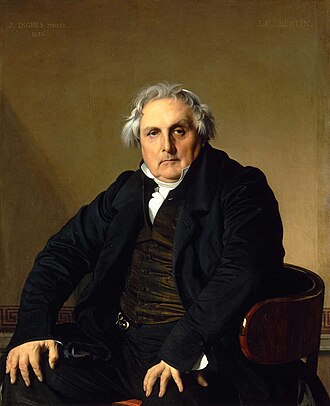 Portrait of Monsieur Bertin - Jean-Auguste-Dominique Ingres (1832)
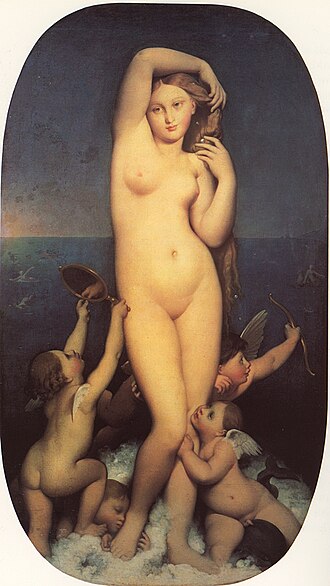 Vénus Anadyomène - Jean-Auguste-Dominique Ingres (1808)
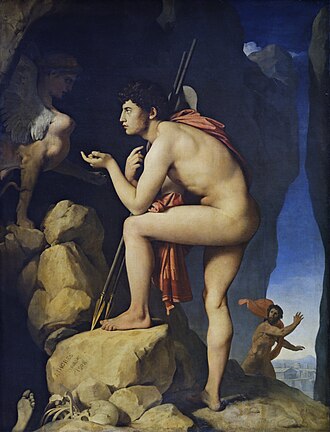 Oedipus and the Sphinx - Jean-Auguste-Dominique Ingres (1808)
Dipinti di artisti collegati
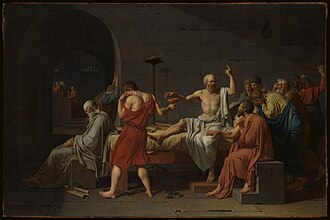 The Death of Socrates - Jacques-Louis David (1787)
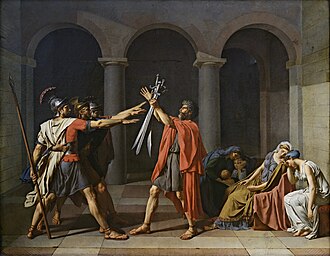 The Oath of the Horatii - Jacques-Louis David (1784)
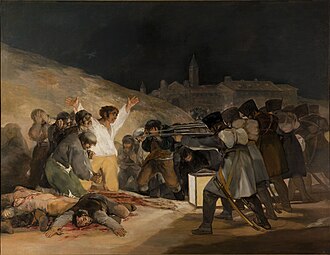 The Third of May 1808 - Francisco Goya (1814)
.jpg) La maja nuda - Francisco Goya (1800)
La maja nuda - Francisco Goya (1800)